SKU: 33071526566
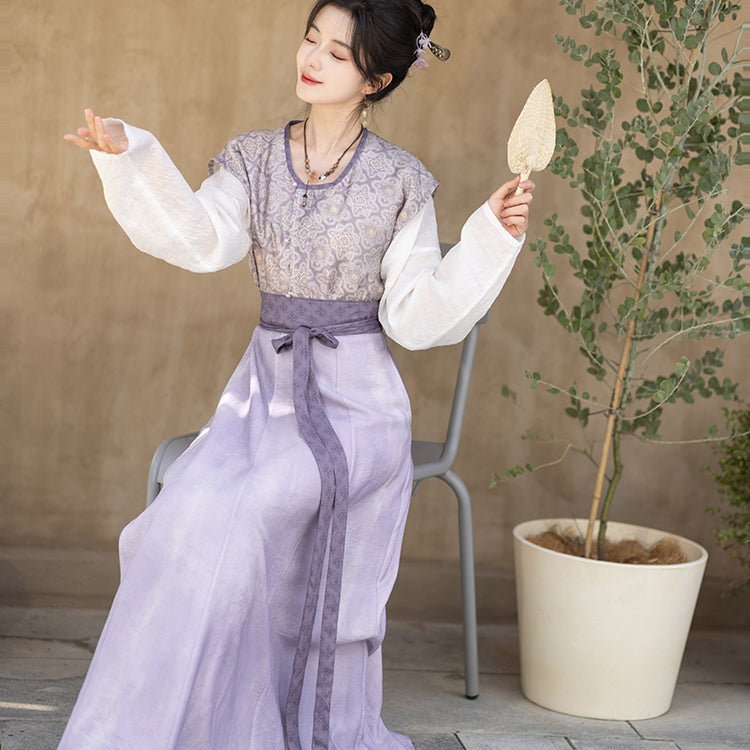
purple autumn dress

purple autumn dress Tang Dynasty Spring/Autumn Clothes Purple Ruqun Dress

Sale price$21.64 Regular price$24.04
Save 10%

Pay in installments of $6.01 with ShopPay, AfterPay and Klarna

Shipping Estimate
USA
  • USA
  • CAN

Ships within 48 hours · Estimated delivery Aug 6 - Aug 11

Promo Codes Available:

For Your Every Summer RSVP, with Code: SUMMER15

Description

purple autumn dress Tang Dynasty Spring/Autumn Clothes Purple Ruqun DressThe system of Tang Dynasty women's Hanfu (618 907 AD) combined traditional ritual norms with inclusive cultural traits, absorbing Hu style elements while preserving Hanfu's essencethis integration is well documented in The New Book of Tang: Records of Chariots and Costumes. It had three core styles reflecting social roles and daily needs: 1. Ruqun (Core Style of Tang Women's Hanfu) As the most common style, Ruqun consisted of a short jacket ("ru") and

The system of Tang Dynasty women's Hanfu (618-907 AD) combined traditional ritual norms with inclusive cultural traits, absorbing Hu-style elements while preserving Hanfu's essence—this integration is well-documented in The New Book of Tang: Records of Chariots and Costumes. It had three core styles reflecting social roles and daily needs:

1. Ruqun (Core Style of Tang Women's Hanfu)

As the most common style, Ruqun consisted of a short jacket ("ru") and a long skirt ("qun"). The ru had diverse collars (cross-collar, front-opening) and sleeve widths: narrow sleeves (Hu-influenced) for commoners’ daily work, wide sleeves for nobles’ elegance. The qun often used "po qun" (segmented skirt) design for fullness; nobles wore silk skirts in bright hues (crimson, emerald) with gold embroidery, while commoners used linen in plain white/gray.

2. Banbi (Casual Outer Garment)

A short-sleeved (elbow-length) outer wear, Banbi paired with Ruqun. Its compact design (Hu-style origin) suited daily activities like weaving, favored by both nobles and commoners. Nobles chose thin silk, commoners coarse cloth.

3. Pibo (Essential Accessory)

A lightweight silk scarf, Pibo draped over shoulders. Nobles used brocaded Pibo for ceremonial occasions, commoners plain ones for daily wear—adding grace to the ensemble.

Overall Characteristics

  • Hierarchical distinction: Fabrics/colors signaled status (silk vs. linen, bright vs. plain).
  • Han-Hu integration: Narrow sleeves, Banbi reflected cultural openness.
  • Practicality & ritualism: Daily styles (Banbi-Ruqun) met needs, while embroidered Ruqun served ceremonies.

About this Tang Dynasty Spring/ Autumn Hanfu

“Wandering in the morning mist among lilac bushes, carries the soft and gentle aura of a quiet maiden.” This style cleverly blends the tender and elegant charm of morning-mist lilacs with the graceful temperament of Tang Dynasty Hanfu in this top-and-skirt set, choosing the soft "lilac purple" as the main tone to fully bring out the gentle and delicate charm of women.

Beizi: This style ingeniously integrates the gentle atmosphere of morning-mist lilacs with the classic charm of Tang Dynasty aesthetics in this beizi. Adorned with original Tang-style baoxiang flower pattern prints, it adopts fabric containing tencel and acetate—light yet textured, making it suitable for wearing in spring and autumn. Every movement in it exudes a long-lasting ancient charm.

Shirt: Crafted from lightweight and breathable tencel jacquard fabric, it echoes the overall outfit with a clean white tone that brings a sense of elegance and freshness. It also features a neat round collar, a sleek minimalist silhouette, and white buttons adorned with imitation gold foil—these details make it bloom with dazzling radiance amid its plain and elegant style, exuding refined and understated charm in its simplicity.

Ruqun: As the graceful core piece that carries the subtle beauty of Eastern aesthetics in the entire outfit, it uses an original ink-wash gradient fabric in a hazy ash-purple hue—like thin clouds under the moon, which tells the unique reserved beauty of Eastern color palettes. Its waistband and sash take the deep purple of ancient kiln Tianmu glaze as the base, adorned with Dunhuang-restored woven patterns; this cleverly echoes the soft tones of the round collar shirt and the delicate patterns of the beizi, further highlighting the ancient charm and delicate details of the whole set, while the added pocket design enhances its practicality for daily wear.

Finishing Touches with Tang Dynasty Hanfu Accessories: Details Define the Atmosphere

  • Pibo: Choose one in the same color (with different saturation) as the skirt or a contrasting color. It is about 2 meters long and draped naturally over both arms, which can modify the figure and add linear beauty.
  • Headpieces: For basic styles, use buyao (tasseled hairpins), chāi (hairpins), and zān (hairpins). In the Flourishing Tang period, you can style the wōduò jì (sloping bun) with gold ornaments; for formal occasions, add phoenix hairpins and pearl buyao.
  • Hanfu Shoes: Match them with “embroidered upturned-tip shoes”, with pearls or gemstones embellished on the shoe tips to echo the overall sense of luxury.
  • Atmosphere-enhancing Items: Holding a hand fan (round fan) or a palace lantern and wearing a jade waist belt can instantly create a classic atmosphere.

About The Brand: 池夏

A Treasure Trove for 2.6 Million Hanfu Enthusiasts

Featured Products: Transforming Thousand-Year Elegance into Everyday Romance

Diverse Silhouettes + Themed Bestsellers:From Ming-style square-collar horse-face skirts to Tang-style round-collar robes, Song-style beizi jackets to Jin-style ruqun dresses, covering both traditional forms and modernized designs. Must-have collections include the poetic color palettes of the 24 Solar Terms series, the classical narratives of Twelve Beauties of Jinling, and the viral Persimmon Fish Luck horse-face skirt (the same style showcased at the Dubai Expo!) and the ethereal Pink Mist modern Hanfu—perfect for daily commutes, photo shoots, or ancient-style gatherings.
Shipping Notes
  • Free Standard Shipping on $100+ Orders to the USA.
  • Except Preorder products are shipped in 48 hours.
  • Delivery to the USA:
  1. Standard Shipping : 3-10 business days
  • If time is of the essence, please consider selecting expedited delivery for faster service.
Exchange/Return Notes
  • We offer a 30-day return/exchange service after receiving.
  • Final sale items are not eligible for returns or exchanges.
  • To process your return/exchange, please contact us at [email protected]
  • Please click here for more details>>> Return & Exchange Policy
SKU: 33071526566

Discover Niche Categories That Outsell purple autumn dress

Top-Converting Item to Boost Your Average Order

4.2 ★★★★★
Based on 24 reviews
Sort
Highest Rating
Newest First
Oldest First
Product Reviews
S
Verified Purchase
Snorting Horses
Houston, US
★★★★★ 5
A Slim Book with a Big Message
The book is an attempt, Keller writes, to connect a person's Christian faith with the desire to help people in need and do justice in all aspects of one's life. He is writing for four groups of people, he says. These are: -- Those, especially the young, who are active in volunteering and want to help the poor but their concern does not affect how they spend money or plan their careers. -- Those who don't see, as Jonathan Edwards said, that when the Spirit enables us to understand what Christ has done for us, "the result is a life poured out in deeds of justice and compassion for the poor." -- Younger evangelicals who have expanded their mission to include social justice along with evangelism. -- People like the atheist Christopher Hitchins who believe that religion "poisons everything." This book, Keller writes, is for "the orthodox (Christian) to see how central to the Scripture's message is justice for the poor and marginalized. I also want to challenge those who do not believe in Christianity to see the Bible not as a repressive text, but as the basis for the modern understanding of human rights." Keller spends the early parts of his book discussing how justice for the poor, the immigrant, the widow and orphan was central to the concept of mercy (in Hebrew, chesedh), justice (mishpat) and righteousness (tzadeqah). Mercy has to do with aligning our attitude with that of a merciful God. Justice is aligning our actions -- equitable dealings with people -- with a just God's. Righteousness in the Hebrew context has more to do with right relationships than obeying a set of rules, as modern Christians often think of it. Someone who is "right with God (is) therefore committed to putting right all other relationships in life." (Alec Motyer) Righteousness is "day to day living in which a person conducts all relationships in family and society with fairness.While tzadeqah is primarily about being in a right relationship with God, the righteous life that results is profoundly social. (See Job 29:12-17, 31-13-28. Keller details the Hebrew law's provision for exercising justice. These are: -- Shemitta, or release. The practice of the Sabbath year, every seventh year releasing people from debts or servitude. Deut. 15:1-2 -- Gleanings. The practice of not harvesting fields to their borders. Keller suggests that modern businesses could imitate this practice by not maximizing profits, thus giving price relief to their customers, and not paying workers the lowest possible wages. Leviticus 19:9-10, 23:22 -- Tithing for the priests and the upkeep of the temple. Every third year the tithe was put in public storehouses for the poor, "the aliens, the fatherless, and the widows." Deut. 14:28-29. This makes me think that churches should practice this in some form by systematically committing a portion of its receipts to serving the poor and needy. -- Year of Jubilee. The practice of every 49th or 50th year of forgiving debts and returning land to its ancestral owner. Leviticus 25:10, 23, 27:21. These practices helped meet the needs of the poor and helped prevent permanent cycles of poverty. The three causes of poverty, according to the Law are oppression, calamity and personal moral failure. The biblical emphasis is usually on the larger structural factors -- corruption, oppressive economic systems and natural disasters. The exercise of justice, however, never distinguishes between the three. That is, no matter why a person is poor, the righteous person should care for him. Well, that's the Old Testament,, some might say. But Jesus showed the same concern for the poor and disadvantaged, if not more so. His response to John in Matthew 11:4-5, and the beginning of his ministry in Luke 4. As Eugene Peterson writes in The Message, the Word became flesh and moved into the neighborhood. He identified himself with the poor and showed special concern for children, aliens, women. Jesus and the prophets all "leveled the charge that while the people attended worship, observed all religious regulations and took pride in their biblical knowledge, nevertheless they took advantage of the weak and vulnerable." Vulnerable people need three levels of help -- relief, development and social reform. Relief is the immediate problem (paying the rent, for instance); development is to help then move beyond dependency (job training); social reform is correcting systemic injustice (redlining).Social reform likely requires the creation of extra-church or parachurch organizations. Churches also can partner with existing organizations or churches that operate in vulnerable populations. Evangelism and social justice "should exist in an asymmetrical, inseparable relationship. Evangelism is the most basic and radical ministry possible to a human being ... not because the spiritual is more important than the physical, but because the eternal is more important than the temporal. If there is a God, and if life with him for eternity is based on having a saving relationship with him, then the most loving thing anyone can do for one's neighbor is help him or her to a saving faith in that God, Keller writes. Doing justice is inseparably connected to preaching grace. One way is that the gospel produces a concern for the poor. The other is that deeds of justice gain credibility for the preaching of the gospel. This book is a slim one that carries a heavy message. It challenges us comfortable churchgoers to examine our community and ask whether we are of any importance to the wider community. If our "church" ceased to exist, would anyone miss us? What are we doing in obedience to God's commands to serve the poor, the widow, the orphan, the prisoner, the hungry? There is a lot here to reflect on and for a small group(s) to discuss and apply. Unfortunately, I contacted the publisher and there is no accompanying study guide. Keller is pastor of Redeemer Presbyterian Church in New York City.
WAS THIS REVIEW HELPFUL?YesReportShare
Reviewed in the United States on October 12, 2011
C
Verified Purchase
Consumer
Lowell, US
★★★★★ 4
Four Stars
Format: Paperback
Interestin.
WAS THIS REVIEW HELPFUL?YesReportShare
Reviewed in the United States on November 15, 2017
C
Verified Purchase
Cheyenne Harmon
Whiting, US
★★★★★ 5
Taste good
These are great
WAS THIS REVIEW HELPFUL?YesReportShare
Reviewed in the United States on March 28, 2026
B
Verified Purchase
Brynlee123
Whiting, US
★★★★★ 5
Good.
These work really well. Price is great. My kids have not complained about the taste or any issues with chewing them. No sleep issues or grogginess upon waking.
WAS THIS REVIEW HELPFUL?YesReportShare
Reviewed in the United States on May 7, 2025
J
Justine
Belleville, US
★★★★★ 5
Great product. Works well and tastes good too!
I purchased this melatonin for my five year old. Not only is she a terrible sleeper she’s extremely particular about how things taste. This product works wonderfully, and tastes great too! It works quickly to help my child fall asleep, within 10 minutes, and now they are able to sleep through the night without any issues. I highly recommend this product for parents looking for a natural way to help their child sleep better.
WAS THIS REVIEW HELPFUL?YesReportShare
Reviewed in the United States on August 6, 2024

recommand products