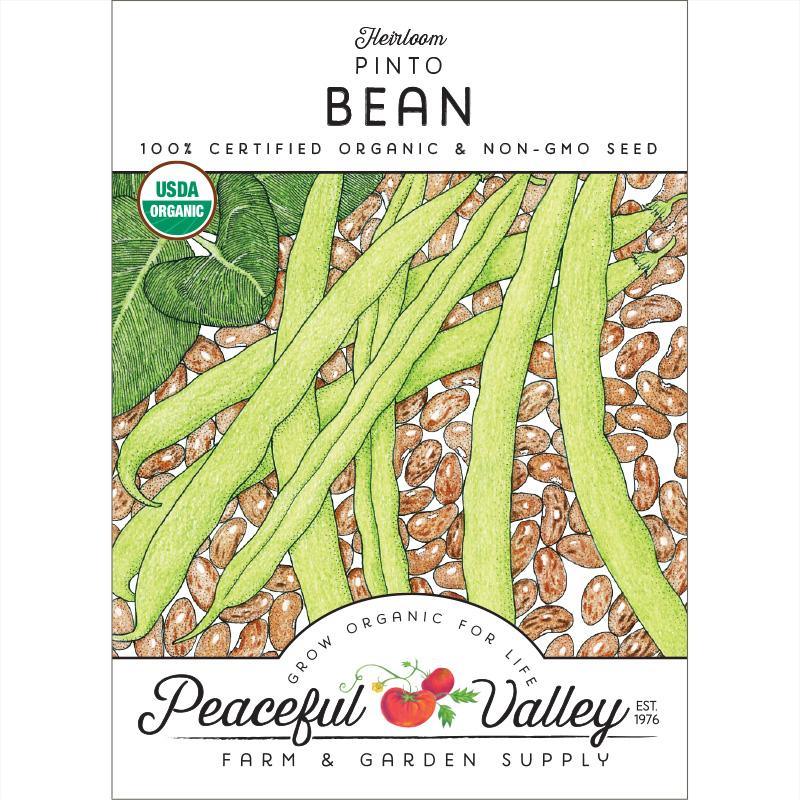
pinto bean seeds for planting Pinto Bean Seeds (Organic)
SKU: 93482322688
pinto bean seeds for planting

pinto bean seeds for planting Pinto Bean Seeds (Organic)

Sale price$22.73 Regular price$25.25
Save 10%

Shipping Estimate
USA
  • USA
  • CAN

Ships within 48 hours · Estimated delivery Jul 7 - Jul 12

Promo Codes Available:

For Your Every Summer RSVP, with Code: SUMMER15

Description

pinto bean seeds for planting Pinto Bean Seeds (Organic)Pinto Bean is a versatile and reliable legume, cherished for its speckled appearance and hearty flavor. The pods mature to reveal creamy beige seeds with unique reddish brown streaks, making them as attractive as they are delicious. Thriving in full sun and well draining soil, Pinto Beans are warm season crops that mature in about 85 90 days. The bushy plants grow compactly, making them suitable for small gardens or interplanting with other crops.

Pinto Bean is a versatile and reliable legume, cherished for its speckled appearance and hearty flavor. The pods mature to reveal creamy beige seeds with unique reddish-brown streaks, making them as attractive as they are delicious. Thriving in full sun and well-draining soil, Pinto Beans are warm-season crops that mature in about 85-90 days. The bushy plants grow compactly, making them suitable for small gardens or interplanting with other crops. Pinto Beans are a favorite for their culinary versatility, ideal for soups, stews, refried beans, and burritos. They are also rich in protein and fiber, making them a nutritious addition to your meals. Easy to grow and low-maintenance, this variety is drought-tolerant and benefits from well-spaced planting to ensure good airflow. Pinto Beans are a rewarding choice for home gardeners seeking a productive, nutrient-rich crop. Whether you’re growing them for fresh use or drying for long-term storage, Pinto Beans deliver consistent quality and flavor.

Bean - Pinto - Phaseolus vulgaris

Tender Annual Bush. Dry. Heirloom. This speckled bean is the most popular bean in the U.S. and is beloved by kids and adults alike. Pinto beans are perfect for frijoles refritos, mashed in burritos, or served whole. Green (fresh) pintos are a gourmet treat in Mexico. The delicious mild flavor is the hallmark of this staple of Mexican cuisine.

Did You Know? Pinto beans get their name (like Pinto ponies) from their mottled coloring.

Soil & Water: Legumes like well-drained soil rich in organic matter and with a moderate amount of nutrients. Water lightly at planting, moderately at flowering, and heavily throughout harvest time. Avoid overhead watering.

Planting & Growing: Sow directly in garden when soils have warmed and danger of frost has passed. Keep seedbed evenly moist.

Harvesting & Storage: Bush beans will produce all of their fruit over a few weeks' time. Leave the pods on the plant until they have completely dried. Store dry, shelled beans in an airtight container.

Soil Temperature: 70-85°F
Planting Depth: 1"
Germination: 5-11 Days
Height At Maturity: 2’-3’
Days to Maturity: 75-85 Days
Sun/Shade: 
Spacing After Thinning: 4"-6"
Approx Seeds per Pack: 50 | Per 1 oz bulk: 60 Seeds
 

Pinto beans, scientifically known as Phaseolus vulgaris, are one of the most beloved and versatile legumes in the culinary world. These beige and speckled beans are renowned for their creamy texture and nutty flavor, making them a staple in various dishes, especially in Southwestern cuisine. Whether you're an experienced gardener or a novice looking to explore the world of homegrown produce, pinto bean seeds are an excellent choice for your garden.

Pinto Bean Basics

  • Appearance: Pinto beans are medium-sized, oval-shaped beans with a beige or light brown background and speckled or streaked maroon patterns. The name "pinto" is derived from the Spanish word for "painted," alluding to their distinctive appearance.

  • Flavor Profile: Pinto beans are known for their mild, earthy flavor with a hint of nuttiness. They have a creamy texture when cooked, which makes them an ideal candidate for a variety of culinary applications.

Cultivation of Pinto Bean Seeds

  • Planting Time: Pinto beans thrive in warm weather, so it's best to plant them after the last frost date in your region when the soil has warmed to around 60°F (15°C). In most areas, this typically falls in the spring.

  • Soil Requirements: Pinto beans prefer well-drained, loamy soil with a slightly acidic to neutral pH level. Ensure good drainage to prevent waterlogged roots.

  • Sunlight: These beans require full sunlight to grow successfully. Make sure they receive at least 6-8 hours of direct sunlight daily.

  • Spacing: When planting pinto bean seeds, space them about 2-4 inches apart in rows with 18-24 inches between each row. This spacing allows the plants enough room to grow and receive adequate airflow.

  • Watering: Keep the soil consistently moist but not waterlogged during the growing season. Beans are sensitive to drought stress, so regular watering is essential, especially during flowering and pod development.

Culinary Uses of Pinto Beans

Pinto beans are a versatile ingredient in the culinary world, particularly in Southwestern and Mexican cuisines. Here are some popular dishes and applications:

  • Refried Beans: Pinto beans are the primary choice for making refried beans, a staple in Mexican cuisine. These beans are cooked until soft, mashed, and then fried with onions and spices, creating a creamy and savory side dish.

  • Chili: Pinto beans are a common addition to chili recipes. Their mild flavor and creamy texture complement the bold and spicy flavors in chili dishes.

  • Baked Beans: Pinto beans can be used to make delicious baked beans. They are simmered with a savory tomato-based sauce, brown sugar, and spices, resulting in a classic American side dish.

  • Soups and Stews: Pinto beans are often added to soups and stews for their rich and hearty character. They absorb the flavors of the broth or sauce, enhancing the overall taste of the dish.

  • Salads: Pinto beans can be used in salads for added protein and a creamy texture. They pair well with fresh vegetables, herbs, and vinaigrette dressings.

  • Taco and Burrito Filling: Pinto beans make an excellent vegetarian filling for tacos and burritos. They are seasoned with spices and can be mashed or left whole, depending on the desired texture.

Pinto bean seeds are a fantastic addition to your garden if you appreciate the rich and earthy flavors of Southwestern cuisine. Cultivating these beans at home allows you to enjoy their versatility in a wide range of dishes, from soups to salads to hearty stews. With proper care and attention to their growing requirements, you can harvest a bountiful supply of pinto beans to elevate your culinary creations and savor the taste of this beloved legume.

Shipping Notes
  • Free Standard Shipping on $100+ Orders to the USA.
  • Except Preorder products are shipped in 48 hours.
  • Delivery to the USA:
  1. Standard Shipping : 3-10 business days
  • If time is of the essence, please consider selecting expedited delivery for faster service.
Exchange/Return Notes
  • We offer a 30-day return/exchange service after receiving.
  • Final sale items are not eligible for returns or exchanges.
  • To process your return/exchange, please contact us at [email protected]
  • Please click here for more details>>> Return & Exchange Policy
SKU: 93482322688

Discover Niche Categories That Outsell pinto bean seeds for planting

Top-Converting Item to Boost Your Average Order

4.2 ★★★★★
Based on 814 reviews
Sort
Highest Rating
Newest First
Oldest First
Product Reviews
J
Verified Purchase
Jon and Carissa Yoder
Alexandria, US
★★★★★ 5
Beautiful
Format: Hardcover
The familiar story of Jesus through the lens of a First Nations storyteller. It is beautiful and brought me to tears. I can’t wait to read it to my kids.
WAS THIS REVIEW HELPFUL?YesReportShare
Reviewed in the United States on November 30, 2024
S
Steph A
Belleville, US
★★★★★ 5
Insightful Iteration of the Christmas Story, Minus the European Lens
Format: Hardcover, Format: Hardcover
Premise Birth of the Chosen One is a picture book adaptation of the birth of Jesus, with text taken from the First Nations Version: An Indigenous Translation of the New Testament. This translation was overseen by Terry M. Wildman, in collaboration with an intertribal committee of First Nations Americans. I recommend checking out the website to learn more about this beautiful project, and checking out the clip of the First Nations version of The Lord’s Prayer. A quick disclaimer: Although I am multitribal Indigenous American, I am not well-acquainted with the culture. As I struggled a bit to write this review, I shared the story with my mom, who is much more familiar with our culture. To my observation, my mom found the book to be beautiful and moving. Storytelling The story of Jesus’ birth, attested to in Scripture, is often filtered through a European lens. So often, nativity portrayals depict lightly complected versions of Mary and Joseph– an incongruous incarnation of their middle-Eastern heritage. Renaissance artwork was, I believe, instrumental in forming these pictures within the western imagination. Birth of the Chosen One tells the story of Jesus’ birth through the lens of Indigenous American storytelling. I’m so grateful for this portrayal, which offers representation to young Indigenous readers, while also affording those of other backgrounds insight into a different culture. Translation of Proper Nouns One of the most striking elements that distinguishes this translation of the Christmas story from more common English translations is the translations of the names. While reading the story to myself, I was a bit perplexed by some of the names (Mary, for example, is known as Bitter Tears). In sharing the story with my mom, however, she pointed me to the Hebrew origins of the familiar names we read in the Christmas story. I learned from my mom that one meaning of Mary is, indeed, “bitter,” and we also learned from the story that Bethlehem means “House of Bread.” As my mom pointed out, this is a very powerful truth, since Jesus describes Himself as the “Bread of Life.” Throughout the story, these translated names bring new meaning to the birth of Jesus. It was eye-opening to see how much of the story is missed, with Anglicized names that don’t mean as much to the average reader as they would have meant to the Ancient Hebrew/Jew. Helpfully, the Author’s Note at the end of the story offers a list of corresponding Anglicized / translated names and locations. Narrative Rendering Just as the translated nouns bring fresh meaning to the familiar account of Christmas, the narrative also draws out the truth of Jesus’ coming in a way that is both powerful and meaning-ful. Jesus Himself spoke in stories, and I am personally a huge fan of allegory. For me, the different style presented the sweet simplicity of the truth of the Gospel, with refreshing novelty. The words of Jesus’ birth, so familiar to me, take on new meaning with different stylistic presentation. My favorite passage in the story comes from the mouth of Creator’s Chosen One (the angel Gabriel). He tells Bitter Tears, “He will set people free from their bad hearts and broken ways.” I consider the phrase “bad hearts and broken ways” to be a more meaning-ful iteration of the concept of sin. And, the Gospel itself is referred to as “the good story,” which I considered to be a beautiful (and once again, more powerful) descriptor. Illustrations Hannah and Holly Buchanan render the story of Jesus’ birth in lively colors, with images that bring First Nations culture to life. The twin sisters are completing PhDs in art history, and the Indigenous characters are depicted in traditional attire. While I don’t have the vocabulary to describe all of the details, I do really like seeing the Nativity presented in this way– with characters portrayed in a more relatable way. Readers who are not First Nations have the opportunity to visit Bethlehem, the House of Bread, in a new way, rather than in the style and coloration of European art. The following elements stood out to me: Use of sweet, colorful wildflowers– both in the meadow landscape and as a decorative vine/garland Jesus’ star is portrayed as hugely illuminating and BRILLIANT, with the size and radiance of a sun The characters’ faces are expressive. Bitter Tears often appears solemn or thoughtful. The Seekers of Wisdom blend thoughtfulness and hope. Chief Looks Brave (Herod) appears as a stony-faced background silhouette. (I found this stylistic choice to be especially effective). Content / Discussion Note On the page about the heavenly chorus, the text describes “a great number of spirit warriors.” The illustration includes the single “spirit-warrior,” portrayed as a man with eagle feathers and an eagle headress– alongside other eagles. My hesitation here is that the spirit-warriors / angels are being depicted as eagles. The book of Ezekiel, however, does describe certain supernatural beings with aquiline characteristics. Recommendation Status Birth of the Chosen One is an important Christmas story because it removes the Western lens through which many of us have been taught to read the nativity. The direct translations from the original Hebrew language are eye-opening and offer much-needed context. I would consider myself well-acquainted with the Christmas story, and I learned from this book. I’m also so happy for the representation offered in Birth of the Chosen One. Recommended for readers of all ages, regardless of cultural background. Disclosure: I received a complimentary copy of the book from the publisher. Opinions expressed are my own.
WAS THIS REVIEW HELPFUL?YesReportShare
Reviewed in the United States on November 30, 2024
M
Mouttet Menagerie
Port Orchard, US
★★★★★ 5
Native retelling of Christmas story
Format: Hardcover
Birth of the Chosen One is a beautiful retelling of the Christmas story. I will say that I struggled with the reading of it from the aspect of years (and years) of hearing and reading the original version. I can see where Birth of the Chosen One could be a good introduction to Christianity for First Nation Peoples or Native Americans. I appreciated that Terry Wildman has both Ojibwe and Yaqui heritage. I also appreciated that the illustrators are members of the Miami tribe. Experience as a tribal member gives these three the authority to present a Native American version of the story. The book closes with a note from Terry Wildman that will help readers keep track of the Native American names in the story. I received a complimentary copy of Birth of the Chosen One. This is my honest review.
WAS THIS REVIEW HELPFUL?YesReportShare
Reviewed in the United States on October 28, 2024
M
Morven Baker
Port Orchard, US
★★★★★ 5
Just the most beautiful book
Format: Hardcover
I bought this for me grandchildren to give them a refreshingly different perspective from the traditional Christmas story which most often features white characters which, in all reality, were most definitely brown. It's a treasure, and I'd recommend every family to purchase a copy.
WAS THIS REVIEW HELPFUL?YesReportShare
Reviewed in the United States on September 29, 2024
C
Verified Purchase
connor
Lowell, US
★★★★★ 5
Transformative & inspirational
Format: Paperback
“The Five Love Languages - Bible Study Book” is a truly transformative and inspirational resource. Combining the wisdom of Gary Chapman’s classic book with the depth of biblical teachings, this study guide offers profound insights into how to love others in a way that is both meaningful and impactful. The lessons are practical, easy to follow, and relevant to everyday life. Whether you’re a newlywed, a long-time spouse, or simply seeking to improve your relationships, this study guide is a must-have. It has deepened my understanding of love and has had a positive impact on my relationships. Highly recommend it to anyone looking to grow in love and understanding!
WAS THIS REVIEW HELPFUL?YesReportShare
Reviewed in the United States on June 1, 2024

recommand products