SKU: 90041711705
white lily plants

white lily plants Hymenocallis liriosme (native) - "Texas Spider Lily"

Sale price$26.66 Regular price$29.62
Save 10%

Shipping Estimate
USA
  • USA
  • CAN

Ships within 48 hours · Estimated delivery Jul 15 - Jul 20

Promo Codes Available:

For Your Every Summer RSVP, with Code: SUMMER15

Description

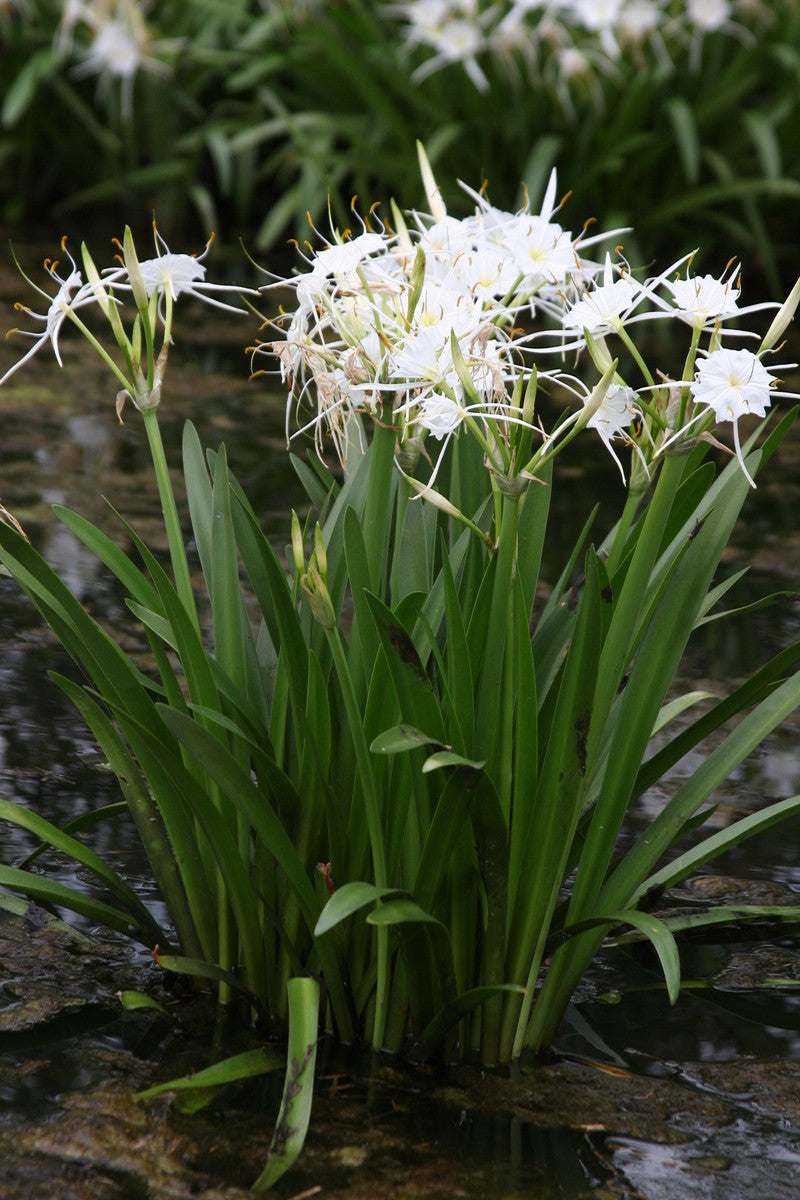
white lily plants Hymenocallis liriosme (native) - "Texas Spider Lily"This native lily is also known as the "Texas Spider Lily." Every April, these spidery white blooms begin to appear in wetland areas across Texas and the Southeastern United States. They make large clumps and showy displays in settings that are often too hostile to other bulbs and plants. The flowers fade as we head into May, but the show is well worth it! They produce multiple softball size blooms atop strong stalks amid dark green foliage. In pond

This native lily is also known as the "Texas Spider Lily." Every April, these spidery white blooms begin to appear in wetland areas across Texas and the Southeastern United States. They make large clumps and showy displays in settings that are often too hostile to other bulbs and plants. The flowers fade as we head into May, but the show is well worth it! They produce multiple softball-size blooms atop strong stalks amid dark green foliage. In pond areas, they look like islands of white color!

We can start with a lot of things to say about the "Texas Spider lily", but let's just start with that it is one-of-a-kind and one of the only natives we readily grow and promote. As gardeners, we are always looking for something to make our garden beautiful yet connected to our environment as well. The "Texas Spider lily" offers a unique opportunity to satisfy both of those goals. As a native though, we want to be very clear on something. Natives like to be in specific conditions.

WARNING: Yes, we have this above, but we want your bulbs to be successful for you and this is extremely important! Please note that the native habitat for this bulb is an environment in which it is extremely wet in the spring, and dry in the summer. Some examples of this would be fields that have standing water in the spring but dry out in the summer, spillways from lakes or ponds that over flow in the spring but don't in the summer, stream banks that are high in the spring and low in the summer, bar ditches that collect water in the spring off the side of a road, etc. The bulbs are smaller than what you would expect for the amount of blooms they eventually put out once they are mature. We have them circling the farm ponds at the Southern Bulb Company farm. In August, these ponds are lower and dry around the banks...the bulbs love it, and bloom in standing water in April when the ponds are high.

Appearance: When the "Texas Spider lily" blooms, the white "spiders" sit on tall, narrow stems. The dark green stems usually stand about 2 feet tall, but they can grow up to 3 feet tall depending on the conditions. The blooms usually appear in April, and the white blooms cluster to create a softball-size clump. The Hymenocallis liriosme is distinguished from other varieties by the yellow center deep in the bloom's center. The "Texas Spider lily" has a light sweet fragrance.

Resilient: The "Texas Spider lily" is a hardy plant that can grow in zones 8-10. This bulb needs to be planted in an area that is extremely wet in the spring and dry in the summer. WARNING: Native flowers and bulbs can be hard to sometimes adapt to modern landscapes. Please note that the native habitat for this bulb is an environment in which it is extremely wet in the spring, and dry in the summer.

Uses for this Bulb: Some examples of this would be fields that have standing water in the spring but dry out in the summer, spillways from lakes or ponds that over flow in the spring but don't in the summer, stream banks that are high in the spring and low in the summer, bar ditches that collect water in the spring off the side of a road, etc.

Urban examples of use for this water loving flower include detention areas required for commercial construction, natural drainage areas that need native plants and aren't easily mowed, or areas that have clean water requirements and needs plants to help filter the water before it drains off site.

The bulbs are smaller than what you would expect for the amount of blooms they eventually put out once they are mature. We have them circling the farm ponds at the Southern Bulb Company farm. In August, these ponds are lower and dry around the banks...the bulbs love it, and bloom in standing water in April when the ponds are high.

Native and History: This bulb is a native Texas bulb. It can endure the tough weather that Texas has to offer especially the hot dry summer in full sun. We have an early historical account of this bulb in the State of Texas. In the early to mid-1800's, explorer Jean Louis Berlandier, a Swiss-French botanist, charted the plants of Mexico, an area that included sections of present-day Texas. In his journal he describes a scene where his expedition party that hiked from San Antonio to Rusk, TX found itself surrounded by knee-high white lilies. Many believe these flowers were the white spidery blooms of Hymenocallis liriosme. Berlandier wrote of many interesting aspects of life in Texas in the mid 1850's, such as foot long fresh water prawns from the rivers taken to open markets in San Antonio in wooden wheel barrows. Alas, abundant foot long fresh water prawns in Texas rivers can no longer be found. However, the botanical displays of these white spider lilies have persisted and can still be enjoyed today! Drive county roads in April, and you could find yourself in the middle of these spectacular beauties. We're excited to offer them to our customers!

You will receive small to medium bulbs in this special offer. The bulbs were harvested from our wet spring soil so be prepared for them to look this way. The best thing that you can do is to plant them as soon as possible in conditions similar to their native environment - somewhere wet right now that will be dry this summer. We know that this means digging in the mud, but you are doing this for the bulbs and for the beautiful stand that you will have in the future!

If we are sold out, contact our office to be put on a waiting list for the Texas Spider Lily! You can email us at [email protected] or call us at 1-888-285-2486.

Shipping Notes
  • Free Standard Shipping on $100+ Orders to the USA.
  • Except Preorder products are shipped in 48 hours.
  • Delivery to the USA:
  1. Standard Shipping : 3-10 business days
  • If time is of the essence, please consider selecting expedited delivery for faster service.
Exchange/Return Notes
  • We offer a 30-day return/exchange service after receiving.
  • Final sale items are not eligible for returns or exchanges.
  • To process your return/exchange, please contact us at [email protected]
  • Please click here for more details>>> Return & Exchange Policy
SKU: 90041711705

Discover Niche Categories That Outsell white lily plants

Top-Converting Item to Boost Your Average Order

4.6 ★★★★★
Based on 590 reviews
Sort
Highest Rating
Newest First
Oldest First
Product Reviews
S
Verified Purchase
Stephanie
Lake Worth, US
★★★★★ 5
Essential reading
Format: Audiobook
I wish I’d learnt this history decades ago. This book illuminates how the world has, for many of us, come to be seen through a white supremacist lens. It provides religious, political, technological, sociological context over centuries and Millenia. It explains the justifications used to treat our fellow humans as ‘less than’ - the sort of thinking that we in the ‘western’, white, colonial world have inherited, that persists through literature, philosophy and mythology, and that continues to fuel bigotry and oppression today. Eye opening. Can’t recommend more highly (book, kindle, audiobook).
WAS THIS REVIEW HELPFUL?YesReportShare
Reviewed in the United States on January 27, 2026
M
Verified Purchase
Martin Firestein
Cuba, US
★★★★★ 5
Perhaps too ambitious for its own good
Having just finished Dr. Kendi's magnum opus on the history of American racism, I can confidently say that this is a very ambitious work. It attempts to describe the political, social, economic, philosophical, and cultural development of racist ideas throughout American history while at the same time, offering biographical sketches of 5 Americans who were/are representative of their time and place (Cotton Matther/Colonial America, Jefferson/Revolutionary era, William Garrison/Civil War and Reconstruction Era, W.E.B. DuBois/Jim Crow era, and Angela Davis/Civil Rights and Black Power era). Perhaps it's a bit too ambitious, though. The amount of ground the book tries to cover prevents it from being able to cover anything in great detail. Thus, the biographies of the 5 individuals are incomplete, and the racist or assimilationist ideas in each time period are discussed superficially. Dr. Kendi's book also jumps around a lot from one subject to another, which can be a bit jarring or disrupt the flow of the narrative. Don't get me wrong. The book does a very good job explaining how a lot of what has passed for antiracism in US history was really assimilationist thinking, and it also convincingly argues that racism and racist policies flow from the political, economic, or social advantages that one group gains by the persecution of the other. However, I am left with the distinct impression that Dr. Kendi should've narrowed his focus to something that could've been more manageable. Perhaps he should've focused exclusively on the difference between antiracism vs assimilation. Perhaps instead of attempting biographies of 5 individuals, he should've devoted each chapter (or section) of the book to discussing the racist or assimilationist ideas of that time period, and how they developed or changed over time. Overall, my best advice would be to get this book and read it, because it's very timely with what's going on right now in America, but for those areas that aren't covered in a lot of detail, I would try to supplement it with other literature.
WAS THIS REVIEW HELPFUL?YesReportShare
Reviewed in the United States on July 28, 2020
T
Verified Purchase
Taylor
West Palm Beach, US
★★★★★ 4
Interesting and important read, but less objective than I expected.
Format: Hardcover
I feel this book has received higher review ratings than it probably deserves. Yet, it's still an overall good read and it discusses an important societal issue of U.S. history. This review will include both positive and negative feedback of this book. The author, Ibram Kendi, has done a great job at making this book accessible to readers. It's not overly infused with academic jargon. The chapters are also quite short, which makes it easier to read. The substance of the book is pretty informative too. Kendi's frequent usage of quotes really exposes the racist attitudes and ideas that were (and still are) present in American society. Although this book contains an abundance historical quotes, many of them lack sufficient explanation and context. As a student of history, I appreciate deeper, rounded discussions of historical figures. I felt that Kendi mostly includes short bits of statements from historical figures, then hastily shows how those statements equal racism in the person being discussed. I guess Kendi's style is OK. It just doesn't quite feel dedicated to historians craft. Another, less important critique is about the book title's usage of the term "Definitive." I'm surprised that this work was labeled as definitive. To be definitive, it would need to include racial histories of ALL ethnic/racial groups throughout both the American colonial and U.S. eras. Alternatively, this book's title may have been more appropriate as "The Definitive History of Racist Ideas Towards Peoples of sub-Sarahan African Descent in America." Overall, I'm glad I purchased and read this book. It boldly explains certain sides of history that much of our society has missed. I did not grow up in a "racist" household. Yet, this book helped me reflect on my own attitudes, which have been influenced by racist ideas to some degree. I hope others (especially other Americans) can read this book with an open heart and mind.
WAS THIS REVIEW HELPFUL?YesReportShare
Reviewed in the United States on August 12, 2018
J
Verified Purchase
John M. DeMarco
Charlottesville, US
★★★★★ 5
The REAL American History
Bearing 511 pages of text supported by nearly 70 pages of footnotes, Ibram X. Kendi’s Stamped From the Beginning (Bold Type Books, 2017) is, for me, not an “alternative” American history but THE American history. Kendi, founding director of the Boston University Center for Antiracism Research, makes a convincing argument—which he emphasizes in his other books and public speaking—that, contrary to conventional assumptions, racist policies drive racist thinking and not the other way around. And, Kendi adds, it’s economic, political, or cultural self interests that give birth to such policies and motivate their rejection when new circumstances demand it. In making his case, Kendi patiently and passionately traces the development, implementation, and adaptations of three racial dynamics across the history of the U.S.: 1. Segregation: Blaming Black people themselves for racial disparities, and therefore denying them the privileges 2. enjoyed by white Americans 3. Assimilation: Blaming Black people and racial discrimination for racial disparities, and demanding Black people change their behavior in order to experience less racism Antiracism: Pointing to racial discrimination and policies while defending Black people’s right to be themselves In addition, Kendi structures this narrative across five lengthy sections, each centered on the impact of a specific, influential “tour guide” and their contemporaries: 1. Cotton Mather, early America’s greatest preacher and intellectual, and a staunch promoter of racist policies and ideas 2. Thomas Jefferson, primary author of the Declaration of Independence, and America’s first Secretary of State, second Vice President, and third President, who held contradictory views amid incongruous political and personal actions 3. William Lloyd Garrison, an influential publisher who opposed slavery but embraced assimilationist ideas 4. W. E. B. DuBois, a towering Black intellectual who gradually shifted from assimilation to antiracism 5. Angela Davis, one of the best known Black scholars and antiracist activists still alive today When you’re done reading Stamped From the Beginning, you’ve gained a new framework for noticing and examining race and its interrelated justice issues. Current racial events take on a richer meaning, with their nuances and complexities more tangible than before. Other books on racial justice help to reinforce this framework and further develop a reader’s embryonic skills for noticing racism within themselves, others, policies, and systems—and doing something about it. To grow increasingly fluent in Black history is to awaken from the slumber of an incomplete, biased, and often false American narrative that’s been drilled into most of our minds since we were young children. Since racism remains very much alive today, waking up is crucial and, from my experience, invigorating and teeming with possibilities for a more purposeful life.
WAS THIS REVIEW HELPFUL?YesReportShare
Reviewed in the United States on August 15, 2020
R
Verified Purchase
Red-Haired Ash
Boise, US
★★★★★ 5
This should be required reading for everyone..
Stamped From the Beginning discusses the history of racism and racist ideas in America. Kendi focuses on five main people who have made the biggest impact on racism and anti-racism in our history: Puritan minister Cotton Mather, Thomas Jefferson, abolitionist William Lloyd Garrison, W.E.B. Du Bois, and legendary activist Angela Davis. “When men oppress their fellow-men, the oppressor ever finds, in the character of the oppressed, a full justification for his oppression.” Douglass, amazingly, summed up the history of racist ideas in a single sentence.” - (Fredrick Douglass) This was an incredibly powerful and educational book. I knew going into this book that the United States education system has failed at teaching the history of slavery, emancipation, Jim Crow, and the continued struggle. But it still amazed me at how much it doesn’t teach. With every single chapter I learned new things that should have been taught to me in school. While this is a very large book filled with history, it was an easy read. Normally I would have read this book in a few days but instead I stretched it out over a month and a half. I read, reflected, took notes, did more research and I still know that I have a lot to learn. My book is now covered in sticky notes and I know I will be rereading this in the future because I know I missed stuff. “That is what it truly means to think as an antiracist: to think there is nothing wrong with Black people, to think that racial groups are equal. There are lazy and unwise and harmful individuals of African ancestry. There are lazy and unwise and harmful individuals of European ancestry. There are industrious and wise and harmless individuals of European ancestry. There are industrious and wise and harmless individuals of African ancestry. But no racial group has ever had a monopoly on any type of human trait or gene—not now, not ever.” This book changed the way I viewed the history of the United States. So much of this history has been glossed over by the education system, and other history books. This book should be required reading for everyone especially since the education system won’t teach us the true history of the United States. All I can say is, READ THIS BOOK!
WAS THIS REVIEW HELPFUL?YesReportShare
Reviewed in the United States on October 1, 2020

recommand products