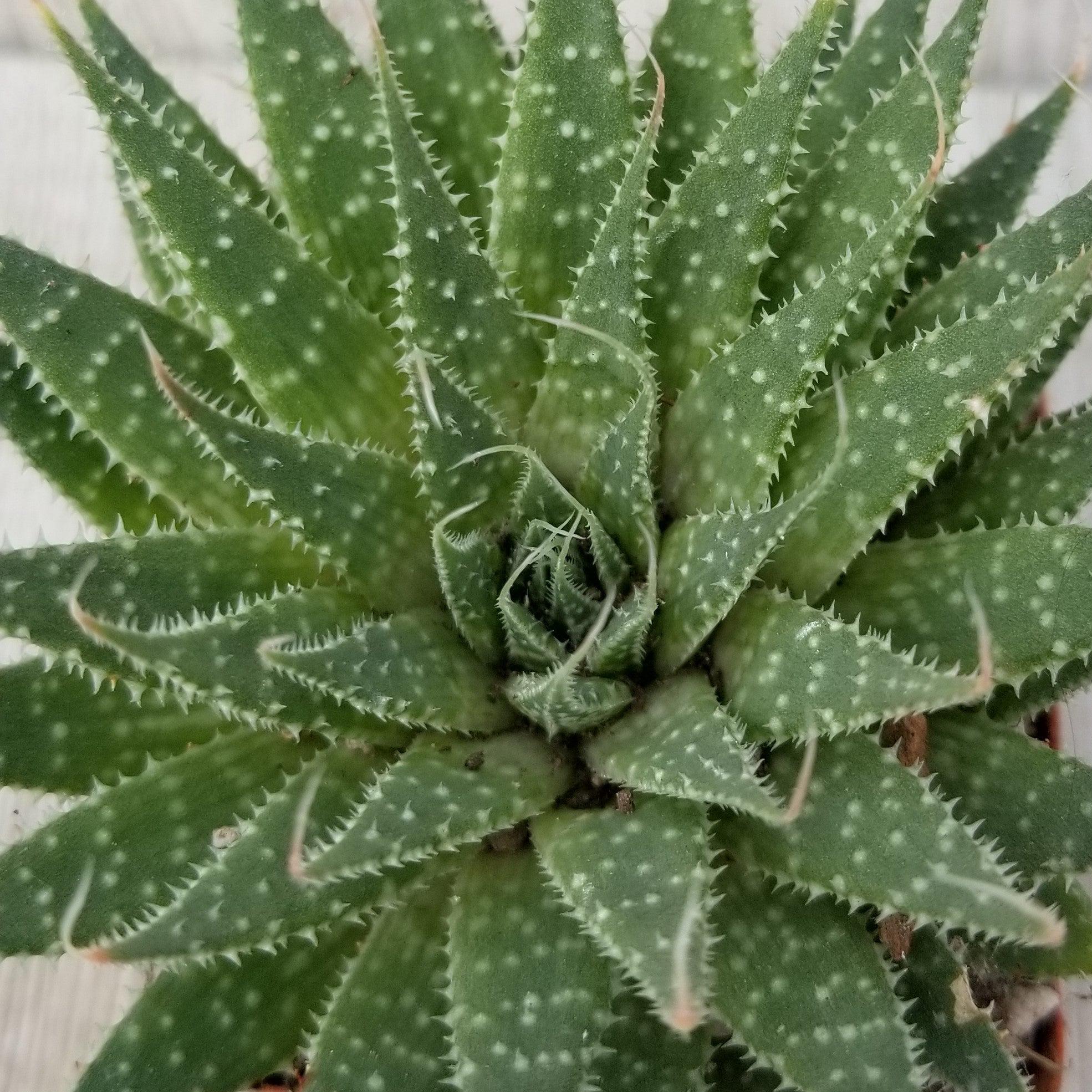
lace aloe succulents 'Lace Aloe
SKU: 89555478648
lace aloe succulents

lace aloe succulents 'Lace Aloe

Sale price$21.76 Regular price$24.18
Save 10%

Shipping Estimate
USA
  • USA
  • CAN

Ships within 48 hours · Estimated delivery Jul 9 - Jul 14

Promo Codes Available:

For Your Every Summer RSVP, with Code: SUMMER15

Description

lace aloe succulents 'Lace AloeIntroducing the Lace Aloe, known as Aloe aristata (or Aristaloe aristata) which is vibrant among the aloe genus! The Lace Aloe gets its name from the intricate, lacy patterns on its leaves. The Aloe aristata of this low growing perennial succulent. The specific epithet aristata means "bearing bristles or a beard." It is sometimes also known as torch plant, spider aloe, and Guinea fowl Aloe. This lace aloe is not just any ordinary houseplant; it's a

Introducing the Lace Aloe, known as Aloe aristata (or Aristaloe aristata) which is vibrant among the aloe genus! The Lace Aloe gets its name from the intricate, lacy patterns on its leaves.

The Aloe aristata of this low-growing perennial succulent. The specific epithet aristata means "bearing bristles or a beard." It is sometimes also known as torch plant, spider aloe, and Guinea-fowl Aloe.


This lace aloe is not just any ordinary houseplant; it's a compact, hardy succulent that has recently undergone reclassification.

The lace aloe is grown primarily for its attractive succulent rosettes with yellow spots and white bumps on dark green leaves with lacy edges and soft white spines.

Hailing all the way from South Africa, the Aloe aristata can grow up to 8 inches tall and 6 inches wide. From wide bottoms to sharper points at the top, these leaves are pure perfection. 

This sun-loving Aloe aristata plant thrives on warmth and dryness; it's like having your very own sunshine-filled oasis indoors or outdoors in xeriscape landscapes. This frost-hardy wonder boasts leaves that mimic the elegance of Haworthia plants and grows at an astonishing pace.  

When it comes to flowering, these pollinator-friendly lace aloe plants bloom with tubular orange-red lace aloe flowers during the sizzling summer months, that attract both bees and hummingbirds alike  talk about being irresistible to nature's most delightful creatures! 

When and How to Water Your Lace Aloe

The Lace Aloe has moderate watering needs. It is a succulent plant that prefers to be underwatered rather than overwatered. Its large, fleshy succulent stems and lanceolate leaves store water for use during times of drought. It's pretty risky to feed it too much water because it doesn't require it because of this adaptation. 

When watering, make sure to thoroughly saturate the soil and then allow it to completely dry before watering again. This Aloe plant is drought-tolerant and can withstand periods of dryness, so it's better to err on the side of underwatering. 

 In the spring and summer, during the active growing season, you can water the Lace Aloe every two to three weeks. However, in the fall and winter, during the dormant period, watering should be reduced to once a month or even less, as the lace aloe plant requires less moisture during this time. It's always a good idea to check the moisture level of the soil before watering to ensure it is dry.

Light Requirements - Where to Place Your Lace Aloe

When growing indoors, the Aloe Aristata prefers bright, indirect light. It thrives in a location with plenty of natural sunlight, such as a south-facing window.  If your home doesn't receive much natural light, you can also use artificial grow lights to provide the necessary light for the plant's growth. Just make sure to position the lights a few feet away from the plant to prevent heat damage. 

For outdoor cultivation, the lace aloe can thrive in full sun and partial shade for at least 4-6 hours per day. It's important to protect the aloe aristata from prolonged, direct sunlight, as it can cause the leaves to become scorched. If you notice the leaves turning brown or yellow, it may be a sign that the aloe aristata plant is receiving too much light.

Remember, finding the right balance of light is crucial for the health of the Lace Aloe.

  1. If the aristata lace aloe isn't receiving enough light, it may become leggy, and its growth may slow down.
  2. On the other hand, too much light can cause the leaves to become discolored or sunburned.

Observing the Aloe aristata response to its current light conditions and making adjustments as needed will help ensure its well-being.

Optimal Soil & Fertilizer Needs

The Lace Aloe thrives in well-drained soil that mimics its natural habitat. A coarse sand or gritty soil mix is ideal for this succulent plant, as it allows excess water to drain away quickly and prevents the roots from sitting in soggy soil. Instead, simply mix garden soil or buy a well-draining potting mix, or ideally use our specialized succulent potting mix that contains 5 natural substrates and mycorrhizae to promote the development of a strong root system that helps your succulent to thrive.

When it comes to fertilizer, the aristaloe aristata Lace Aloe is not a heavy feeder. It can thrive in nutrient-poor soil, so you don't need to fertilize it frequently. During the growing season, which is typically in spring, you can apply a balanced natural fertilizer once a year.

However, it's important to note that succulents like the Lace Aloe are more prone to damage from overfertilization than underfertilization. Excessive fertilizer can lead to burnt roots and other issues. So, it's best to err on the side of caution and fertilize sparingly. Always observe the plant's response and adjust your fertilization routine accordingly. 

Hardiness Zone & More

If you're growing the Lace Aloe indoors, it prefers temperatures between 50-80°F and can tolerate slightly cooler temperatures at night. Avoid placing them near drafts or heating vents, as sudden temperature changes can stress the plant.

You can place it in a well-ventilated area or use a fan to improve air circulation.   It is strongly advised that plants be shielded from cold, wet soil conditions in areas that experience a lot of winter and spring moisture (especially rain).  

For outdoor cultivation, the Lace Aloe is a cold-hardy plant and can tolerate mild frost in USDA zones 7-12. If you live in a colder climate, you should put them in a pot, and they can then be kept outdoors during the summer and brought in as the temperature drops. 

In terms of humidity, the Lace Aloe is adaptable and can tolerate a wide range of humidity levels, but it generally prefers drier conditions. It's important to provide good airflow around the plant to prevent excessive humidity and reduce the risk of fungal diseases. 

How to Propagate Your Lace Aloe?

You can easily propagate your lace aloe by removing offsets that grow around the base of the plant. These offsets can be gently separated from the main plant and planted in their own pots with well-draining soil to encourage root growth. Additionally, you can also propagate lace aloe through leaf cuttings by allowing the cut ends to callous over before planting them in soil.

Wildlife - Lace Aloe Attracts the Following Friendly Pollinators

The Lace Aloe attracts pollinators such as bees, hummingbirds, and butterflies with their tubular orange flowers. These succulents are also known for their ability to thrive in low-water conditions, making them a popular choice for drought-tolerant gardens.

Butterflies
Bees
Hummingbirds
Lady Bugs
Multi Pollinators
Other Birds

Toxicity: The Lace Aloe is completely safe for humans and pets. It is a popular choice for indoor succulent gardens due to its low maintenance requirements and attractive appearance.

Key Takeaways

  1. The Lace Aloe forms a compact rosette of dark green, fleshy leaves adorned with white, lace-like spots and soft spines along the edges, giving it a unique, ornamental appearance.
  2. Also known as Spider Aloe, this name reflects its spiky, delicate leaves that resemble spider legs, adding an intriguing visual element to small gardens and indoor spaces.
  3. When in bloom, Lace Aloe produces tall stalks topped with tubular, orange-red flowers that attract hummingbirds and bees, adding vibrant color to your garden in late summer and fall.
  4. This aloe is highly drought-tolerant, requiring minimal watering once established, making it an excellent choice for xeriscaping or low-maintenance indoor and outdoor gardens.

The Bottom Line

Overall, the Lace Aloe (Aloe aristata) is a striking, compact succulent known for its unique rosette of dark green leaves adorned with white, lace-like markings and soft spines. Its ability to tolerate cooler temperatures and mild frost makes it more versatile than many other aloe species, especially in outdoor gardens. With its low water requirements, Lace Aloe is a perfect addition to drought-tolerant landscapes or as a low-maintenance indoor plant. During its bloom period, it produces vibrant orange-red flowers that attract pollinators, adding seasonal interest. For best care, place it in well-draining soil with plenty of sunlight, water sparingly, and protect it from extreme cold.

Shipping Notes
  • Free Standard Shipping on $100+ Orders to the USA.
  • Except Preorder products are shipped in 48 hours.
  • Delivery to the USA:
  1. Standard Shipping : 3-10 business days
  • If time is of the essence, please consider selecting expedited delivery for faster service.
Exchange/Return Notes
  • We offer a 30-day return/exchange service after receiving.
  • Final sale items are not eligible for returns or exchanges.
  • To process your return/exchange, please contact us at [email protected]
  • Please click here for more details>>> Return & Exchange Policy
SKU: 89555478648

Discover Niche Categories That Outsell lace aloe succulents

Top-Converting Item to Boost Your Average Order

4.8 ★★★★★
Based on 1946 reviews
Sort
Highest Rating
Newest First
Oldest First
Product Reviews
M
Verified Purchase
Marcel Dupasquier
Grantham, US
★★★★★ 4
A strange book I don’t grok
I have started to read this book directly after I had read “The Moon is a harsh Mistress” and after the first chapter, I almost stopped reading again. The first chapter starts promisingly enough, after a Mars expedition with only four couples, finding the fitting couples that contained all the required capabilities in themselves had been difficult enough, had failed, years later, another expedition is started, and this time, the flight takes much shorter. They find a young man there and bring him back, but how they treat him here, locked and no women allowed, for the first time really showed me how old Robert Heinlein’s books really are and here, for the first time, it was an annoyance. What would happen if a woman would visit him? We find out in the second chapter, and the answer is, basically, nothing. Then, for about 10% of the book, we get Jill, working in the hospital where the Man from Mars is kept, discussing with Ben, a journalist, about the implication of the Man from Mars. Once he owns the whole Mars, once he owns a majority of Lunar Enterprises. In any case, the government under the Secretary General cannot keep him alive. Then, finally, some action occurs: Ben tries to get the Man released, but fails miserably; Jill subsequently tries to prisonbreak with the Man. They escape to Ben’s place but the henchmen are not far away. They ring at the door, there is a confrontation and... it’s over. They go to another benefactor, Jubal, who keeps Jill and the Man hidden for rest of almost half of the book. There, Jubal thinks about how to help the Man, together with getting Ben back, while he tries to learn as much as possible about the Martian and Mars. Then, the henchmen appear again, ready to arrest everybody, and after the Martian makes the policemen disappear once more, Jubal eventually manages to bluff the Secretary General into calling back the second arresting team and agreeing to meet with the Man from Mars with him, Jubal, as the official delegate for the Martian. At the meeting, Jubal does what he can to make the Man’s live safe: He gives the Secretary General the mandate the manage the money of the Martian with the payment as much money as he sees fit. Having thus secured the Martian’s safety, the Martians keeps living at Jubal’s place and learning. They visit a service of the Fosterite church, where people gamble, visit the bar and have stories with women but when the archbishop wants to have one-to-one talk with the Martian, latter recognizes former’s evilness and discorporates him. Eventually, the Man from Mars has learned all he can at Jubal’s and he and Jill set out for the world. They join a circus troupe where the Martian performs a levitating trick with Jill, only it is not a trick, he really does so. But they are unsuccessful, the marks see right through it. They leave again, but not before they have listened to a snake charmer sermon about the Fosterites and before they make her a water brother. They next move to Las Vegas where Jill works in a show and the Martian as croupier and they elucidate naughty pictures. Thereafter, they go to San Francisco, where the Martian reads all the books about the various religions without grokking anything. They then visit a zoo where the Martian breaks out laughing as he, observing monkeys, finally groks people. They founded their own church, but it’s not a religion. The Martian had hereto shown some extraordinary capabilities, such as being able to enter a trance state where he could stay under water for hours, telekinesis and the ability to discorporate things or beings at will. Had the reader so far been wondering how he could do that, if the Old Ones on Mars has changed him somehow on Mars, now it become clear that this was not the case. Everybody can do it but, in order to facilitate such deeds, which were connected to Martian creed, one had to understand the Martian concepts, which one could only by firstly learning the Martian language. The Martian church was thus foremost a Martian language school. That was however not all it was. The Martian idea was that there was no God than God in everyone of us. All other religions were considered as truths, only that they were kind of hiding that God was each of us, and thus the creed was “Thou are God.” In the Martian church, also free love was practiced. We get hence a chapter where Ben was shocked by this and fled the church most hurriedly to report to Jubal, only to join it again the next chapter. And of course, we get Fosterites who try to start a persecution against their competitors. The end then also makes sense, but I don’t understand why. It was on one hand logical but on the other hand why was it necessary? This is thus not really a work of science fiction and but rather a theological treatise. I think it could have shortened somehow, then realized, that what the original editors thought as well. It was my third book I read from Robert Heinlein, Starship Troopers was a good concept which Joe Haldeman made into a good book, the Moon is a harsh Mistress was a quick read that kept me hooked, but considering, it is basically a story of the American struggle for independence, just on the Moon, and it will also be my last. There are other science fictions authors out there.
WAS THIS REVIEW HELPFUL?YesReportShare
Reviewed in the United States on November 15, 2022
B
Verified Purchase
b slev
West Palm Beach, US
★★★★★ 5
seekers paradise
Format: Kindle
Some of this book disturbed me a little but overall I found it amazing and fascinating. Possibilities abound in fantasy and can be just the thing you need to open up. Enjoy! I sure did.
WAS THIS REVIEW HELPFUL?YesReportShare
Reviewed in the United States on May 22, 2026
J
Verified Purchase
Jenni DaVinCat
Los Angeles, US
★★★★★ 3
We Should All Be a Little Stranger.
I understand why this book is often cited as one of the most important sci-fi books of all time. While reading it, you might begin to question why it’s lumped into the sci-fi category because the themes are very human. It is science fiction, that cannot be argued, but it’s also a coming of age story, a religious story and at its very core, a story about love. Valentine Michael Smith was born and raised on Mars, but he is a human. He is brought back to Earth to learn what it means to be a human. This causes the reader to be forced to think outside of the box because Michael is not just coming from a different human culture, he has never learned what it means to be a human so any chapter told from his perspective is like an outsider, looking in on human culture. It’s wildly fascinating to think about ourselves in this manner. As Michael progresses in his grokking of humans, he gets out to explore the world and to challenge it. Our concepts of God/religion and sex/love are strange to him. We tend to not really think about it from an outside perspective because this is just the way life is, but being forced to think about it, makes for a very fascinating read. I’d never really considered myself to be a “prude” but there were times that this book made me feel that way. At times, the reader must take a step back and remember that Heinlein did intend for many of the themes to be viewed as satire of what is commonly accepted. There were a few negatives when reading this book, however. It was written in the sixties, which was a very different time from today in terms of the way women are spoken to/about and how they are treated. Heinlein wasn’t too bad in this regard, but there were a few sentences that made me stop for a second. Heinlein also has some of his characters go on these long drawn-out speech tangents that go on for pages and pages. I felt it was a little unnecessary to go on for that long, especially considered the length of the uncut version. It took me a little while to get through this book and normally I’m a pretty quick reader. Negatives aside, I do feel like this book is important. The story itself is not challenging, but as I stated before, it challenges the reader to think about humans from an outside perspective and that is fascinating. He really doesn’t seem to rely too much on Sci-fi elements, preferring to focus on the human elements of the story (love, religion etc.). If you’re looking for something long and fulfilling, this may just be the sci-fi book for you!
WAS THIS REVIEW HELPFUL?YesReportShare
Reviewed in the United States on September 29, 2016
K
Verified Purchase
Kendal Brian Hunter
Birmingham, US
★★★★★ 5
Wicked Satire, yet Strangely Familiar
Format: Mass Market Paperback
Heinlein's satire is wicked and well-placed, reminiscent of Voltaire and Swift. IF you love British comedy, you'll love this book. Both come from the same sarcastic taproot. I'm still debating whether or not the main charter is Smith or Jubal. Maybe it is us, since we need to recognize that we are Juba, and must nurture, and eventually become like Smith. Smith's reflective, contemplative message, reminds of Thomas A Kempis ( ), James Allen ( ), Lao Tzu ( ). Smith's message is nothing new: as C. S. Lewis pointed out, "Really great moral teachers never do introduce new moralities: it is quacks and cranks who do that... The real job of every moral teacher is to keep on bringing us back, time after time, to the old simple principles which we are all so anxious not to see." . In fact, Smith's slogan "Thou art God" is merely run-of-the-mill Christianity: * "Inasmuch as ye have done it unto one of the least of these my brethren, ye have done it unto me." * "Be ye therefore perfect, even as your Father which is in heaven is perfect." * "Therefore, what manner of men ought ye to be? Verily I say unto you, even as I am." * "Ye are gods; and all of you are children of the most High." * "God became man so that man might be god." * "It is a serious thing to live in a society of possible gods and goddesses to remember that the dullest and most uninteresting person you may talk to may one day be a creature which, if you saw it now, you would be strongly tempted to worship, or else a horror and corruption such as you now meet if at all only in a nightmare. . . . There are no ordinary people. You have never met a mere mortal, Nations, cultures, arts, civilizations, these are mortal, and their life is to ours as the life of a gnat. But it is immortals whom we joke with, work with, marry, snub, and exploit--immortal horrors or ever lasting splendours." . Heinlein seems to have stolen a page from Søren Kierkegaard, who tried to re-Christianize Christianity ( , 458). To paraphrase John, "Brethren, I write no new commandment unto you, but an old commandment which ye had from the beginning." As I read this book, Smith struck me as oddly familiar. His first name, Michael, refers to the Archangel, the captain of the Lord's army. The second name, Valentine, is the patron saint of all shades of love, phileo, agape, eros, and romance. The last name, Smith, makes him Everyman. But I wonder if there is something more. What happens to Smith is common to all founders of religions--Abraham, Jesus, Mohammed, and so forth. There is evolution, turns and twists of fate, and eventual triumph. However, there is a deeper nuance. Society begins with vulgarized Christianity, then there was the Fosterite Revolution, and another apostasy and commercialization of religion as a Megachurch. And lastly comes along Smith, with his Martian philosophy. This bears a strong parallel to the life of Joseph Smith . In fact, both have a similar martyrdom: "Thou art God" versus "O Lord My God." The satire can get tedious at time, but I think this flaw is excusable. As I read, I kept thinking that this book could loose about 1/3rd of the text. But on the other hand, the artistry and beauty of the wicked satire forces me to say, "Leave it alone." Note: This book is the Q document for so much other fiction. I see shades of "Dune" here and there. Smith the new prophet is akin to Ender, the Speaker for the Dead. And if you have seen Star Trek: The Original Series episode "Charlie X," some of the elements will seem a bit too familiar. Keep in mind that this book came first, and that it does a much better job of mixing wit and wisdom than Kirk and Spock. There is no comparison--after reading this book, "Charlie X" rolls like a flat tire.
WAS THIS REVIEW HELPFUL?YesReportShare
Reviewed in the United States on July 9, 2007
P
Verified Purchase
P. Biealczyc
Massapequa, US
★★★★★ 5
Really nice
Format: Paperback
Great read and gift
WAS THIS REVIEW HELPFUL?YesReportShare
Reviewed in the United States on May 31, 2026

recommand products