SKU: 85561709089
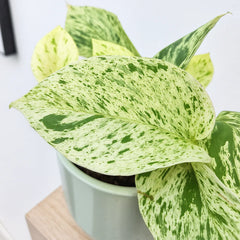
leopard goddess pothos

leopard goddess pothos 10

Sale price$25.94 Regular price$28.82
Save 10%

Shipping Estimate
USA
  • USA
  • CAN

Ships within 48 hours · Estimated delivery Jul 13 - Jul 18

Promo Codes Available:

For Your Every Summer RSVP, with Code: SUMMER15

Description

leopard goddess pothos 10Epipremnum pinnatum Snow Leopard is a rare and highly sought after variegated cultivar of Epipremnum pinnatum, renowned for its striking white and green marbled foliage and vigorous climbing habit. Native to tropical regions of Southeast Asia, this variety combines the resilience and ease of care typical of Epipremnum with show stopping, high contrast variegation. The leaves are elongated and glossy, splashed and streaked with creamy white, pale mint,

Epipremnum pinnatum ‘Snow Leopard’ is a rare and highly sought-after variegated cultivar of Epipremnum pinnatum, renowned for its striking white-and-green marbled foliage and vigorous climbing habit. Native to tropical regions of Southeast Asia, this variety combines the resilience and ease of care typical of Epipremnum with show-stopping, high-contrast variegation.

The leaves are elongated and glossy, splashed and streaked with creamy white, pale mint, and deep emerald tones. Each leaf displays a unique pattern — some heavily marbled, others delicately flecked. As the plant matures and climbs, the foliage becomes larger and may develop elegant fenestrations (natural splits and holes), giving it a distinctive, tropical aesthetic.

Fast-growing and adaptable, ‘Snow Leopard’ can be trained to climb a moss pole or trellis for large, showy leaves or left to trail from a hanging pot for a cascading effect. Its beautiful variegation and low-maintenance nature make it a must-have for collectors of rare houseplants.


Epipremnum pinnatum ‘Snow Leopard’ – Care Guide

Light

Thrives in bright, indirect light. Too little light may reduce variegation, while harsh direct sunlight can scorch the white sections of the leaves.

Watering

Water when the top 2–3 cm of soil feels dry. Keep the soil lightly moist but never waterlogged. Reduce watering in winter. This plant prefers consistent, moderate moisture levels.

Temperature and Humidity

  • Temperature: Prefers warmth, 18–28°C. Avoid draughts and temperatures below 15°C.

  • Humidity: Adapts well to average household humidity but thrives in 50–70%. Mist occasionally or use a humidifier for best growth.

Soil and Potting

Use a chunky, free-draining aroid mix – peat-free compost blended with orchid bark, perlite, and coco coir is ideal. Repot every 1–2 years in spring to refresh the soil and encourage growth.

Feeding

Feed every 2–4 weeks during spring and summer with a balanced liquid fertiliser to promote lush foliage. Pause feeding in winter.

Pruning and Maintenance

Trim back long vines to encourage bushier growth. Remove any green, non-variegated leaves to maintain strong variegation. Propagate easily from stem cuttings in water, moss, or soil.

Growth and Maturity

A fast-growing vine that can reach 2–3 metres indoors. When grown upright with support, mature leaves may develop fenestrations similar to Monstera foliage.

Common Issues

  • Loss of variegation: Insufficient light.

  • Yellowing leaves: Overwatering or poor drainage.

  • Browning edges: Low humidity or excessive sun exposure.

  • Pests: Occasionally mealybugs, spider mites, or thrips.

Background and Benefits

Epipremnum pinnatum varieties are known for their lush growth and durability, and ‘Snow Leopard’ is one of the most decorative forms available. Its bold white marbling stands out against deep green foliage, bringing brightness and texture to any plant collection. Like other Epipremnum species, it also improves indoor air quality by filtering pollutants.


Quick Care Summary

  • Light: Bright, indirect; avoid strong sun

  • Water: Lightly moist; allow topsoil to dry slightly

  • Temperature: 18–28°C; avoid below 15°C

  • Humidity: Average to high (50–70%)

  • Soil: Chunky, well-draining aroid mix

  • Feed: Every 2–4 weeks in spring/summer

  • Growth: Fast-growing climber or trailer; elongated glossy leaves marbled with white and green

Shipping Notes
  • Free Standard Shipping on $100+ Orders to the USA.
  • Except Preorder products are shipped in 48 hours.
  • Delivery to the USA:
  1. Standard Shipping : 3-10 business days
  • If time is of the essence, please consider selecting expedited delivery for faster service.
Exchange/Return Notes
  • We offer a 30-day return/exchange service after receiving.
  • Final sale items are not eligible for returns or exchanges.
  • To process your return/exchange, please contact us at [email protected]
  • Please click here for more details>>> Return & Exchange Policy
SKU: 85561709089

Discover Niche Categories That Outsell leopard goddess pothos

Top-Converting Item to Boost Your Average Order

4.7 ★★★★★
Based on 1835 reviews
Sort
Highest Rating
Newest First
Oldest First
Product Reviews
L
Verified Purchase
LUV 2 Read
Belleville, US
★★★★★ 5
a nice simple history of the American flag
Format: Hardcover
This book is a history of the American flag. It has good illustrations, good print with 3 to 5 sentences per page. A page at the back show appropriate handling and uses.
WAS THIS REVIEW HELPFUL?YesReportShare
Reviewed in the United States on April 8, 2026
A
Verified Purchase
Allen G.
Lowell, US
★★★★★ 5
Good choice to teach kids to be well-mannered at Memorial Day.
Format: Hardcover
The book starts with the 13 colonies each with their own flag. Then it discusses the Revolutionary war and the story of Betsy Ross with the qualifier that It says no one really knows who sewed the first flag. Then it discusses Francis Scott Key and the bombardment of Fort McHenry. Then how a star is added for each state added to the union. Mentions the Civil War and raising the flag on Iwo Jima. After that it has two pages on protocol for displaying and honoring the flag, and gives the pledge of allegiance. It is a good choice to teach kids to be well-mannered at parades and Memorial Day services. The cover art depicts a series of historical flags, not all of which are mentioned in the book which raises the question “Why?”. Starting at the back is the red Saint George’s Cross on a white field. Saint George the dragon slayer is the patron saint of England. The plain cross without the centered crown is the flag of England. This flag is shown on page 2 as the flag of one of the colonies but it doesn’t say which. In front of that is the flag of Maryland Colony which is still used as their state flag. Next in line is the coiled rattle snake Don’t Tread on Me flag. According to my Compton’s Encyclopedia, this originated with Esek Hopkins the first US Navy commander in chief and was used from 1776 to 1778. Colonel Christopher Gadsden presented a copy of this flag to the South Carolina legislature, so it is often referred to as the Gadsden flag but this is incorrect. The rattle snake image was used in 1775 by the minute men of Culpepper County Virginia. The image was widespread in the revolution and may have been used earlier than that. The snake is portrayed with 13 rattles, one for each colony. Rattle snakes will not initiate an attack on humans as we are too big to eat, but if stepped on they will counter attack and can be deadly. The point of the image is that the colonists did not want war, but would not tolerate abuse. (There is a rumor that this flag is connected to the slave trade, but Hopkins was from Rhode Island which was not part of the Confederacy, and I have not found any evidence to support this rumor). Next is the flag of New England which has the Saint George cross with a Pine Tree on a blue field. This flag was used at the battle of Bunker Hill. Normally the New England flag has a red field, but blue was substituted because the red caused confusion with the British Royal Navy ensign which has a Union Jack in the top left on a red field. Naval ensigns are designed to be highly visible at distance or in the smoke of battle. The bright red field is more visible than the Union Jack alone. The Union Jack is the national flag of the United Kingdom. Next is the Union Jack on a field of thirteen stripes. This is the first flag of the thirteen colonies. It was used in 1775 and 1776 as the flag of the continental army and navy but never officially adopted. Next is the Betsy Ross flag, followed by the Fort McHenry flag, and the modern flag. I hope this helps.
WAS THIS REVIEW HELPFUL?YesReportShare
Reviewed in the United States on September 4, 2023
S
Verified Purchase
SweetT
Omaha, US
★★★★★ 5
No progressive agenda! Perfect kids book!
Format: Hardcover
I'm a homeschooling parent of a kindergartener. As part of our social studies curriculum, I have been introducing the Pledge of Allegiance and the anthem, and I wanted to find a book that would go a little further into how the flag came to be and why we stand to say the Pledge, and this was the perfect book! It's written with great accuracy and at a child's level. There is also no progressive agenda, as I had discovered with some of the other kids books on the subject. It also lists when and how you are to stand for the flag, and has the Pledge printed in it. Would definitely recommend!
WAS THIS REVIEW HELPFUL?YesReportShare
Reviewed in the United States on September 27, 2025
M
Verified Purchase
Michele
Los Angeles, US
★★★★★ 5
Very patriotic and educational
Format: Hardcover
I love everything about this book for my flag crazy grandson! He loves learning about our American flag. Very patriotic book. He's a bit young (not yet 3 years old) to fully understand it. But it's amazing what he picks up from having it read to him (over and over and over again!) He loves to sit and look at the pictures early in the morning before the rest of us are up and awake.
WAS THIS REVIEW HELPFUL?YesReportShare
Reviewed in the United States on April 18, 2025
U
Verified Purchase
Ulrike HD
Birmingham, US
★★★★★ 5
Great to teach with
Format: Hardcover
Respect for the flag is very important to me. I had volunteered to present flag etiquette to 5th grade social studies class. After the presentation, I realized I need to find something easier for them to comprehend. Purchased to help me share with younger students.
WAS THIS REVIEW HELPFUL?YesReportShare
Reviewed in the United States on December 11, 2025

recommand products