SKU: 85510539517
kalanchoe a succulent

kalanchoe a succulent Mother of Thousands Plant 'Kalanchoe laetivirens' 4" Pot

Sale price$23.33 Regular price$25.92
Save 10%

Shipping Estimate
USA
  • USA
  • CAN

Ships within 48 hours · Estimated delivery Jul 15 - Jul 20

Promo Codes Available:

For Your Every Summer RSVP, with Code: SUMMER15

Description

kalanchoe a succulent Mother of Thousands Plant 'Kalanchoe laetivirens' 4" PotIntroducing the mother of thousands plants, scientifically known as Kalanchoe laetivirens, is a fascinating succulent from the Kalanchoe genus that is native to Madagascar. It has several other common names, such as Alligator Plant, Mexican Hat Plant, and Devil's Backbone. However, the true Mother of Thousands is Kalanchoe daigremontiana, which can be identified by the distinctive purplish brown markings on the undersides of its leaves. The mother of

Introducing the mother of thousands plants, scientifically known as Kalanchoe laetivirens, is a fascinating succulent from the Kalanchoe genus that is native to Madagascar. It has several other common names, such as Alligator Plant, Mexican Hat Plant, and Devil's Backbone. However, the true Mother of Thousands is Kalanchoe daigremontiana, which can be identified by the distinctive purplish-brown markings on the undersides of its leaves.

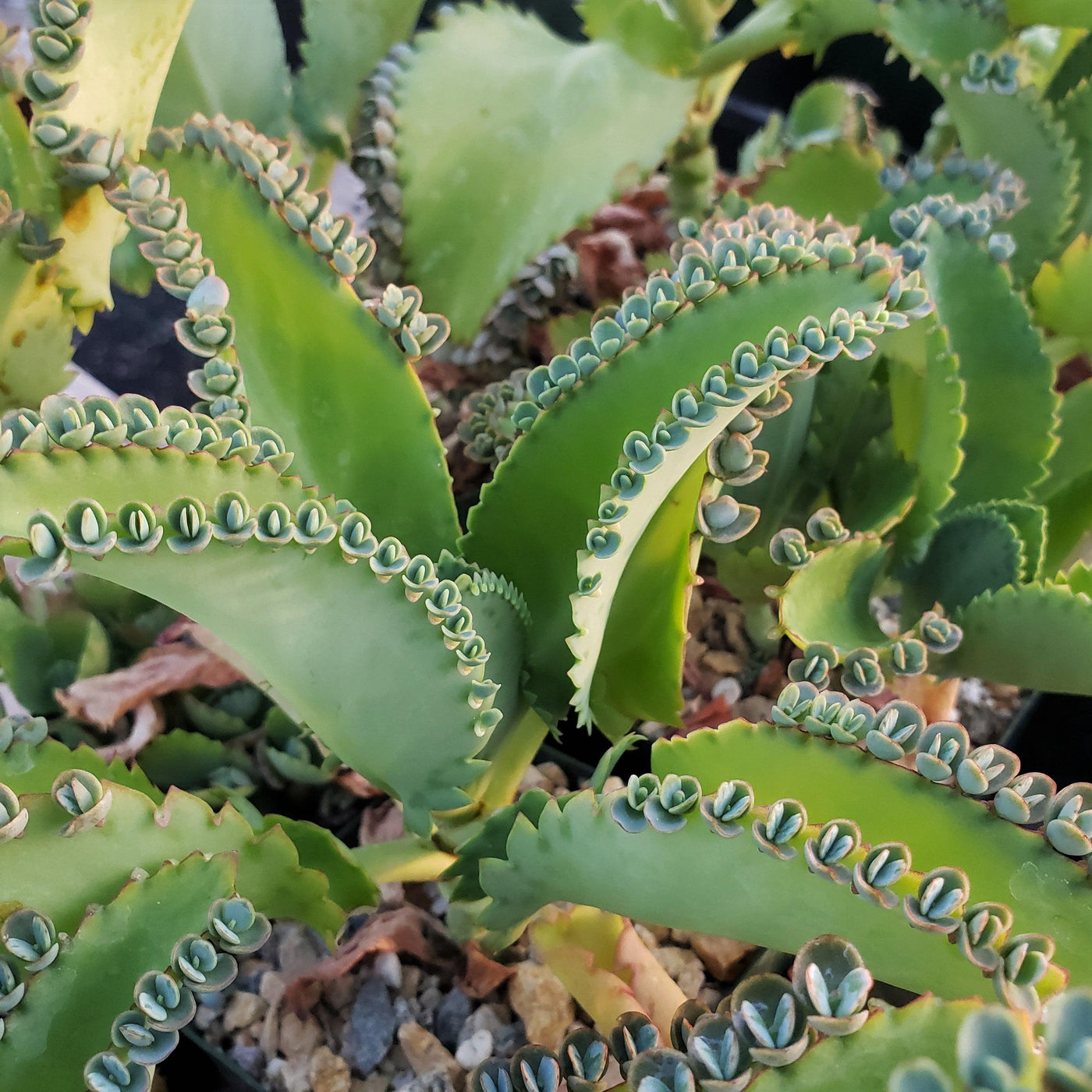
The mother of thousands gets its name from its unique ability to produce a lot of plantlets along the edges of its leaves. These plantlets, also known as "baby plantlets" or "pups," are miniature versions of the mother plant and can easily drop off and take root in the surrounding soil, giving rise to new plants.  

Most people confuse the Kalanchoe plants because of their similarities, but the name "mother of thousands" (Kalanchoe laetivirens) refers to the tiny plantlets that develop along the edges of its leaves, whereas "mother of millions" (Kalanchoe delagoensis) produces plantlets on the tips of its leaves. There's even a hybrid called Kalanchoe houghtonii that combines the features of both plants. It's like a wonderful Kalanchoe family reunion! 

The leaves of this monocarpic mother-of-thousand plant are thick and fleshy, with an attractive grayish-green color. They are often adorned with small, reddish-brown spots or markings, adding to the Kalanchoe plant's visual appeal. The mother-of-thousand succulent has an upright growth habit and can reach a height of up to 3 feet, making it a striking addition to any indoor or outdoor space. 

The flowers of the mother of thousands plants are small, tubular, and bell-shaped. They are typically pinkish-grey in color and can appear in clusters on tall stalks. The flowering season for this mother-of-thousand plant is usually in late winter or early spring, and the flowers can last for several weeks. When grown indoors, it rarely blooms. 

Mothers of thousands are considered to be mildly toxic to pets and humans if ingested. It contains compounds that can cause gastrointestinal discomfort. It's always best to keep it out of reach of curious pets and children. 

You can propagate your alligator plant through its small plantlets. Pick two or three plantlets from the leaves and propagate them properly. The plant does not require any pruning other than the removal of dead stalks and dropped plantlets. It's like a little plant factory!  

It's worth noting that while the Kalanchoe daigremontiana mother-of-thousand plant can be a delightful addition to your plant collection, it can also be considered invasive in some regions. The plantlets it produces can spread easily and take over if not properly managed. So, if you decide to grow this plant, it's important to be mindful of its potential to become invasive and take appropriate measures to control its growth.

When and How to Water Your Mother of Thousands Plant

Just like its closely related Kalanchoe plant, the mother of millions, this succulent is also adapted to arid conditions and is drought tolerant. Mother of thousands needs water at room temperature. Extreme cold or freezing temperatures or extremely hot water damages the roots of your Kalanchoe laetivirens. 

To keep your mother of thousands happy, allow the soil to dry out completely between waterings. Stick your finger about an inch into the soil, and if it feels dry, then it's time to give it a good drink. Remember to use well-drained soil and a pot with good drainage and holes to prevent water from pooling and causing root rot. 

During the cooler months or when the plant is in a dormant phase, you can reduce the frequency of watering even further. These succulents are built to store water in their leaves, so they can handle dry spells better than excessive moisture. 

Light Requirements - Where to Place Your Mother of Thousands Plant 

The mother of thousands loves bright, indirect sunlight. It thrives in a spot where it can soak up plenty of light throughout 4-6 hours of the day. Find a sunny east-facing window or a well-lit area in your home for your Kalanchoe mother-of-thousand succulent to bask in the sunshine. 

However, be careful not to expose the mother of thousands to direct sunlight for extended periods, as it can scorch its leaves. So, a balance of bright, indirect light is ideal for this plant's growth and health. 

Remember, finding the right lighting conditions will help your mother-of-thousand plant flourish and showcase its unique characteristics! 

Optimal Soil & Fertilizers

When it comes to the soil and fertilizer needs of the mother-of-thousand plant, here's what you need to know!

For soil, the mother of thousands prefers well-draining potting soil that allows excess water to flow away. Instead of using the peat-moss-based soil, make or buy a well-draining potting mix, or ideally use our specialized succulent potting mix that contains 5 natural substrates and mycorrhizae to promote the development of a strong root system that helps your succulent to thrive. 

As for fertilizing, the mother of thousands doesn't require frequent feeding. You can use a balanced, natural NPK fertilizer with an equal ratio of about (5-10-5) during the growing season, which is typically spring. 

Remember, it's always best to under-fertilize rather than over-fertilize succulents like the mother of thousands. Too much fertilizer can cause salt buildup and harm the plant. So, a light feeding every few months should be sufficient to keep your plant happy and thriving! 

Hardiness Zone & More 

Typically grown in hot, arid desert regions, the Mother of Thousands plants thrive indoors in warm, dry surroundings. Only in hotter climates, such as Florida and Hawaii, can the slow-growing mother of thousands be grown outside. 

If you live in USDA regions 9 to 11, you can also grow this particular plant outdoors year-round, but they are not frost-tolerant, so you should plant them indoors or put them in a pot and move them indoors during the winter if you live outside of these regions.

Keep your Kalanchoe laetivirens away from cold, drafty windows and air vents if you are growing it indoors in a cold climate. 

As for humidity, this Kalanchoe mother-of-thousands succulent grows wherever it can tolerate a range of levels, but it's important to provide good air circulation.

While household humidity is generally good enough, these mother-of-thousand succulents will do even better with some extra moisture in the air. Set up a humidifier nearby or grow them in naturally humid rooms like your bathroom or kitchen. 

The Bottom Line

Give it a try and enjoy the beauty and intrigue this unique Kalanchoe laetivirens mother of thousands brings to your home or garden! You can find out more information about the difference between the Mothers of Thousands and the Mothers of Millions right here on Planet Desert. 

Shipping Notes
  • Free Standard Shipping on $100+ Orders to the USA.
  • Except Preorder products are shipped in 48 hours.
  • Delivery to the USA:
  1. Standard Shipping : 3-10 business days
  • If time is of the essence, please consider selecting expedited delivery for faster service.
Exchange/Return Notes
  • We offer a 30-day return/exchange service after receiving.
  • Final sale items are not eligible for returns or exchanges.
  • To process your return/exchange, please contact us at [email protected]
  • Please click here for more details>>> Return & Exchange Policy
SKU: 85510539517

Discover Niche Categories That Outsell kalanchoe a succulent

Top-Converting Item to Boost Your Average Order

4.2 ★★★★★
Based on 298 reviews
Sort
Highest Rating
Newest First
Oldest First
Product Reviews
K
Verified Purchase
Kiwi Cove
Waukegan, US
★★★★★ 5
A Must for contemporary military and civilian leaders in national security
Format: Kindle
This is a very very useful work for members of the contemporary national security strategy community. While Hew's reputation as a historian is very high, it is his thoughtful and insightful comments that he makes in the latter chapters that lay out some of the critical challenges facing contemporary military and civilian leaders.
WAS THIS REVIEW HELPFUL?YesReportShare
Reviewed in the United States on August 19, 2016
T
Verified Purchase
Terry Tucker
Louisville, US
★★★★★ 5
Astoundingly Good
Format: Kindle
This is a must have book. It is, beyond a doubt, the best book I have read on military strategy. The author is clear, provides case examples, and more importantly makes this "readable." I retired with 24 years on active duty and spent 15 more working in PMC's working in austere and conflict environments. THIS book is long overdue.
WAS THIS REVIEW HELPFUL?YesReportShare
Reviewed in the United States on April 6, 2014
R
Verified Purchase
Rachel Gollub
Alexandria, US
★★★★★ 5
Thoughtful and deeply insightful
Format: Kindle
Browse not only goes over the current state of the US military in detail, but also ends with concrete and manageable suggestions to fix the major problems. Really good book.
WAS THIS REVIEW HELPFUL?YesReportShare
Reviewed in the United States on October 19, 2025
T
Verified Purchase
Thomas M. Magee
Lake Worth, US
★★★★★ 5
Eye Opening, Thought Provoking and Scary
Format: Hardcover
This book will grab your attention, keep you spell bound and scare the heck out of you. The author was the Chief of Staff under Senator McCain for the Senate Armed Services Committee. This book is about new technology in the defense field and our inability to deal with it. The new technology comes in many forms. There now are missiles that fly 2 or 3 times faster than what is available now. The missiles can reach out many many thousands of miles more, enough to hit America from the other side of the world. Now computers are recently coming out on the market which are smaller and 2 or 3 times faster than previous computers. All of that combines to radically speed up the decision time for war operations. The author calls it the kill chain. The change doesn't stop there. The tactics used by our competitors has radically changed warfare. The examples the author uses comes from Russia. He reviews their invasion of "Little Green Men" in the Ukraine turned warfare upside down. They infiltrated troops into the land. Then they merged with dissent forces already in the country. Then the war stars, but on a small scale. Before you know it Russia grabbed Crimea and neutralized a huge slice of the Ukraine. That was the first time since WWII where borders changed. The last part of the book is the most scary. He relies on his experience in Congress. He cites several examples to show where the bureaucracy is incapable of change. The pressures of on going operations, turf wars, political desires to protect home based companies all have immobilized the bureaucracy. He also cites the case of the Army trying to get a new side arm. It took 17 million to test an off the shelf pistol. The case showed how fear of risk has layered on level after level of control and check. Those levels of course adds costs. That was just one weapons program. Can you imagine what the cost is as you expand that out to really big ticket things like carriers. It leads to the Pentagon to continue buying weapons it doesn't need and use tactics which really come out of WWII. As the Pentagon games go on the world's armies change. I think his point about the bureaucracy caught in a never ending loop also might explain other troubles across the globe. That leads to the scary part. Is the country ready for the future? Will it defend the nation for the future? If it isn't 9/11 might be a match strike in comparison.
WAS THIS REVIEW HELPFUL?YesReportShare
Reviewed in the United States on June 11, 2020
S
Verified Purchase
Steve Dietrich
Natrona Heights, US
★★★★★ 4
Eyes Wide Open (with a few omissions)
Format: Audiobook
Thought provoking and great insights but with a few material omissions. As others have noted this is an extremely thought provoking book. Perhaps the most disturbing is the discussion of war gaming a war with China and in most every Chinese initiated war China wins. A close runner-up was the lack of widespread commitment of other senate members to be as fully informed as possible on the military side of military affairs including budgets for specific projects. It's hard to document the claim that two issues were serious omissions but I think there were. There are seemingly minor details that are important Robert McNamara worked for Ford not GM. This is important for decisions at Ford by McNamara's accolates took Ford down to one of its smallest market share of the postwar years. McNamara gave Ford the Falcon , his successors brought out the Mustang. His arrogance cost billions and thousands of lives. McCain recognized the political folly of the initial "leased" Boeing Replacement Tanker Program but that is not discussed. Neither is the continuing debacle of the program, felony convictions/pleas of top Boeing execs and the Pentagon's civilian chief of procurement all associated with the ill-fated tanker program. Declared a near emergency need at the turn of the century, twenty later the tankers can not perform the mission and tens of billions over budget. To put the Tanker Program debacle in perspective, In July 1962 the US achieved its first orbital space flight and its first Moon landing 7 years later. In contrast the replacement tanker program has been in process Boeing was awarded the contract in 2002 , 19 years later and the tankers are not fully operational. Along the way both Boeing and a top civilian dod official did some hard time on felony corruption convictions/pleas. The author notes that in the event of an outbreak of war between the US and China the US ships must get far offshore to have even a chance of survival, well beyond the range of existing carrier based aircraft to attack Chinese forces. The lack of tankers, short range attack aircraft and light loads prevents the Navy from going deep inland. Part of the problem is that the Navy was induced to scrap the long range, extremely deadly F-14B and F-14X and replace them with the slower, shorter range , less carrying capacity F-18s (also made by Boeing) . The Navy had available at the time the F-14X upgrade program which would have converted the F-14 to an even more deadly fighter / bomber and equipped them with a follow-on to the Phoenix missiles, so badly needed to defend the fleet against airborne launched cruise missiles. In addition there were further upgrades in the works to give the Phoenix missiles extremely valuable capabilities. A further indication of the suspicious pattern is that DOD required that all F-14 tooling and parts be destroyed. The claim was made that the F-14s were maintenance hogs. Partly true but largely fixed with the F-14X digital conversion and new engines. While the maintenance hours per flight hour were problematical, when looked at in the big picture they were a rounding error in the 6,000 or so sailors in the Battle Group working 10-15 hour days and the thousands onshore supporting the effort. Does this matter, well yesterday the Chinese ran a practice attack on a US carrier as about 15 aircraft approached within 250 nautical miles of the carrier. Most certainly within range to launch enough hypersonic cruise missiles to virtually assure the carrier would be taken out of action or sent to the bottom of the ocean. As the author notes today's strategy requires that the carriers flee the area and standoff about 1,000 miles. Faster, much longer range F-14x aircraft with the next generation Phoenix would significantly reduce this threat. They would also do the same against large Russian aircraft carrying many cruise missiles. The F-35s will help overcome this deficiency but until they are fully operational and our Naval tanker capabilities redeveloped US capabilities are seriously compromised. The author makes many great observations regarding deficiencies in procurement management, in the Pentagon , Congress and White House. Examples discussed include the Army's failed attempt to acquire a new pistol. The 500 page request for proposals and flawed competition would be a joke were in not for the fact that the taxpayers precious dollars were wasted in the failed effort. An illustration of how perverted the situation has become was illustrated today with a note the the US Air Force had issued an RFP for a "modesty curtain" to be installed on our ancient B-52's because there were now female personnel flying missions. This is a need that should be solvable by a few individuals over a bottle of wine who would probably come up with better ideas, reviewed by an engineer on Monday and perhaps fabricated in one of the base shops. As others have noted it was USAF Col John Boyd who revolutionized the air to air combat, was shunned by top Brass while at the Pentagon and left to his own devices prepared his famous day long lecture on Winning and Loosing Wars that in turn helped rewrite the USMC land battle doctrine. Most all of this work done out of sight of his "leaders" . The author might have also given credit to leaders like Admiral Tom Connolly who sacrificed his career to save Naval aviation from the terminally flawed F-111B as an example of the character and courage needed in the Pentagon, Congress and the White House today and into the future. The author's descriptions of the challenges posed by an aggressive and expansive China should be taken to heart by every American. Unless we stop treating military procurement as a Chicago like spoils system and manage both what we buy and what we pay for it we are inviting Chinese military challenges and placing an even greater financial millstone around the necks of American taxpayers and their future generations. Overall , not perfect but a very important must read
WAS THIS REVIEW HELPFUL?YesReportShare
Reviewed in the United States on January 30, 2021

recommand products