SKU: 83773381738
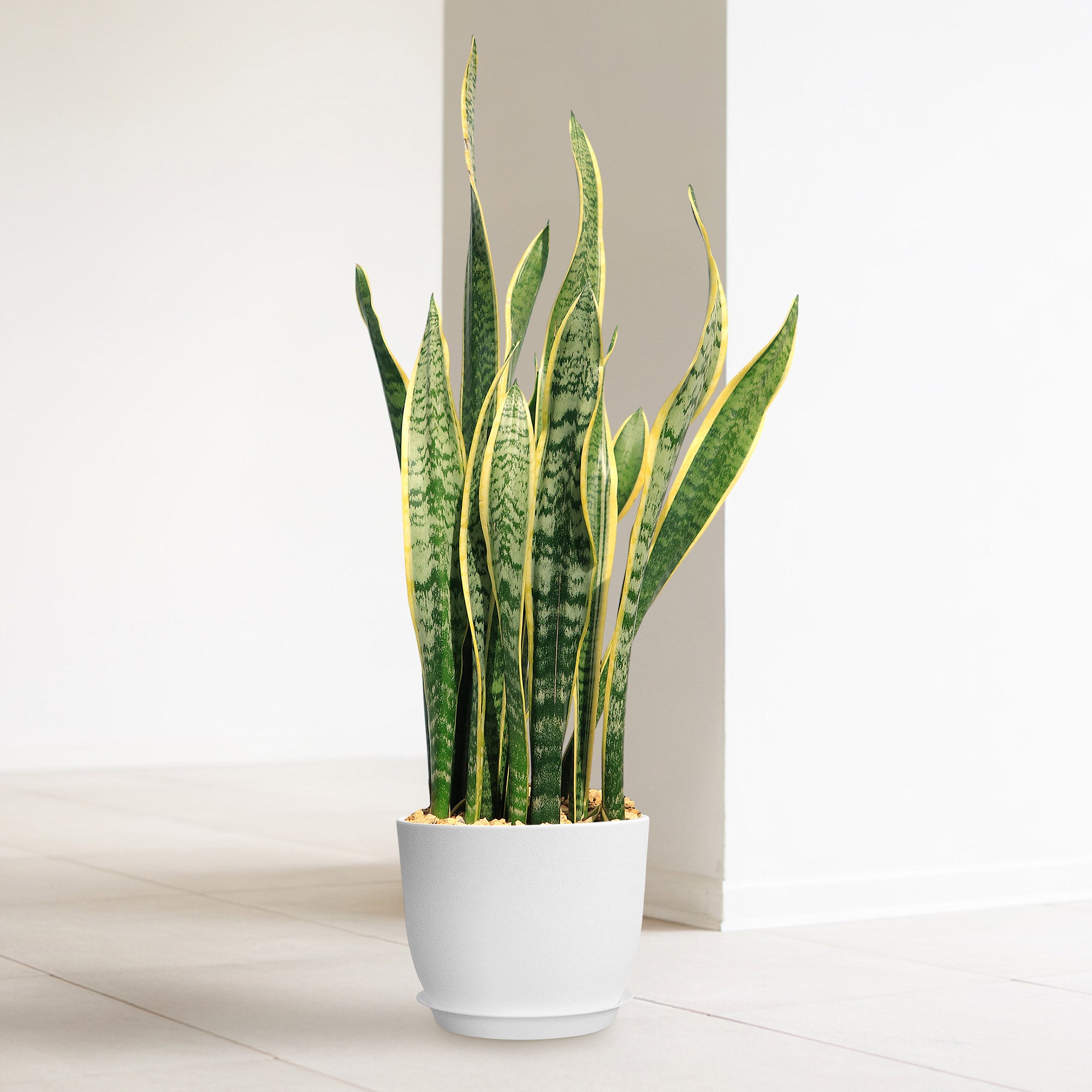
sansevieria in pot

sansevieria in pot Variegated Snake Plant

Sale price$20.12 Regular price$22.36
Save 10%

Shipping Estimate
USA
  • USA
  • CAN

Ships within 48 hours · Estimated delivery Jul 15 - Jul 20

Promo Codes Available:

For Your Every Summer RSVP, with Code: SUMMER15

Description

sansevieria in pot Variegated Snake PlantIntroducing the Sansevieria laurentii, known as the variegated snake plant, is one of the most popular snake plant varieties. Native to Tropical West Africa, the Sansevieria laurentii has several other common names, such as snake plant laurentii, variegated mother in law's tongue plant, Sansevieria trifasciata laurentii, or striped snake plant. The Sansevieria laurentii differs from the other main type of snake plant, Sansevieria zeylanica because of

Introducing the Sansevieria laurentii, known as the variegated snake plant, is one of the most popular snake plant varieties. Native to Tropical West Africa, the Sansevieria laurentii has several other common names, such as snake plant laurentii, variegated mother-in-law's tongue plant, Sansevieria trifasciata laurentii, or striped snake plant.


The Sansevieria laurentii differs from the other main type of snake plant, Sansevieria zeylanica because of its green leaves with yellow striped edges and larger size.

The plant has tall, rigid sword-like leaves that grow upright and can reach up to 8 feet tall.

Its leaves provide a striking contrast between their dark green color and the dazzling gold variegation around the edges. 

The flowers of this variegated snake plant are creamy white, pale green, and bloom from late winter through early spring, making it a true showstopper in any garden. This perennial Sansevieria laurentii succulent is perfect for those looking for a low-maintenance addition to their garden or indoor space.  

Sansevieria is part of our clean air plant collection, which filters airborne toxins. The Laurentii snake plant is a popular plant that can be grown in both rock gardens and landscaping, as well as in decorative pots indoors. It's a versatile plant that adds beauty to outdoor spaces and brings a touch of greenery to indoor environments. 

However, because this snake plant laurentii grows slowly, large plants can be expensive

When and How to Water Your Variegated Snake Plant 

The Variegated Snake Plant is a drought-tolerant succulent that should be watered every 2–3 weeks during spring and summer and only once every 4–5 weeks during fall and winter, allowing the soil to dry completely between waterings.

From March to August, during the growing season, water your Sansevieria laurentii every 2 to 3 weeks, giving just enough water to moisten the root zone. This is when the plant is actively photosynthesizing and may absorb water more quickly, especially in warm, bright indoor conditions. Always ensure excess water drains out fully and never let the pot sit in water.

From September to February, during the dormant season, reduce watering to once every 4 to 5 weeks, or only when the soil is bone dry. The plant’s growth slows down significantly during cooler months, and its water needs decrease accordingly. Overwatering in winter can easily lead to soft, rotting roots or fungal issues.

Thanks to CAM photosynthesis, this snake plant opens its stomata at night, conserving water efficiently throughout the day. This adaptation, along with its thick, moisture-retentive leaves, means it’s better to underwater than overwater. Wrinkling or slight leaf shriveling are early signs it’s time to water, while mushy or yellowing leaves indicate excess moisture and possible root rot.

Light Requirements - Where to Place Your Variegated Snake Plant

If growing indoors, place your Sansevieria succulents directly in front of a west- or south-facing window, where it gets 4-6 hours of bright, indirect light.

If Sansevieria laurentii don't receive enough bright light, their dark green leaves with yellow variegated edges may grow leggy, become paler, and shorten.

So, make your succulent happy and give your variegated snake plant plenty of brighter light.

When growing outdoors, this Sansevieria laurentii prefers full sun to partial shade for at least 4-6 hours but can also tolerate low light conditions, making it a great choice for rooms with limited natural light. Direct sunlight should be avoided because it can burn your variegated snake plant leaves.

Remember, it's important to gradually acclimate it to the outdoor environment to prevent sunburn. Start by placing it in a shaded area and gradually move it to a spot with more sunlight over a few weeks. This will help the plant adjust to the increased light levels.

Optimal Soil & Fertilizer Needs 

The Sansevieria laurentii snake plant thrives in well-drained soil and should be fertilized once a year in spring. Moisture can be a real killer, leading to root and stem rot in no time. But fear not, my fellow green thumbs! Planet Desert has got your back with our specialized succulents potting mix that includes organic mycorrhizae – perfect for promoting healthy roots and happy Sansevieria laurentii. 

When it comes to fertilizing your variegated snake plant, it only needs a small amount of fertilizer applied once a year in the spring. Succulents prefer a fertilizer with lower doses of NPK, with a maximum ratio of 5-10-5 that is higher in phosphorus than nitrogen. 

Hardiness Zones & More 

In the United States, this is mostly an indoor plant, but if you live in southern Florida or Hawaii, then you can cultivate it outdoors in USDA zones 9-11. 

This plant thrives in dry, semi-tropical conditions, but it goes dormant when temperatures dip, slowing its growth significantly.

If exposed to prolonged cold or frost, especially below 50°F, the leaves may suffer scarring, mushiness, or collapse.

Even in zones where outdoor cultivation is possible, it’s best to grow them in containers so they can be easily relocated when temperatures become unfavorable.

How to Grow Variegated Snake Plant Best Indoors

To grow your Variegated Snake Plant successfully indoors, maintain a warm, stable environment with temperatures between 65°F and 75°F, which closely mimics its native tropical climate. This plant does not tolerate frost or cold drafts, so it should always be kept away from open windows in winter or air conditioning vents. High humidity can also be problematic, as it increases the risk of rot, so aim for dry, well-ventilated indoor conditions. Its upright, sword-shaped leaves not only make it a great vertical accent in tight spaces but also help purify indoor air, making it both a functional and decorative choice for homes and offices.

Wildlife - Variegated Snake Plant Attracts the Following Friendly Pollinators

The variegated snake plant produces small, fragrant flowers that attract a variety of friendly pollinators such as bees, butterflies, and hummingbirds. These pollinators are essential for the plant's reproduction and play a crucial role in maintaining biodiversity in the ecosystem.

Butterflies
Bees
Hummingbirds
Lady Bugs
Multi Pollinators
Other Birds

According to ASPCA, the variegated snake plant is mildly toxic to humans and pets if ingested. The entire plant contains saponins, which can cause gastrointestinal issues like nausea, vomiting, and diarrhea. However, it is safe to touch and handle, making it a popular choice for indoor decoration in homes with pets or children.

How to Propagate Your Sanseveria laurentii

The Sansevieria laurentii can be propagated through division or leaf cuttings. To propagate through division, carefully separate the plant into smaller sections with roots attached and replant them in fresh soil. For leaf cuttings, simply cut a healthy leaf into smaller sections and plant them in soil to root.

Key Takeaways

  1. The variegated snake plant stores water in its thick, upright leaves, making it extremely drought-tolerant and perfect for forgetful waterers or low-maintenance homes.
  2. Its striking vertical foliage is edged with golden-yellow margins, giving it a bold, architectural look that stands out in any modern interior.
  3. This plant improves indoor air quality by filtering toxins like formaldehyde and benzene, making it both beautiful and functional for home or office spaces.
  4. Thanks to CAM (Crassulacean Acid Metabolism) photosynthesis, it absorbs carbon dioxide at night, making it one of the few houseplants ideal for bedroom air purification.
  5. It’s nearly indestructible in the right pot, tolerating low light, dry air, and minimal care, yet leaf damage can occur if temperatures drop below 50°F.

Final Thoughts

Overall, the Sansevieria Laurentii (snake plant laurentii) is a beautiful and resilient plant suitable for indoor spaces due to its ability to tolerate various conditions. Its upright leaves and variegated pattern add elegance to any room. It is low-maintenance, thrives in well-draining soil, and prefers bright, indirect light. Watering should be minimal to prevent overwatering. It can withstand neglect and drought periods. Sansevieria Laurentii's air-purifying qualities make it an excellent choice for improving indoor air quality.  

With the easy-to-care-for variegated snake plant - Sansevieria laurentii, you'll start to spend less time maintaining your garden and more time taking in its beauty! 

You may also like the other popular snake plant varieties, including the moonshine snake plant, the mother-in-laws snake plant, the Cylindrical snake plant, and the Zeylanica snake plant.

Shipping Notes
  • Free Standard Shipping on $100+ Orders to the USA.
  • Except Preorder products are shipped in 48 hours.
  • Delivery to the USA:
  1. Standard Shipping : 3-10 business days
  • If time is of the essence, please consider selecting expedited delivery for faster service.
Exchange/Return Notes
  • We offer a 30-day return/exchange service after receiving.
  • Final sale items are not eligible for returns or exchanges.
  • To process your return/exchange, please contact us at [email protected]
  • Please click here for more details>>> Return & Exchange Policy
SKU: 83773381738

Discover Niche Categories That Outsell sansevieria in pot

Top-Converting Item to Boost Your Average Order

4.1 ★★★★★
Based on 1809 reviews
Sort
Highest Rating
Newest First
Oldest First
Product Reviews
A
Verified Purchase
Ariel
Charlottesville, US
★★★★★ 3
Not a bad start
Format: Kindle
3 stars Thank you Netgalley and Briar Boleyn for the ARC! A camelot/king Arthur retelling with fae. I was hooked by the idea of this book immediately and was eager to jump into this world. • slow burn • enemies to lovers • who did this to you Morgan Pendragon watched her mother die by her father's hand when she was just eight years old, hiding under the bed. Morgan is believed to have the tainted blood of the fae in her veins and is cast aside so that her fathers illegitimate son, Arthur, can become the king. She's seen his cruel treatment of the fae firsthand, so when he sends her on a journey to find a fae weapon she seizes the opportunity to do more with her life. Along the way, she finds more than she could have imagined. I don't know a whole lot about King Arthur and Camelot but I had a lot of fun with this story! The plot has some similar tropes to popular romantasy books (From blood and ash) but there's enough originality here that it doesn't feel like I'm reading a copy. I liked how the fae were different in appearance than what is typical in most fantasy books I've read. In this book they have blue hair, violet skin and a wide range of other characteristics. I thought that the world building was easy to follow and I could easily immerse myself into this world. After reading the blurb I kept wondering when she was going to go on the journey to find Excalibur and it doesn't happen until around the 45% mark. The story is a bit slow at times but starts to pick up once they begin their journey to find Excalibur. The John Wick style Inn was a fun concept that I enjoyed reading about. There are a lot of similarities to this and FBAA and I would have liked to have it be a little more different, but I'm hoping book two will have the story turn into something of its own. Overall I enjoyed reading this story and I'm looking forward to reading book two especially after that ending.
WAS THIS REVIEW HELPFUL?YesReportShare
Reviewed in the United States on May 27, 2023
J
Verified Purchase
Jeff Gomske
Grantham, US
★★★★★ 5
Astonishing, Fun, Entertaining, Fantastic
Format: Kindle
I consider The Martian my favorite fictional novel of the last 15-20 years. The movie was incredible in that they actually followed the book closer than 99% of other films based on books. It remains my favorite movie of the last 15 years or so as well. I don't know anyone (personally) that loves either of them as much as I do. With that said, I was REALLY looking forward to Artemis. It was good...but, it was certainly not in the same caliber as The Martian was (at least not for me). I enjoyed it a lot, however and appreciated how author Andy Weir chose to go in a completely different direction and not just rehash another similar story, which I am certain would have been great as well. As a result, I was cautious regarding Project Hail Mary. It sounded a little too close to The Martian, but yet, also different in that the circumstances simply could not be more opposite and the stakes so much higher. I'm trying to figure out the best way to summarize without giving too much away from this utterly compelling novel. As I read several reviews, I noticed a recurring theme: SCIENCE. Lots and LOTS of science. Holy cow, they were right. Many years ago I read Apollo 13 and Jim Lovell and his co-writer, try as they might, simply could not dumb down Orbital Mechanics anywhere near enough for me to have even a minor clue as to what they were attempting to say...I just skipped 90% of it and hoped that the sentences written afterwards, would help to make sense of what I had just skimmed over. I'm a lot of things, but a math wizard is definitely not one of them. Michael Crichton (Jurassic Park) had an amazing talent for dumbing-down the science of what he was trying to explain in ways that genuinely made sense (most of the time). Not everyone has this talent, and I would say Andy Weir falls squarely in between. He's certainly better than Jim Lovell, but not quite as good as Crichton. But then again, outside of a science textbook, I haven't really read anything with quite as MUCH science as Project Hail Mary. So maybe he's just as good, but he just puts more science into his books than Crichton, maybe that's it...? Either way, be prepared for a lot of astonishingly interesting science within the pages of this novel...and I DO mean a LOT. I don't say this to make you wary or steer you away...on the contrary, Andy Weir has a special talent for making hard science truly entertaining. The book opens with an absolutely amazing and frightening premise: an astronaut awakes from an induced coma to find the only other two people on board have died at some point along their journey...but it gets worse. He has no idea who he is, or why he's on the ship, and oh yeah, they look to be a long way from home. A really, REALLY long way from home. In fact, the sun he sees isn't actually OUR sun at all. He's managed to leave our solar system entirely. And he has no idea why. ((Minor Spoilers)) The book goes through some clever flash-backs, which set the stage for why the mission happens, and slowly, carefully explains how they managed to get so far away from earth in such a short amount of time. Basically, earth's sun seems to be dying. At the rate of decay, we have maybe 19 years left before the gradual cooling has catastrophic consequences resulting in the death of billions (best guess). Why the sun is dimming is quite the conundrum in the first place. Turns out it really isn't dying, it's being killed by an outside source...which turns out to be easily the greatest find in history. It's alien life, and they are using the sun for food, essentially. It's alien life, but not intelligent life. But still, wow! ALIENS, right??? After this monumental discovery, and some tremendous research done by the most improbable scientist, the investigation into what is happening and why and what to do about it expands exponentially to other nations in order to pool all the resources possible to hopefully save the sun, and by extension, the human race as well. They learn. A LOT. A plan is put together, and with the help of the newly discovered microscopic alien life, which can also double as a power source (along with a few other nifty surprises), they begin to create one last, Hail Mary that could very well be the last chance we might have to save earth. It's audacious. It's dangerous, and it is absolutely critical that it succeed. As our astronaut's memory slowly unravels, so does his identity: Ryland Grace. He's a teacher on earth. Just a science teacher. Not even a college professor. He's amazingly smart, though. But he's no astronaut...and certainly not one who would volunteer to go on a one-way mission to another solar system to "try" and save humanity. Yet here he is. Alone. light years from earth, trying to solve the biggest riddle in all of human history. Ryland accepts his situation, such as it is, with relative indifference (for the most part). It doesn't matter HOW he got here. He's here now and he may as well use that time to be as productive as possible, right? Along the way, he unravels even more information regarding the microscopic alien life which is slowly dimming our sun during some additional flashbacks. The aliens, dubbed, "Astrophage" are quite the galactic plague as it turns out. Stars all over the galaxy are also losing their light, all due to the little buggers. All that is, except one particular star named, Tau Ceti. Now why would that one star be unaffected by Astrophage, when every single star around it has been affected to some degree. The plan is to go there and figure it out and send the information back, hopefully in time to save the sun before the damage to earth is beyond repair. There is an incredible amount of stuff going on. The story switches from Tau Ceti to flashbacks of how the whole mission was planned and implemented (which is VERY entertaining, especially Director Stratt, who may actually be my favorite character in the entire novel). Weir is becoming quite adept at building tension, and abruptly switching the story from Tau Ceti back to earth and building more of the backstory then switching back to Tau Ceti. Keeping it all in check and most importantly, interesting all while mixing in a healthy dose of science, which I am to understand is pretty much all genuine, is quite the juggling act. I have long known science can be astronomically entertaining (see what I did there?) when done right...but unfortunately very few people in a position to teach science actually know the best way to create that interest in others. I can say without reservation, Andy Weir definitely knows how to do it...at least in written form. There is so much I want to say more regarding this truly phenomenal story, but I simply cannot without ruining a lot of the fun and surprises revealed along the way...and it is killing me to keep it locked in. Though I labeled a spoiler warning earlier, I don't think it gave away any more than what the author himself has revealed in interviews he has done regarding the book, and what you can glean from reading the summary here and just a couple other reviews. Tying all of that science together is truly astonishing to me. The creativity to put it into a novel that is remarkably exciting to read is nothing more than incredible talent. Kudo's to Andy Weir for not just hitting a home run, Project Hail Mary is a Grand Slam all the way. I truly did not want this story to end. By the way, I enjoyed the ending quite a bit. I don't know if everyone will. But it was fine for me. I think the ending screams "sequel" at some point too. A lot was left open-ended (IMO) and I wouldn't mind reading a follow-up to this. It doesn't HAVE to happen, but there are a lot of ways where the story could go if Andy chose to do it. Just sayin'. Just run out and buy this book.
WAS THIS REVIEW HELPFUL?YesReportShare
Reviewed in the United States on May 10, 2021
M
Verified Purchase
Mahlon Everhart
Pawtucket, US
★★★★★ 5
Wonderful
Format: Kindle
The amount of detail in this book is so interesting and the specifics of so much theoretical ideas revolving around true ideas makes it so fun to read. The writer does a great job and describing every situation enough where you get the point but not too much to try to bore you . The book is very easy to follow, keeps you on your toes, was pretty funny to me, and truthfully just a great book for anyone!
WAS THIS REVIEW HELPFUL?YesReportShare
Reviewed in the United States on May 20, 2026
J
Verified Purchase
John Haldane
Charlottesville, US
★★★★★ 4
Read it in 2 days
Format: Paperback
This is science based science fiction. How refreshing to read science without turning the story into horror. Without a plethora of characters, it is easy to remember who is who. The story moves along well enough that I wanted to keep going. It us a p age turner in many respects. All this said, there were too many crises suddenly resolved like some Star Trek episode from 1966. It reached the point where I said to myself, "OK, this doesn't matter. Move along, nothing to see here." There was good humor, some surprising twists, and enough involvement with characters that I didn't want to put it down. As science fiction goes, it was good like pulp stories go. It wasn't like Ursula LeGuin or Robert Heinlein but I would probably pick up the next book he writes.
WAS THIS REVIEW HELPFUL?YesReportShare
Reviewed in the United States on May 21, 2026
K
Verified Purchase
Kindle Customer
Waukegan, US
★★★★★ 5
Excellent story
Format: Kindle
This book is worth your time. It is a great introduction to a variety of scientific disciplines without insulting the reader. It also respects and understands humanity, engineering, history and political science. Then it lays that foundation to tell the story of a unique friendship of two beings with mutual goals who have to communicate and problem solve together. Along the way, you can really contrast how Grace and Rocky do it, vice the Hail Mary team did it.
WAS THIS REVIEW HELPFUL?YesReportShare
Reviewed in the United States on May 22, 2026

recommand products