SKU: 83300734673
meadow grass and flower seed

meadow grass and flower seed California Wild Lawn Seed Mix

Sale price$20.72 Regular price$23.02
Save 10%

Pay in installments of $5.75 with ShopPay, AfterPay and Klarna

Shipping Estimate
USA
  • USA
  • CAN

Ships within 48 hours · Estimated delivery Aug 8 - Aug 13

Promo Codes Available:

For Your Every Summer RSVP, with Code: SUMMER15

Description

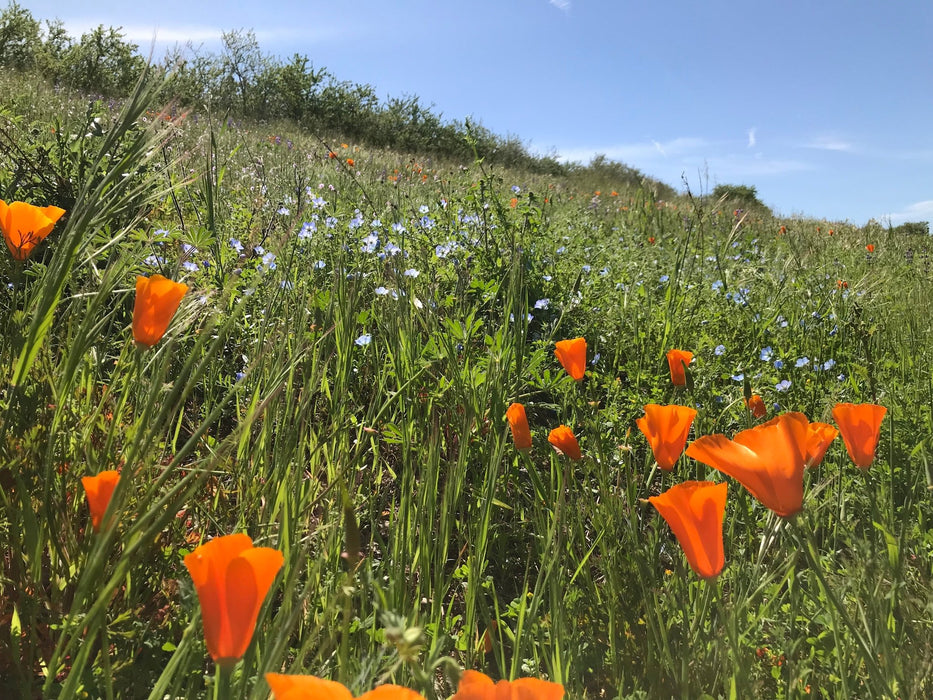
meadow grass and flower seed California Wild Lawn Seed MixA low grow, low water, low maintenance, fire wise, wildflower and native grass lawn that supports pollinators. Inspired by the super bloom meadows of California, we developed this as an alternative to traditional lawns. Unlike non native turf grass (with its high water requirements and low ecological value), our California Wild Lawn provides: Native grasses and wildflowers comprising a low stature meadow that you can actually walk on. Infrequent

A low-grow, low-water, low-maintenance, fire-wise, wildflower and native grass lawn that supports pollinators.

Inspired by the super-bloom meadows of California, we developed this as an alternative to traditional lawns.

Unlike non-native turf grass (with its high-water requirements and low ecological value), our California Wild Lawn provides:

  • Native grasses and wildflowers comprising a low-stature meadow that you can actually walk on. 
  • Infrequent mowing. Cut the lawn low at the beginning of the summer dry season to eliminate combustible biomass, in periods of abundant rainfall, let it grow lush with flowers.
  • A water-smart ground cover that does not require irrigation beyond initial establishment -- in the event of a drought, just mow it low and let it remain dormant. Life will spring back when natural rains return.
  • A dazzling color display that feeds native bees, butterflies, and songbirds, and richly textured native grass that resemble a wild grassland.

Mix Composition:

Re-Seeding Annual Wildflowers (49%): California Goldfields (Lasthenia californica), Five Spot (Nemophila maculata), Red Maids (Calandrinia ciliata), Farewell to Spring (Clarkia amoena), Tomcat Clover (Trifolium wildenovii), Tidy Tips (Layia platyglossa), Chinese Houses (Collinsia heterophylla), Bird’s Eye (Gilia tricolor), Bicolor Lupine (Lupinus bicolor), California Bluebell (Phacelia campanularia), Dwarf California Poppy (Eschscholzia caespitosa), Foothill Clover (Trifolium ciliolatum), Maiden Clover (Trifolium microcephalum), Baby Blue Eyes (Nemophila menziesii), Owl’s Clover (Castilleja exserta), Goldfields (Lasthenia glabrata)

Perennial Wildflowers (6%): Springbank Clover (Trifolium wormskioldii), Perennial California Poppy (Eschscholzia californica var. Martima), turf-type Western yarrow (Achillea millefolium ‘Yaak’)

Native Grasses (55%): Seashore Bentgrass (Agrostis pallens), Three Week Fescue (Festuca microstachys), Idaho Fescue (Festuca idahoensis), Molate Red Fescue (Festuca rubra ‘Molate’), California Oatgrass (Danthonia californica), Western Fescue (Festuca occidentalis), Prairie Junegrass (Koeleria macrantha)

Appropriate Range: This mix is well adapted to most locations from Southern Oregon through Southern California, at elevations ranging from sea-level to about 3,000 feet, and areas with an average of 10 or more inches of annual precipitation. (Note this mix will do okay in dry areas, such as the southern San Joaquin Valley, but may need supplemental irrigation for establishment).

Butterfly Host Plants: The various plants in this mix are likely caterpillar host plants for the following butterflies: Springbank Clover, Maiden Clover, Foothill Clover and Tomcat Clover: western cloudywing (Thorybes diversus), Queen Alexandra’s sulphur (Colias alexandra), Shasta blue (Plebejus shasta), greenish blue (Plebejus saepiolus), Chinese Houses, Owl’s Clover, and Farewell to Spring: Pacific green sphinx moth (Proserpinus lucidus), Grasses: sandhill skipper (Polites sabuleti), roadside skipper (Amblyscirtes vialis), Sonora skipper (Polites sonora), Linsey’s skipper (Hesperia lindseyi), western branded skipper (Hesperia colorado).

Establishment Recommendations: This mix is best established from Autumn through late Winter in most locations, but can be started at other times with supplemental irrigation during initial establishment. (If established with supplemental irrigation, watering should be discontinued at the beginning of the next rainy season).

Seed should be surface-scattered directly onto well-prepared bare-ground. Existing lawns can be removed and replaced with this mix by using a sod-cutter, herbicides, or by smothering with tarps or cardboard. Please see our basic site preparation guidelines here for an overview. Note that new planting sites (where there previously was no lawn) should be largely free of competing weed seed such as cheatgrass and may need several seasons of preparation to create a clean seed bed.

Maintenance and Fire Notes: While the species in this seed mix are relatively low stature, in conditions with excellent soil fertility and moisture, the mature flowering canopy can reach more that 18-inches in height. Selective cutting with secateurs, a scythe, or string trimmer can manage height expectations during the growing season.

Note that while this wild lawn is great alternative to traditional lawns and can tolerate occasional foot traffic, it is not as durable as non-native turf grass. We do not recommend this mix for high-traffic areas, including areas with significant pet activity.

Natural California grasslands largely go dormant in summer with the onset of the dry season. To reduce fire-risk, we recommend cutting down the wild lawn after flowering, and before the lawn completely dries out. (Mowing to about 4-inches is ideal, and rough cutting with a scythe is an excellent, wildlife-friendly option). The mowed biomass should be either cut and bagged, or raked up and removed from the site. (Note that to preserve small invertebrate life in the lawn clippings, the mowed material can be composted in a safe nearby location and occasionally watered to reduce combustibility and enhance composting efficiency.

This list is informed by fire-wise native plant guidelines developed by the Fire Safe Council of San Diego, the Fire Safe Council for Monterey County, the Resource Conservation District of Santa Cruz County, and the City of Anaheim Fire & Rescue. We have intentionally selected plants for their low-fire risk benefits.

With sufficient heat and dry conditions however, any landscape plants are combustible. For this reason, we recommend consulting fire-wise resources for maintaining a defensible space near structures. Core principles to consider include reducing vegetation immediately adjacent to homes and buildings, and maintaining vertical spacing between ground vegetation and the lower canopy of trees and shrubs so that ground-based fires cannot jump to low-hanging tree branches.

Note that by cutting your lawn after flowering, you increase the potential for your wildflowers to reseed themselves. However, some native wildflowers naturally decline in abundance over time. To increase the abundance of your favorite flowers, your wild lawn can be periodically (every few years) mowed low to the ground re-seeded with select wildflower species.

Seed Mix Weight: 1-pound (enough to cover about 800 to 1000 square feet).


Shipping Notes
  • Free Standard Shipping on $100+ Orders to the USA.
  • Except Preorder products are shipped in 48 hours.
  • Delivery to the USA:
  1. Standard Shipping : 3-10 business days
  • If time is of the essence, please consider selecting expedited delivery for faster service.
Exchange/Return Notes
  • We offer a 30-day return/exchange service after receiving.
  • Final sale items are not eligible for returns or exchanges.
  • To process your return/exchange, please contact us at [email protected]
  • Please click here for more details>>> Return & Exchange Policy
SKU: 83300734673

Discover Niche Categories That Outsell meadow grass and flower seed

Top-Converting Item to Boost Your Average Order

4.6 ★★★★★
Based on 16 reviews
Sort
Highest Rating
Newest First
Oldest First
Product Reviews
A
Verified Purchase
Anthony
Belleville, US
★★★★★ 5
Yup. It's MCT (AFAIK), and its affordable!
Size: 32 Fl Oz (Pack of 1)
Great stuff. Great price. Great bottle! Packaged well, and the bottle design is flawless. It comes with two caps, one traditional cap style, and one hinged with a functional pour spout that prevents getting oil ALL over the bottle and ultimately EVERYTHING else like some other brands I've used in the past. Can't beat the price. Unfortunately, I cannot give a qualitative review as to the quality, as my testing capabilities are limited and any attempt to do so would be highly speculative. However, there is nothing obviously different (good/bad) about this verses competitor products. I will be purchasing regularly! :) ---------Opinion/Observation on overall performance balance for the constrained budget. -------- I think that the largest gain/loss is going to be your overall dietary consumption of quality fats, and reduction in carbs consumed and removal of sugars . E.g, it doesn't matter if your consuming an "metabolically optimized C8 isolated MCT oil" in the morning if you loading up on low quality fats in the afternoon, or if your other ducks are out of line (read: sleep, exercise and greater diet). Your better off spending less on your MCT, and more on your other needs to optimize your equation. In my personal case, I find being able to liberally use a cheap MCT (Viva) in larger quantities dynamically as needed throughout the day to keep myself energized and focused on the task at hand is a much better solution for efficiency than having to "ration" out a C8 isolate. Though I probably spend just as much if not more by using it this way, by being able to consume at a higher quantity, overall performance is greater in this case. Additionally, when consuming with other foods and metabolic efficiency and flavour is not as paramount (or when coconut would taste good), I'll opt for a quality coconut oil, as its also marginally cheaper per ounce. (about 13-15$/32oz compared to 18-20$/32oz for MCT). I have used HealthWorks Coconut oil in the past, and it was absolutely delicious. I recently got Kirkland (as on inspection it seemed to have the same qualities) for pennies on the dollar; but it tastes burnt, so I'm not sure if it was a batch issue, warehouse storage, or simply there processing methods but its defiantly not up to par in a taste test. I'll most likely try Viva in the future, as I've been impressed with them so far. Takeaway: Great product if you like to use a lot of MCT! Just make sure your micros (vitamins and minerals) are in check if you exceed the 50% fat macro level. :)
WAS THIS REVIEW HELPFUL?YesReportShare
Reviewed in the United States on October 26, 2016
D
Verified Purchase
David Burt
Phoenix, US
★★★★★ 5
flavor, healthy
Size: 32 Fl Oz (Pack of 1)
Ok, this oil is perfect I've used it in baking and raw desserts, coffee, and shakes It last a long time and fid not go bad I would reccomend
WAS THIS REVIEW HELPFUL?YesReportShare
Reviewed in the United States on March 30, 2026
K
Verified Purchase
Kieran McCarty
Draper, US
★★★★★ 5
Takes the best from coconut oil, leaves the rest
Size: 32 Fl Oz (Pack of 1)
Regular coconut oil is recommended on paleo and keto diets, but it has a strong flavor and its solidity at room temperature means you can’t really use it on cold foods. This MCT oil derived from organic coconuts is a great solution for salad dressings, smoothies, and bulletproof coffee (even iced coffee!) that is vegan (instead of with butter) and more efficient at giving you energy than with coconut oil. Viva MCT Oil contains mostly Caprylic and Capric Acids, two of the three MCTs that are more efficiently converted to energy (the other one, Caproic Acid, is sort of unpleasant tasting, so they don’t include it in this mix) and very little Lauric Acid, which is a somewhat longer chain that takes longer to break down — some say it shouldn’t even be considered an MCT. Plain Coconut oil is about 75% Lauric Acid, so this oil is much more efficient in conversion to ketones for energy. It basically takes the best things in coconut oil and leaves the stuff that is less useful for ketosis. And unlike some MCT oils, Viva’s is derived only from (organic, non-GMO) Coconut oil, not Palm oil, so you don’t have to worry about contributing to deforestation in Indonesia and destruction of orangutan and tiger habitat. Although coconuts also can adversely affect ecosystems to some extent because birds don’t nest in them, thereby depriving the surrounding soil of the resupplied nutrients in bird guano, the trees take longer to grow than oil palms, so it’s less worth it to tear down forest to plant them, and there are industry consortiums dedicated to making coconut farms sustainable and eco sensitive. Although I like the flavor of coconut, there are some things I don’t want it in. For all of those, there’s Viva MCT Oil. I have asked the company if it would affect the effectiveness if I used it to cook with, there’s nothing on the package that indicates one way or the other. I’ll update this review when I get an answer.
WAS THIS REVIEW HELPFUL?YesReportShare
Reviewed in the United States on May 25, 2019
C
Verified Purchase
Customer
Louisville, US
★★★★★ 5
Purchase or perish.
Format: Paperback, Format: Paperback
I don't think Mike can produce anything below 5 stars. In his recent Christmas episode on the Naked Bible Podcast I was a bit wary of listening to it. I realize this is a review of his book here, but let me make my point. The problem with not wanting to listen to his Christmas episode is that I don't really care if Christmas was/is a pagan holiday. So, honestly, it wasn't appealing to me. Somehow I ended up listening to it, and I'm telling you the amount of information he crammed in there was FASCINATING. I'm not kidding. I was so tired of hearing that subject (because I've been born and raised into Christianity), but Mike and Trey did their thing and it had me on the edge of my metaphorical seat the entire time. If you listen to that episode (Naked Bible Episode 195) you'll see exactly what I'm talking about. And what's the point of all that I just said? It's that Mike doesn't do anything half way. All that he puts out is serious work that is worthy of much consideration. No Hillary v. Trump fact checking here (though I'm sure he'd encourage you to research what he's saying). The point is, however, that not everyone has the training that he or his contemporaries have. And THAT is exactly why it is paramount that we rely upon scholars who have said extensive training. I challenge you with this (something I've challenged myself to accept): You essentially know nothing about the Bible if you don't have not just Heiser's background, but other scholars such as John H. Walton. There are many to list, but Walton would be a good companion to list next to Heiser. If you're the lay-person, do yourself a favor and pick up this work, or The Unseen Realm (or both!) and any of Walton's work. Open up your mind and challenge yourself to realize that unless you are incredibly familiar with the Ancient Near East's way of life and thought processes, then it's highly likely that you don't actually understand what is going on when you read the Bible. Enter "The Bible Unfiltered." Considerations for the seminary student: This is a great book for those who need a quick reference on a particular subject. Heiser's name is well known, and thus to reference this book in one's papers, even for a one-liner, is to reference legitimate scholarship. I'm not advocating that one does one's entire paper off of just one chapter from this book, but my point is more-so that with Heiser's reputation it will be known that you're not quoting Joe Scholar who earned his PhD in I Do What I Want. If you know Mike then you know that he's done a lot of work to present to you CONTEXTUAL research on any given listed topic. For that alone the price is worth it (though it undoubtedly cost him more to do the research that it does for us to purchase the book). Considerations for the lay-person: 1. On p. 7, Heiser says, "If Bible study doesn't seem like work to you, you aren't really doing it." Yes, that's harsh, but so was Phinehas, Peter, Paul, and Jesus. (Even Bonhoeffer was harsh in his "The Cost of Discipleship")! Over and over again Heiser says on his podcast that Bible reading is not actually Bible STUDY (not yelling, I just don't have italics in this comment box). 2. This book is great for having a quick reference for subjects. You do not have to read the book in order to understand the content of any given chapter. I use this book to help direct me to other scriptures that I can't seem to remember. Here, Heiser treats topics with brevity, yet with depth at the same time--depth that stems from years of immersing hisself in the original cultural context, the surrounding culture's contexts, and original languages of the Bible. In other words, this book will act, for the lay person, as an appetizer that gets you excited for the full meal and subsequently spark a desire within you to finally take seriously contextual Bible study. If you've never read Heiser's stuff before, this is a great place for you to get introduced to his work. From here I'd recommend getting The Unseen Realm, and then Reversing Hermon. Follow all his other works at drmsh.com, nakedbiblepodcast.com, and moreunseenrealm.com (I'm not getting paid to say all of this). Considerations for the scholar: Rid yourself of your presuppositions, get with the times, and adopt the supernatural worldview of the Bible's authors, because yours isn't supernatural enough. (Can that be considered speaking the truth in love?...) (Pictures won't rotate for some reason. Sorry!). My hand on the book next to the Schuyler Bible shows the size of the book.
WAS THIS REVIEW HELPFUL?YesReportShare
Reviewed in the United States on January 3, 2018
P
Verified Purchase
Pastor Jamie Strickler
Cuba, US
★★★★★ 5
Excellent Resource
Format: Paperback
Heiser is always top notch!
WAS THIS REVIEW HELPFUL?YesReportShare
Reviewed in the United States on May 22, 2026

recommand products