SKU: 69696567629
plump succulents

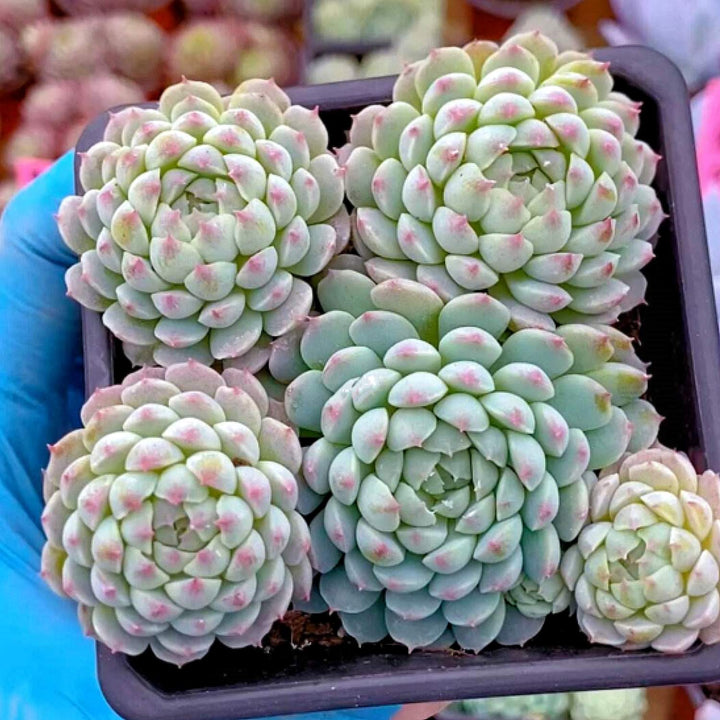
plump succulents Echeveria 'Ball of Fat'

Sale price$21.62 Regular price$24.02
Save 10%

Shipping Estimate
USA
  • USA
  • CAN

Ships within 48 hours · Estimated delivery Jul 15 - Jul 20

Promo Codes Available:

For Your Every Summer RSVP, with Code: SUMMER15

Description

plump succulents Echeveria 'Ball of Fat'About Echeveria 'Ball of Fat' Echeveria 'Ball of Fat' is a hybrid succulent cross between Echeveria Minima and Echeveria Elegans Alba. Its thin leaves form a tight, compact rosette ball when it thrives, making it charming and attractive. However, if this succulent doesn't receive enough sun exposure, it is prone to stretch out and grow leggy, which causes the white and pink colors to fade and turn green. Inheriting the characteristics of Echeveria

About Echeveria 'Ball of Fat'

Echeveria 'Ball of Fat' is a hybrid succulent cross between Echeveria Minima and Echeveria Elegans Alba. Its thin leaves form a tight, compact rosette ball when it thrives, making it charming and attractive. However, if this succulent doesn't receive enough sun exposure, it is prone to stretch out and grow leggy, which causes the white and pink colors to fade and turn green. Inheriting the characteristics of Echeveria Minima, Echeveria Ball of Fat is known for forming clusters and is often used in DIY succulent bouquets.

How to Care for Echeveria 'Ball of Fat'

Sunlight: Echeveria Ball of Fat enjoys at least six hours of bright sunlight daily throughout the year. Growing them in outdoor areas where they can receive ample sunlight is highly recommended. However, in sweltering summers, it is advisable to provide shade or move them to an airy place to prevent sunburn or plant rot.

Water: Watering Echeveria Ball of Fat when the potting soil completely dries out or when the bottom leaves touch soft. Avoid leaving water in the crown of succulents, especially in sweltering summer. Reduce water amount in cold winter as it goes dormant and stops growing.

Soil & Planter: Add one part of green zeolite, two parts of perlite, five parts of maifanitum stone, and two parts of organic materials to make a perfect potting soil mix to grow Echeveria Ball of Fat. Use a wide planter pot to plant this succulent variety, as its clusters require more space.

Temperature: Echeveria Ball of Fat thrives in warm and dry environments with temperatures ranging from 50-77℉. Move the plant indoors before the temperature drops to 32℉ as this variety is not a cold hardy succulent.

Fertilizer: Replant the succulent with fresh organic soil every spring, which can provide the essential nutrients for them to thrive. Moreover, feeding them with slow-release fertilizer two or three times in spring can also meet the need.

Propagation: Cut off the cluster and do propagation. Before propagation, make sure to disinfect the sharp blade properly. In case the succulent grows too many clusters at the base, you can use a fishing line as another tool to help you complete the job.

More information

Primary color: green
Secondary color: white/pink
Cold hardiness: zone 10~zone 12
Product format: 2" pot
Suitability: balcony, outdoor garden, near window
Propagation: leaf, cluster buds
Special characteristics: easy to cluster

Shipping Notes
  • Free Standard Shipping on $100+ Orders to the USA.
  • Except Preorder products are shipped in 48 hours.
  • Delivery to the USA:
  1. Standard Shipping : 3-10 business days
  • If time is of the essence, please consider selecting expedited delivery for faster service.
Exchange/Return Notes
  • We offer a 30-day return/exchange service after receiving.
  • Final sale items are not eligible for returns or exchanges.
  • To process your return/exchange, please contact us at [email protected]
  • Please click here for more details>>> Return & Exchange Policy
SKU: 69696567629

Discover Niche Categories That Outsell plump succulents

Top-Converting Item to Boost Your Average Order

4.6 ★★★★★
Based on 1790 reviews
Sort
Highest Rating
Newest First
Oldest First
Product Reviews
M
Verified Purchase
Manuel Hinds
Carnegie, US
★★★★★ 5
A distant mirror of our current problems
Format: Hardcover
The title of this excellent book accurately describes its contents:it is about a battle fought to define a new world order, that which was emerging from the ashes of World War II. The book also conveys the messy complexity of such a historical process--how individual characters interpreted the events around them, realized that they were giving shape to a radically new future, tried to take advantage of them to advance their own personal and national interests, and succeeded in accordance with their intelligence, the cunning of their argumentation, and, above all, the shifts in the real power that supported them. Masterly, Benn Steil makes the reader feel how Keynes and White gradually reached an unspoken and unrecognized agreement regarding the shape that the new world would have, and then fought to gain advantage in that new world--Keynes trying to keep the British Empire paramount in the world order, now based not on the Royal Navy but on Britain's alliance with the United States, the emerging superpower, and White asserting the unimpeded power of the United States. Focusing on one crucial aspect of the new order, money, Steil is able to reenact the human drama of the transfer of world power from Britain to the United States in all orders of life. It is an excellent history book. The book, however, goes beyond history as the narration and understanding of past events. When reading it, there is an eerie feeling that you are reading about current events. The process that led to Bretton Woods started thirty years before, with World War I and the end of the classical gold standard. When the war ended, a new monetary system was created, which was called the gold exchange standard. It resembled but emasculated the power of the old gold standard to keep monetary order in the world at large. This new system gave central banks the power to create money independently of the international consequences of doing it. With time, central banks abused this power, created a boom in the 1920s and then a depression in the 1930s. Bretton Woods was convened to reintroduce order in the monetary world. Like the gold standard of old, the new system created there was tied to gold in an effort to ensure stability. Yet, it also allowed central banks freedom to create money under certain circumstances. As it happened in the 1920s and 1930s, central banks abused their power, blew up the international system (in this case the Bretton Woods system) and then led the world into a series of booms and busts that has not ended as yet. A new monetary order will be needed to avoid worldwide inflation and protracted recessions. To understand the issues that will be crucial to give shape to this new monetary order it will be necessary to revisit the making of Bretton Woods in detail. There is no better way to understand these issues that Ben Steil's The Battle of Bretton Woods. Thus, in addition to being an excellent history book, it is also an excellent book about current events. Full disclosure: I wrote a previous book with Benn Steil: Money, Markets and Sovereignty (Yale University Press, 2009).
WAS THIS REVIEW HELPFUL?YesReportShare
Reviewed in the United States on May 28, 2013
D
Verified Purchase
djwatkins487
Boise, US
★★★★★ 5
The Battle of Bretton Woods
Format: Hardcover
From the growing reliance upon international finance and the devastating repercussions of two World Wars, Steil weaves together an important narrative that tells the story of America's rise to the world stage as a major power. Britain's reign of dominance comes to an abrupt end under the weight of the Second World War and the dependence of their territories. Reliance on foreign aid and mounting debt put Britain in a precarious situation for which the United States capitalized on to secure its place as the dominant world power. Through the ideas and experiences of two brilliant economists, Harry White and John Keynes, were guided through the creation and implementation of an economic solution to remedy, and further amalgamate the global financial framework. At Bretton Woods, White and Keynes promote slightly different plans that form the International Monetary Fund and World Bank; organizations designed to monitor, stabilize, and assist international finance. To Britain, and much of the world's chagrin, the organizations are formed in a manner that benefited the United States post-World War Two position as a creditor nation. Dollar dominance in the newly designed financial markets promotes short-term growth for the United States. However, financial mismanagement and over-extension soon lead the U.S. down a path of monetary hardship that ultimately results in our current situation as debtor nations (much like Britain was when the story began). The author ends the narrative by chronicling the effects of Bretton Woods on the United States, Britain, and international finance from the mid-twentieth century to the present. This book tells the remarkable story of America's rise to power through a financial lens. Steil is a wonderful writer who describes complex ideas of monetary policy, international economics, and currency manipulation in such a manner that is easy to understand and leaves the reader wanting more.
WAS THIS REVIEW HELPFUL?YesReportShare
Reviewed in the United States on August 16, 2013
A
Verified Purchase
Alfred H.
Chelsea, US
★★★★★ 5
A concise, readable history of European developments prior to W.W. i.
Format: Paperback
This is part of a 4 volume series on (primarily) European history covering the development of the French and Industrial revolution(s) with particular emphasis on the Belle Epoque that marked the end of nearly 100 years of peace among the European Powers. It covers a variety of topics ranging from the emergence of the working classes; the role of the middle class; industrial capitalism; nationalism; the sciences and the arts; and, even a chapter on the "New Woman". Quite encompassing in its treatment and its analysis of the a period that serves as a background to the twentieth century.
WAS THIS REVIEW HELPFUL?YesReportShare
Reviewed in the United States on August 3, 2018
J
Verified Purchase
Juan Manuel Wills
Grantham, US
★★★★★ 5
Un comentario
Format: Paperback
El mundo burgués generó desarrollos muy importantes para los habitantes de Europa Occidental particularmente; incrementó de manera importante los niveles de vida de una porción significativa de la sociedad, introdujo innovaciones claras en las ciencias, en lo educativo, en el comercio global y en el intercambio entre diferentes culturas. Mejoró la productividad, las comunicaciones, la alimentación......Pero también incorporó consigo tendencias negativas y difíciles que cambiaron para siempre la interrelación entre pares al crearse una diferencia significativa de clases, la alta, burguesa y la trabajadora y proletaria, continuó la discriminación sobre la campesina, estableció el concepto forzado de nacionalismo, transformó a los países mas desarrollados en imperios con ansias de crecimiento y de dominio de los menos preparados, se evidenció la explotación del tercer mundo, se inició el armamentismo y la instigación a la guerra que culminó con la desastrosa confrontación de 1914. El mundo, a partir de ese momento no volverá a ser igual. Todos estos conceptos, esta historia, están amenamente descritos por el autor, con un gran conocimiento de la época y con una inteligente asociación de los acontecimientos para hacer entender al lector sus grandes transformaciones e implicaciones. Como los otros tres libros de la serie, lo recomiendo ampliamente. Permite entender todo la evolución de nuestra civilización en los dos últimos siglos así como la influencia generada por los grandes imperios de la época y sus pensadores
WAS THIS REVIEW HELPFUL?YesReportShare
Reviewed in the United States on November 28, 2011
P
Verified Purchase
Peyman ADL DOUSTI HAGH
West Palm Beach, US
★★★★★ 5
This is a good book to read and understand how the European nations ...
Format: Paperback
This is a good book to read and understand how the European nations deployed their armies around the world to extract natural resources from other nations. Now, we have developing and underdeveloped nations.
WAS THIS REVIEW HELPFUL?YesReportShare
Reviewed in the United States on October 1, 2017

recommand products