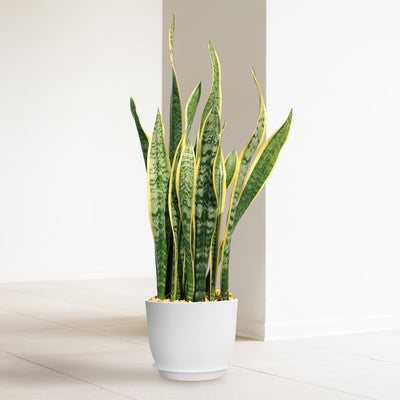
SKU: 65625730626
sansevieria macrophylla variegata

sansevieria macrophylla variegata Variegated Snake Plant

Sale price$18.90 Regular price$21.00
Save 10%

Shipping Estimate
USA
  • USA
  • CAN

Ships within 48 hours · Estimated delivery Jul 11 - Jul 16

Promo Codes Available:

For Your Every Summer RSVP, with Code: SUMMER15

Description

sansevieria macrophylla variegata Variegated Snake PlantIntroducing the Sansevieria laurentii, known as the variegated snake plant, is one of the most popular snake plant varieties. Native to Tropical West Africa, the Sansevieria laurentii has several other common names, such as snake plant laurentii, variegated mother in law's tongue plant, Sansevieria trifasciata laurentii, or striped snake plant. The Sansevieria laurentii differs from the other main type of snake plant, Sansevieria zeylanica because of

Introducing the Sansevieria laurentii, known as the variegated snake plant, is one of the most popular snake plant varieties. Native to Tropical West Africa, the Sansevieria laurentii has several other common names, such as snake plant laurentii, variegated mother-in-law's tongue plant, Sansevieria trifasciata laurentii, or striped snake plant.


The Sansevieria laurentii differs from the other main type of snake plant, Sansevieria zeylanica because of its green leaves with yellow striped edges and larger size.

The plant has tall, rigid sword-like leaves that grow upright and can reach up to 8 feet tall.

Its leaves provide a striking contrast between their dark green color and the dazzling gold variegation around the edges. 

The flowers of this variegated snake plant are creamy white, pale green, and bloom from late winter through early spring, making it a true showstopper in any garden. This perennial Sansevieria laurentii succulent is perfect for those looking for a low-maintenance addition to their garden or indoor space.  

Sansevieria is part of our clean air plant collection, which filters airborne toxins. The Laurentii snake plant is a popular plant that can be grown in both rock gardens and landscaping, as well as in decorative pots indoors. It's a versatile plant that adds beauty to outdoor spaces and brings a touch of greenery to indoor environments. 

However, because this snake plant laurentii grows slowly, large plants can be expensive

When and How to Water Your Variegated Snake Plant 

The Variegated Snake Plant is a drought-tolerant succulent that should be watered every 2–3 weeks during spring and summer and only once every 4–5 weeks during fall and winter, allowing the soil to dry completely between waterings.

From March to August, during the growing season, water your Sansevieria laurentii every 2 to 3 weeks, giving just enough water to moisten the root zone. This is when the plant is actively photosynthesizing and may absorb water more quickly, especially in warm, bright indoor conditions. Always ensure excess water drains out fully and never let the pot sit in water.

From September to February, during the dormant season, reduce watering to once every 4 to 5 weeks, or only when the soil is bone dry. The plant’s growth slows down significantly during cooler months, and its water needs decrease accordingly. Overwatering in winter can easily lead to soft, rotting roots or fungal issues.

Thanks to CAM photosynthesis, this snake plant opens its stomata at night, conserving water efficiently throughout the day. This adaptation, along with its thick, moisture-retentive leaves, means it’s better to underwater than overwater. Wrinkling or slight leaf shriveling are early signs it’s time to water, while mushy or yellowing leaves indicate excess moisture and possible root rot.

Light Requirements - Where to Place Your Variegated Snake Plant

If growing indoors, place your Sansevieria succulents directly in front of a west- or south-facing window, where it gets 4-6 hours of bright, indirect light.

If Sansevieria laurentii don't receive enough bright light, their dark green leaves with yellow variegated edges may grow leggy, become paler, and shorten.

So, make your succulent happy and give your variegated snake plant plenty of brighter light.

When growing outdoors, this Sansevieria laurentii prefers full sun to partial shade for at least 4-6 hours but can also tolerate low light conditions, making it a great choice for rooms with limited natural light. Direct sunlight should be avoided because it can burn your variegated snake plant leaves.

Remember, it's important to gradually acclimate it to the outdoor environment to prevent sunburn. Start by placing it in a shaded area and gradually move it to a spot with more sunlight over a few weeks. This will help the plant adjust to the increased light levels.

Optimal Soil & Fertilizer Needs 

The Sansevieria laurentii snake plant thrives in well-drained soil and should be fertilized once a year in spring. Moisture can be a real killer, leading to root and stem rot in no time. But fear not, my fellow green thumbs! Planet Desert has got your back with our specialized succulents potting mix that includes organic mycorrhizae – perfect for promoting healthy roots and happy Sansevieria laurentii. 

When it comes to fertilizing your variegated snake plant, it only needs a small amount of fertilizer applied once a year in the spring. Succulents prefer a fertilizer with lower doses of NPK, with a maximum ratio of 5-10-5 that is higher in phosphorus than nitrogen. 

Hardiness Zones & More 

In the United States, this is mostly an indoor plant, but if you live in southern Florida or Hawaii, then you can cultivate it outdoors in USDA zones 9-11. 

This plant thrives in dry, semi-tropical conditions, but it goes dormant when temperatures dip, slowing its growth significantly.

If exposed to prolonged cold or frost, especially below 50°F, the leaves may suffer scarring, mushiness, or collapse.

Even in zones where outdoor cultivation is possible, it’s best to grow them in containers so they can be easily relocated when temperatures become unfavorable.

How to Grow Variegated Snake Plant Best Indoors

To grow your Variegated Snake Plant successfully indoors, maintain a warm, stable environment with temperatures between 65°F and 75°F, which closely mimics its native tropical climate. This plant does not tolerate frost or cold drafts, so it should always be kept away from open windows in winter or air conditioning vents. High humidity can also be problematic, as it increases the risk of rot, so aim for dry, well-ventilated indoor conditions. Its upright, sword-shaped leaves not only make it a great vertical accent in tight spaces but also help purify indoor air, making it both a functional and decorative choice for homes and offices.

Wildlife - Variegated Snake Plant Attracts the Following Friendly Pollinators

The variegated snake plant produces small, fragrant flowers that attract a variety of friendly pollinators such as bees, butterflies, and hummingbirds. These pollinators are essential for the plant's reproduction and play a crucial role in maintaining biodiversity in the ecosystem.

Butterflies
Bees
Hummingbirds
Lady Bugs
Multi Pollinators
Other Birds

According to ASPCA, the variegated snake plant is mildly toxic to humans and pets if ingested. The entire plant contains saponins, which can cause gastrointestinal issues like nausea, vomiting, and diarrhea. However, it is safe to touch and handle, making it a popular choice for indoor decoration in homes with pets or children.

How to Propagate Your Sanseveria laurentii

The Sansevieria laurentii can be propagated through division or leaf cuttings. To propagate through division, carefully separate the plant into smaller sections with roots attached and replant them in fresh soil. For leaf cuttings, simply cut a healthy leaf into smaller sections and plant them in soil to root.

Key Takeaways

  1. The variegated snake plant stores water in its thick, upright leaves, making it extremely drought-tolerant and perfect for forgetful waterers or low-maintenance homes.
  2. Its striking vertical foliage is edged with golden-yellow margins, giving it a bold, architectural look that stands out in any modern interior.
  3. This plant improves indoor air quality by filtering toxins like formaldehyde and benzene, making it both beautiful and functional for home or office spaces.
  4. Thanks to CAM (Crassulacean Acid Metabolism) photosynthesis, it absorbs carbon dioxide at night, making it one of the few houseplants ideal for bedroom air purification.
  5. It’s nearly indestructible in the right pot, tolerating low light, dry air, and minimal care, yet leaf damage can occur if temperatures drop below 50°F.

Final Thoughts

Overall, the Sansevieria Laurentii (snake plant laurentii) is a beautiful and resilient plant suitable for indoor spaces due to its ability to tolerate various conditions. Its upright leaves and variegated pattern add elegance to any room. It is low-maintenance, thrives in well-draining soil, and prefers bright, indirect light. Watering should be minimal to prevent overwatering. It can withstand neglect and drought periods. Sansevieria Laurentii's air-purifying qualities make it an excellent choice for improving indoor air quality.  

With the easy-to-care-for variegated snake plant - Sansevieria laurentii, you'll start to spend less time maintaining your garden and more time taking in its beauty! 

You may also like the other popular snake plant varieties, including the moonshine snake plant, the mother-in-laws snake plant, the Cylindrical snake plant, and the Zeylanica snake plant.

Shipping Notes
  • Free Standard Shipping on $100+ Orders to the USA.
  • Except Preorder products are shipped in 48 hours.
  • Delivery to the USA:
  1. Standard Shipping : 3-10 business days
  • If time is of the essence, please consider selecting expedited delivery for faster service.
Exchange/Return Notes
  • We offer a 30-day return/exchange service after receiving.
  • Final sale items are not eligible for returns or exchanges.
  • To process your return/exchange, please contact us at [email protected]
  • Please click here for more details>>> Return & Exchange Policy
SKU: 65625730626

Discover Niche Categories That Outsell sansevieria macrophylla variegata

Top-Converting Item to Boost Your Average Order

4.6 ★★★★★
Based on 1672 reviews
Sort
Highest Rating
Newest First
Oldest First
Product Reviews
M
Verified Purchase
Matthew Wilson
Chelsea, US
★★★★★ 5
Gospel Centered Gold
Format: Kindle
This book essentially takes the Christ centered theology taught by guys like Walter Marshall (Gospel Mystery of Sanctification), Horatius Bonar (The Everlasting Righteousness & God's Way of Holiness) and John Colquhoun (A Treatise on the Law and the Gospel), and it packages it in a way that is easy for anybody to understand and apply in the classroom. I have not come across another book that does this particularly for teaching children. I highly recommend this book for those who are involved in children's ministry (even adult ministry for that matter). It will particularly help those in your youth ministries understand the law/gospel distinction and gospel motivation. Once the teacher understand this, it will begin to permeate his/her lessons.
WAS THIS REVIEW HELPFUL?YesReportShare
Reviewed in the United States on August 22, 2023
S
Verified Purchase
Shelby Pritchard
Houston, US
★★★★★ 4
"Moral reform is not the same as Christian growth."
A while back, a ministry acquaintance of mine decided to impart a little "wisdom" to this children's pastor. His advice? Well, in the context of discussing preaching and teaching, he said: "Kids just need to be told what to do." Explaining, he adding "Obeying parents, reading Bible, that kind of thing." Within context, he was heavily implying that they don't need theology, or the teaching about why we do what we do. Instead, he was settling for simple moralism. As an amusing contrast, I had begun reading Show Them Jesus only shortly before that. Whatever good intentions may have lain in his heart, that acquaintance sadly failed to remember the axiom "Rules, without relationship, breeds rebellion." Show Them Jesus takes the Biblical philosophy that showing children Jesus, and helping them know him, allows morals and behavior to flow naturally from that relationship. Rules that children will want to follow themselves, rather than complain about and find every chance to break or bend, which is inevitable with simple moralism. The book is divided into two sections. The first is "Why Teach The Good News" and the second "How to Teach the Good News." Each chapter within those sections has a title, a subtitle, and a relevant quote. For example Chapter 4 has "The Factory-Preset Fourth Grader" with the subtitle "Because the good news changes hard hearts." While the titles are usually inventive and fun, they are also insightful enough to specifically address the problem and solution offered in that chapter. The basic premise of the book is summed up in a statement made early on. "Rather than coax the kids into temporarily acting better, Joe [a fellow teacher at the author's church] told about Jesus and trusted God to use that message to make the kids become better." The author, upon discovering this, tried it, tested it, and found it to be so true that he wanted to share it with the world. Hence, the book. In the aforementioned Chapter 4, one of my favorite chapters, the author begins with an all too familiar situation. He had just finished teaching on greed, specifically, not being greedy. Next up was snack time, and the class promptly began fighting over who got more cookies. Noting that simply moral teaching just wasn't cutting it, as studies show, and lives display. Taking the time to dissect each of the good reasons we try to motivate good behavior, he finds each lacking when compared with a genuine fascination and love for God. Part 1 absolutely shines in the approachable language, relatable stories, and Biblical evidence. His philosophy is, like the Bible, simple, yet profound. It strips away tradition to reveal the hollow human efforts behind it and instead purposes the solid and soul-transforming power of the Good News of the Gospel. At this point, I was begging to know how to best address this in my own preaching, and eagerly leaped into Part 2. Beginning in chapter 6, the author begins on a slightly wobbly note. He admits he has never been to college, nor received formal training with teaching or biblical interpretation. Sadly, this shows. Chapter 6 covers showing Jesus from the Old Testament, and is populated by as many mountain peaks of beauty as it is valleys of misunderstandings. One of the peaks is his looking at each passage in light of how man has failed (or will fail) through sin, and how God responds to that. This is formally known as Bryan Chappell's "Fallen Condition Focus." (1) Using this, the author rides this principle, not to the modern day, but first, to how Jesus either solved the problem, or offered a better solution than the one in the OT. He does this with one of three questions: "Who God is," "What God does," and "Jesus Solves Problems," This is actually a pretty interesting approach, and one that many teachers would benefit greatly from. He lays incredible emphasis on getting past the human players and looking to God for the lesson to be learned. He even recommends ditching pre-made lessons to try out this "good news" focused approach, an idea I (after reading far too many moralistic and simplistic and topical) I heartily agree with. Later, however, the author writes that each passage can have several themes and main ideas. While that's true to a point, concepts like the "Hermetical Idea" and/or "Exegetical Idea" rely on the fact that passages contain one big idea, and additional elements explain or apply it. He also offers the idea that some OT passages are wrought with a "tension" and incompleteness until Jesus is applied. While this sounds nice, it also means saying that God's Word was incapable of conveying the truth he wanted until thousands of years after it was written. What then of the original, biblical author's intent to his original audience? Sometimes, it seems, in the eagerness to find Jesus, Show Them Jesus misses that God is also, well, God. Using the author's own approach to find how God loved sinners would show how God continued to love them in that way in Jesus, rather than heavily hint that there are/were problems with the Bible and it's stories until 33 AD. Thankfully, the remaining chapters, stepping into Christ's time, then into modern application, obviously don't suffer as much from interpretive issues. Chapter 8 is heavy on practical application of this, not only in teaching, but in other classroom policies. It breaks down class rewards, discipline, corporate worship, and even how to handle misbehavior in light of the "good news" model. It's an incredibly hard-hitting chapter that needs to be read and re-read. The final chapter ends with a reminder to stay the course, even when it doesn't seem to be working, or life is frustrating, or even you yourself struggle with this "good news" focus. Christ is there, he loves you, and he will aid you. The conclusion, featuring a sermon excerpt of Spurgeon's, as his Gospel-centered message inspired D. L. Moody to speak far more often of Christ in his own preaching. This hearkens back to the opening of the book, as there, another teacher inspired the author on his own journey. The book closes by challenging the readers to inspire those around them as they too teach Christ. At it's brightest, Show Them Jesus is a brilliant beacon of hope that has the power to turn the stagnant and ineffective moralism upside down and inside out by reminding Christians of the power of God's good news in Christ. Like a surgical knife, it cuts away at false motivations and selfish desires to do right, and makes way for the Bible's truth to penetrate our hearts. He offers the problem, he offers a solution, and now it's our turn to step up to the plate and follow his lead in showing others Jesus. Notable Quotables: Chapter 1: Because Jesus is All We Need - "The good news means you relate to God based on what Jesus has done for you, not what you’ve done to prove yourself worthy." Chapter 4: The Factory-Preset Fourth Grader - "None of us learns to love anyone—including God—by having someone tell us to love them. You love people because you find them beautiful and lovable, and because they love you. The good thing is that God is far, far more beautiful and love-worthy than anything or anyone else, and he loves us far, far more than anyone else ever could." Chapter 8: The Grapes That Taught Good News - "The kids’ attitudes also confirmed what my gut felt when I first heard about the [Bible] bucks: a classroom culture built on rewards for performance wouldn’t fit the good news I planned to teach. It wouldn’t do to teach that God’s rewards in salvation come freely, by grace, but that rewards in the church come by being good and memorizing verses." Chapter 9: The War on Sin - "Moral reform is not the same as Christian growth." 8/10
WAS THIS REVIEW HELPFUL?YesReportShare
Reviewed in the United States on July 28, 2018
S
Verified Purchase
Salt Lick
Fort Morgan, US
★★★★★ 5
Full of great ideas
Format: Paperback
While not well written, the book does deal with a critical topic, i.e. Why do kids leave the church soon after Sunday school? Jack identifies the singular reason and gives very helpful examples of how to prevent the trend from continuing in your S.S. or home. It shows good hands-on, tried and tested ways, not just theory, to help kids (and adults) fall in love with Jesus. Jack reminds us that as teachers or parents we are totally dependent on the Lord to give us that love. I was also helped by the section on discipline/keeping order in the S.S. I expect to use this book to help improve the teaching and discipline in our S.S, Perhaps, most importantly, personal application is needed first.
WAS THIS REVIEW HELPFUL?YesReportShare
Reviewed in the United States on August 27, 2014
T
Verified Purchase
T. Mora
Chelsea, US
★★★★★ 5
Life changing
Format: Kindle
This is without a doubt the best book I have ever read aside from the Bible. This book taught me more in one day than 25 years in church. I had never been more excited about Jesus or the bible until this book, my son has caught on and loves to talk about it. My one goal as a parent, the only thing I truly want for my son is to have a love for god and an understanding of Gods love for him and I didn't know how to reach that goal until I read this. I prayed about it, and this book came up on my suggestion list with one review, could of been the mans wife, but I just knew that it wasn't a coincidence. I have since read it twice in my kindle and came back to order it in hardcover. Every parent and ministry leader should read this heavenly book. I have never read an author that was so humble, not the humble that makes you smirk but the type that makes you cry because you don't feel like you are being schooled or judged but somehow this man gets right on your level and speaks to your soul. Jack, thank you, for your humility, for your obedience, for your love for God, you have changed our lives and I will always be grateful.
WAS THIS REVIEW HELPFUL?YesReportShare
Reviewed in the United States on August 28, 2014
J
Verified Purchase
Jason Hughes
Charlottesville, US
★★★★★ 5
Relevant to the present day.
Format: Paperback
Joseph Stalin makes the concepts of dialectical and historical materialism accessible to the lay-person in this work. It's short, but dense and does a good job of explaining why the communist party of the 1920s and 1930s chose to pursue the policies they did. A fascinating insight into the fundamental world-view of a controversial world figure. Only 44 pages, but you will likely reread it several times in order to truly internalize its messaging. Thankful to the seller for making this essay available as the works of polarizing political figures are often censored, suppressed or outright banned in many places. The English translation does a fine job of conveying the original essay written in Russian.
WAS THIS REVIEW HELPFUL?YesReportShare
Reviewed in the United States on March 2, 2024

recommand products