SKU: 63322241348
planting boston pickling cucumber seeds

planting boston pickling cucumber seeds Heirloom Boston Pickling Cucumber Seeds | Grow Boston Pickling Cucumbers

Sale price$21.07 Regular price$23.41
Save 10%

Shipping Estimate
USA
  • USA
  • CAN

Ships within 48 hours · Estimated delivery Jul 12 - Jul 17

Promo Codes Available:

For Your Every Summer RSVP, with Code: SUMMER15

Description

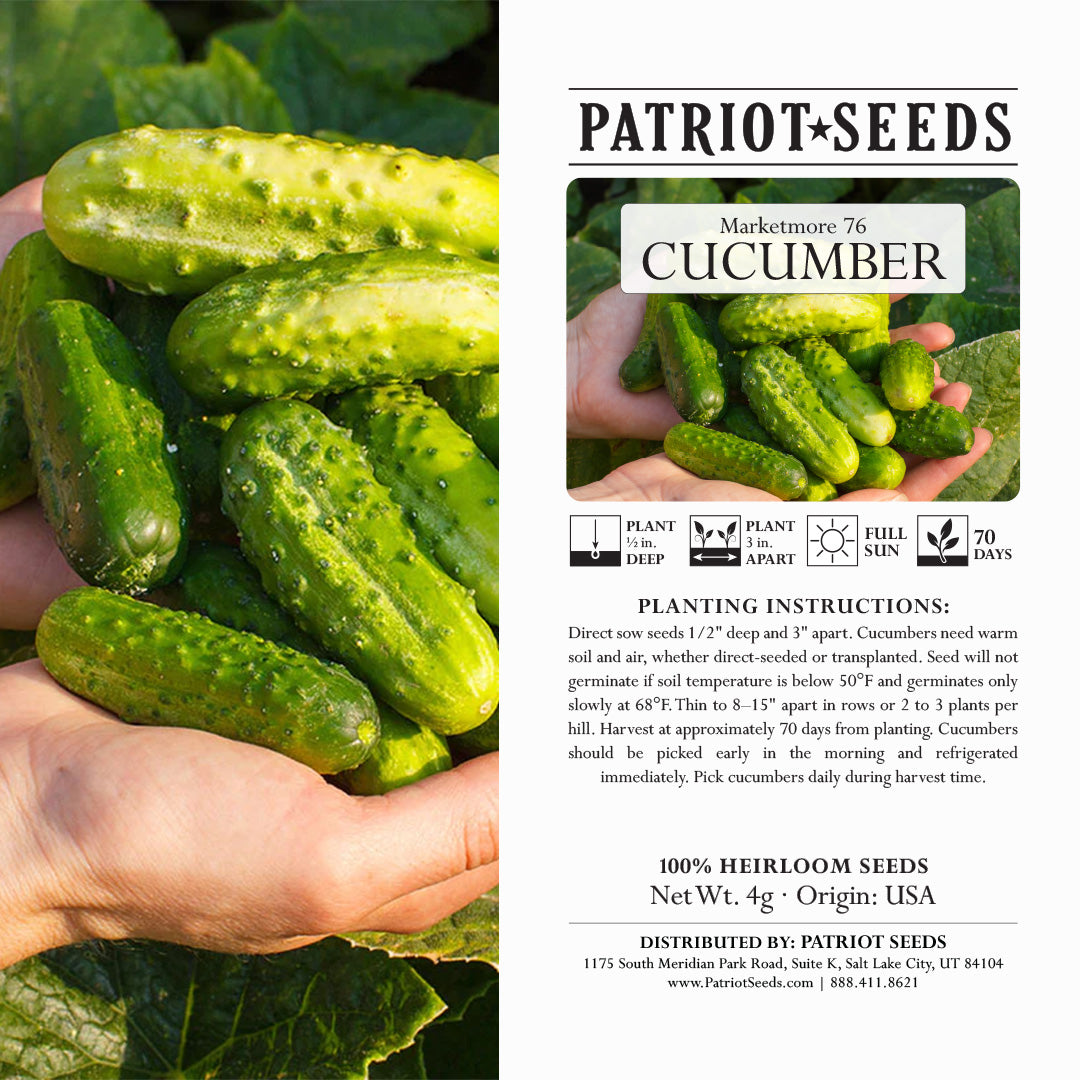
planting boston pickling cucumber seeds Heirloom Boston Pickling Cucumber Seeds | Grow Boston Pickling CucumbersHeirloom Boston Pickling Cucumber (3g) Produces heavy and continual yields of fruits measuring 3 to 6 inches, perfect for pickling. The dark green, blunt ended cucumbers can also be used in salads! The average time to maturity is 57 days. Heirloom Boston Pickling Cucumber Planting Instructions Cucumbers are very sensitive to cold. They need warm soil and air, whether direct seeded or transplanted. Don't rush to plant too early. Seeds will not

Heirloom Boston Pickling Cucumber (3g)

Produces heavy and continual yields of fruits measuring 3 to 6 inches, perfect for pickling.

The dark green, blunt-ended cucumbers can also be used in salads! The average time to maturity is 57 days.

Heirloom Boston Pickling Cucumber Planting Instructions

  • Cucumbers are very sensitive to cold. They need warm soil and air, whether direct seeded or transplanted.
  • Don't rush to plant too early. Seeds will not germinate if soil temperature is below 50°F, and germinate only slowly at 68°F.
  • Direct seed 1 to 1 1/2 inches deep, either in rows (2 inches apart in rows 5 to 6 feet apart) or in hills (3 to 6 seeds per hill, hills spaced 3 to 5 feet apart).
  • Thin to 8 to 15 inches apart in rows or 2 to 3 plants per hill. Snip off plants when thinning to avoid disturbing the roots of nearby plants.
  • For early crops, use black plastic mulch and row covers or other protection to speed warming and protect plants.


    Direct Seed into Holes in Plastic

    Cucumbers seeded into black plastic usually produce larger yields, as well as earlier ones. For extra early crops, start plants inside 3 to 5 weeks before transplanting.

    Sow 3 seeds per pot in 2-inch pots. Thin to 1 or 2 plants per pot. Grow above 70°F during the day and above 60°F at night.

    Be careful when hardening-off plants not to expose them to cold temperatures. Plants with 1 or 2 true leaves transplant best.

    Transplant into black plastic mulch or warm garden soil after danger of frost has passed and weather has settled. Be careful not to damage roots when transplanting.

    If using peat pots, make sure they are saturated before transplanting and completely buried. If using row covers, remove when flowers begin to blossom to assure good pollination.

    For a continuous harvest, make successive plantings every 2 to 3 weeks until about 3 months before the first fall frost date. About 1 month before first frost, start pinching off new flowers so plants channel energy into ripening existing fruit.

    Most cucumbers have both male and female flowers. The male flowers blossom first and produce pollen, but no fruit. Cucumbers are heavy feeders and require fertile soil, nitrogen fertilizer, and/or additions of high-N organic matter sources. Pale, yellowish leaves indicate nitrogen deficiency. Leaf bronzing is a sign of potassium deficiency.

    To reduce pest and disease pressure, do not plant cucumbers where you've grown them in the last 2 years.


    Heirloom Boston Pickling Cucumber Harvesting Instructions

    Generally the time to harvest cucumbers is approximately 60 to 70 days from planting to harvest.

    Cucumbers can be picked at any time there is fruit, depending on the cucumber variety and use of the fruit. Cucumbers should be picked early in the morning and refrigerated immediately.

    The larger a cucumber gets, the more of its flavor is lost, becoming bitter and unpalatable. Cucumbers that have turned yellow are past their peak.

    Once the first cucumbers are ready to be harvested, cut the vine about a 1/2 inch above the fruit. Harvest all of the vegetables before maturity to ensure quality fruits and higher yields.

    During harvest time, cucumbers should be picked at least every other day, with daily harvesting being ideal.


    Saving Seeds

    Slice fruit lengthwise and scrape seeds out with spoon. Allow seeds and jelly-like liquid to sit in jar at room temperature for 3 or 4 days. Fungus will start to form on top. Stir daily.

    Jelly will dissolve and good seeds will sink to bottom while remaining debris and immature seeds can be rinsed away. Spread seeds on a paper towel or screen until dry.

    Shipping Notes
    • Free Standard Shipping on $100+ Orders to the USA.
    • Except Preorder products are shipped in 48 hours.
    • Delivery to the USA:
    1. Standard Shipping : 3-10 business days
    • If time is of the essence, please consider selecting expedited delivery for faster service.
    Exchange/Return Notes
    • We offer a 30-day return/exchange service after receiving.
    • Final sale items are not eligible for returns or exchanges.
    • To process your return/exchange, please contact us at [email protected]
    • Please click here for more details>>> Return & Exchange Policy
    SKU: 63322241348

    Discover Niche Categories That Outsell planting boston pickling cucumber seeds

    Top-Converting Item to Boost Your Average Order

    4.2 ★★★★★
    Based on 85 reviews
    Sort
    Highest Rating
    Newest First
    Oldest First
    Product Reviews
    A
    Verified Purchase
    active reader
    Battle Creek, US
    ★★★★★ 3
    History worth reading
    Format: Kindle
    Presents the history of the Bretton Woods conference, creation of the World Bank and the IMF and global and US politics surrounding the events. Discussion of Harry Dexter White, key US representative at Bretton Woods focuses on claims he was a Soviet spy beginning in the late 1930s and continuing through the conference and into the late 1940s; spends more time than necessary on this even though it is not clear how this affected the outcome of the conference. Most of the discussion of Keynes is on his reputation rather than his economics. Not the definitive history of Bretton Woods.
    WAS THIS REVIEW HELPFUL?YesReportShare
    Reviewed in the United States on July 10, 2013
    J
    Verified Purchase
    John Hemphill
    West Palm Beach, US
    ★★★★★ 4
    Foes at the Top Table
    Format: Kindle
    Those of us who studied economics in the 60s grew up on Keynes. This book provides a fascinating picture of the great man in action. And an equally fascinating picture of the Lend Lease negotiations and then the US hard line at Bretton Woods. Behind this hard line was Harry Woods, of Lithuanian emigre stock, who clawed his way by hard work and intelligence to negotiating prominence in the US Treasury. And who was a Soviet agent of influence. Well written, lucid, and remarkably interesting.
    WAS THIS REVIEW HELPFUL?YesReportShare
    Reviewed in the United States on May 19, 2013
    M
    Verified Purchase
    Manuel Hinds
    Waukegan, US
    ★★★★★ 5
    A distant mirror of our current problems
    Format: Hardcover
    The title of this excellent book accurately describes its contents:it is about a battle fought to define a new world order, that which was emerging from the ashes of World War II. The book also conveys the messy complexity of such a historical process--how individual characters interpreted the events around them, realized that they were giving shape to a radically new future, tried to take advantage of them to advance their own personal and national interests, and succeeded in accordance with their intelligence, the cunning of their argumentation, and, above all, the shifts in the real power that supported them. Masterly, Benn Steil makes the reader feel how Keynes and White gradually reached an unspoken and unrecognized agreement regarding the shape that the new world would have, and then fought to gain advantage in that new world--Keynes trying to keep the British Empire paramount in the world order, now based not on the Royal Navy but on Britain's alliance with the United States, the emerging superpower, and White asserting the unimpeded power of the United States. Focusing on one crucial aspect of the new order, money, Steil is able to reenact the human drama of the transfer of world power from Britain to the United States in all orders of life. It is an excellent history book. The book, however, goes beyond history as the narration and understanding of past events. When reading it, there is an eerie feeling that you are reading about current events. The process that led to Bretton Woods started thirty years before, with World War I and the end of the classical gold standard. When the war ended, a new monetary system was created, which was called the gold exchange standard. It resembled but emasculated the power of the old gold standard to keep monetary order in the world at large. This new system gave central banks the power to create money independently of the international consequences of doing it. With time, central banks abused this power, created a boom in the 1920s and then a depression in the 1930s. Bretton Woods was convened to reintroduce order in the monetary world. Like the gold standard of old, the new system created there was tied to gold in an effort to ensure stability. Yet, it also allowed central banks freedom to create money under certain circumstances. As it happened in the 1920s and 1930s, central banks abused their power, blew up the international system (in this case the Bretton Woods system) and then led the world into a series of booms and busts that has not ended as yet. A new monetary order will be needed to avoid worldwide inflation and protracted recessions. To understand the issues that will be crucial to give shape to this new monetary order it will be necessary to revisit the making of Bretton Woods in detail. There is no better way to understand these issues that Ben Steil's The Battle of Bretton Woods. Thus, in addition to being an excellent history book, it is also an excellent book about current events. Full disclosure: I wrote a previous book with Benn Steil: Money, Markets and Sovereignty (Yale University Press, 2009).
    WAS THIS REVIEW HELPFUL?YesReportShare
    Reviewed in the United States on May 28, 2013
    D
    Verified Purchase
    djwatkins487
    Los Angeles, US
    ★★★★★ 5
    The Battle of Bretton Woods
    Format: Hardcover
    From the growing reliance upon international finance and the devastating repercussions of two World Wars, Steil weaves together an important narrative that tells the story of America's rise to the world stage as a major power. Britain's reign of dominance comes to an abrupt end under the weight of the Second World War and the dependence of their territories. Reliance on foreign aid and mounting debt put Britain in a precarious situation for which the United States capitalized on to secure its place as the dominant world power. Through the ideas and experiences of two brilliant economists, Harry White and John Keynes, were guided through the creation and implementation of an economic solution to remedy, and further amalgamate the global financial framework. At Bretton Woods, White and Keynes promote slightly different plans that form the International Monetary Fund and World Bank; organizations designed to monitor, stabilize, and assist international finance. To Britain, and much of the world's chagrin, the organizations are formed in a manner that benefited the United States post-World War Two position as a creditor nation. Dollar dominance in the newly designed financial markets promotes short-term growth for the United States. However, financial mismanagement and over-extension soon lead the U.S. down a path of monetary hardship that ultimately results in our current situation as debtor nations (much like Britain was when the story began). The author ends the narrative by chronicling the effects of Bretton Woods on the United States, Britain, and international finance from the mid-twentieth century to the present. This book tells the remarkable story of America's rise to power through a financial lens. Steil is a wonderful writer who describes complex ideas of monetary policy, international economics, and currency manipulation in such a manner that is easy to understand and leaves the reader wanting more.
    WAS THIS REVIEW HELPFUL?YesReportShare
    Reviewed in the United States on August 16, 2013
    A
    Verified Purchase
    Alfred H.
    Grantham, US
    ★★★★★ 5
    A concise, readable history of European developments prior to W.W. i.
    Format: Paperback
    This is part of a 4 volume series on (primarily) European history covering the development of the French and Industrial revolution(s) with particular emphasis on the Belle Epoque that marked the end of nearly 100 years of peace among the European Powers. It covers a variety of topics ranging from the emergence of the working classes; the role of the middle class; industrial capitalism; nationalism; the sciences and the arts; and, even a chapter on the "New Woman". Quite encompassing in its treatment and its analysis of the a period that serves as a background to the twentieth century.
    WAS THIS REVIEW HELPFUL?YesReportShare
    Reviewed in the United States on August 3, 2018

    recommand products