SKU: 61577491245
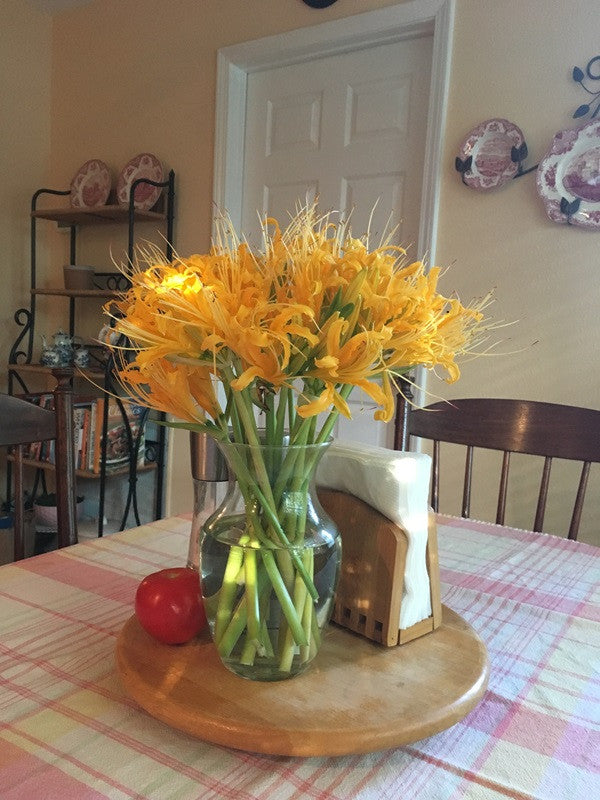
yellow spider lilies lycoris aurea

yellow spider lilies lycoris aurea Yellow Spider Lily (Lycoris aurea)

Sale price$24.26 Regular price$26.96
Save 10%

Shipping Estimate
USA
  • USA
  • CAN

Ships within 48 hours · Estimated delivery Jul 13 - Jul 18

Promo Codes Available:

For Your Every Summer RSVP, with Code: SUMMER15

Description

yellow spider lilies lycoris aurea Yellow Spider Lily (Lycoris aurea)The yellow spider lily or "golden" spider lily is a beauty that glows in the garden with a yellow gold like color. They are often referred to as hurricane lilies because the soaking rains of a hurricane trigger their blooms to emerge about a week after the storm. Softball sized flowers stand atop sturdy 18 24'' stalks. This bulb is for warmer zones and climates (zones 8b 10), but it survives well in our Zone 8 garden by the house in Tyler, TX. In

The yellow spider lily or "golden" spider lily is a beauty that glows in the garden with a yellow-gold-like color. They are often referred to as hurricane lilies because the soaking rains of a hurricane trigger their blooms to emerge about a week after the storm. Softball-sized flowers stand atop sturdy 18-24'' stalks. This bulb is for warmer zones and climates (zones 8b-10), but it survives well in our Zone 8 garden by the house in Tyler, TX. In Houston, Mobile, Orlando, and other cities along the Gulf Coast of the United States, the fall bloom is spectacular.

How they bloom: We know that many of you already know that spider lilies bloom differently than most flowers, but we want to put this here for our new customers. Now is a perfect time to plant spider lilies. Perennial bulbs often need 6-12 months in the ground before they bloom so you are giving the spider lilies that full year in the ground before they will pop up with a bloom on a naked stalk next September/October. Yellow spider lilies usually take 1-2 years planted before presenting foliage or blooms. Your bulbs are developing a strong root system right now to support future foliage and eventually blooms. You might see the foliage this November - April, but don't be concerned if you don't.

Most people still expect to see something growing during the summer months. You won't see anything. These lilies are dormant in the summer. The flowers suddenly appear with the first later summer and early fall rains. One day there is nothing growing and then suddenly you have a surprise, a fully blooming flower! That is why they are called "Surprise lilies". Yellow spider lilies act very similarly to red spider lilies, schoolhouse lilies, and naked ladies. Simply put, they bloom in the fall and then have foliage for the winter. I have spider lilies planted almost 2 years ago that have not yet produced blooms but have produced increasing foliage each year.

Foliage: Let's talk foliage for a moment. We know that we all want to see the beautiful unusual blooms in the fall, but the foliage is very important. The foliage is what allows the bulb to grow and multiply. Many people get very concerned if they don't see the spider lily bloom the first year that they plant it and believe that maybe the bulb isn't any good. The foliage is what you watch for if you don't see your spider lily bloom, or even if you do.

The foliage of the yellow spider acts just like the red spider lily. Below you will see a picture of the foliage of the red spider lily - it looks like grass. We took the picture on November 1st. The foliage has been popping out of the ground a little over the previous couple of weeks, but now you can really see the stand. All of those different tufts of foliage are bulbs, and someday you will see a beautiful stand of red spider lilies here. In this area because of the super dry summer, not one red spider lily bloomed. However, you can see that the bulbs are growing. The foliage is up and ready to take in nutrients over the next several months while helping the bulbs grow, mature, and multiply. I know you will have to take our word for it, but there wasn't even 1/2 that much foliage there last year which shows you how quickly the bulbs multiply. The foliage will continue to grow. Even if it gets hit by a winter cold snap, it will have taken in nutrients for months! Always allow the foliage to die down naturally and don't cut it off. If you cut it, you are killing the bulb. Once the foliage is completely dead which is usually around the beginning of May, this area can be mowed. Remember, it takes a lot of energy for the bulb to push that bloom up out of the ground and open wide. The more time the bulbs can take in nutrients, the more energy they will have for that fall bloom.

Blooms: Yellow spider lilies usually need two blooming seasons before they bloom. They are large bulbs and need time to adjust. This happens often when the bulbs spend too much time out of the ground—this time out of the ground is necessary to ship them. However, once established in your garden they are there for a lifetime! Some say that the flowers bloom two weeks after the first good fall rain. If there is no rain during the month of September, the bulbs have been known to not bloom at all because they are saving their energy to protect the bulb through the dormant summer. The spider lily foliage follows the flower, staying green well through the winter and into late spring. Individual blooms aren't softball-sized but blooms together on a stalk are softball-sized.

Sun Requirements: The single most important thing about landscaping with spider lilies is the sun. They need at least 1/2 day of WINTER sun. That means about 6-8 hours of sunlight during the winter months. If you look at the photo below, you will see that they are in the shade of the trees. You can be sure that most, if not all, of those trees, will lose their leaves in the winter when the greenery needs sunlight. The spider lily puts on its foliage during the winter (November - May) and that is when it takes in the nutrients it needs to produce those golden flowers the following September. The winter foliage soaks up sun energy during winter as it prepares for summer dormancy. The foliage normally completely dies down by around May.

Plant: Don't plant the bulb too deep. You will plant the bulbs 2-3 times deep the height of the bulb (so if your bulb is 2" tall, then you will plant it 4-5 inches deep). You can plant 2-3 per hole to make the blooms look more natural. Spider lilies really do well in any type of soil. They thrive in soil that has plenty of organic material mixed in, but they do not require fertilizer. Newly planted bulbs would actually be harmed by exposure to fertilizer, so if you are going to apply nutrients, limit the application to established plants when the plants are producing their green leafy foliage during the winter. After planting the bulbs, water the soil thoroughly. Damp soil is ok, as long as the bulbs are in a spot where they will receive plenty of winter sun and the foliage is allowed to die down naturally in the spring. Standing water is not good. Once the summer season starts the spider lily will do best in soil that dries out a bit, as this facilitates its entry into the dormant stage when its leaves die back. This period is followed by its blooming season when it will reward daily watering with long-lasting blooms. Too much moisture in the soil will lead to the bulbs rotting.

Plant in a spot that receives sun in the winter. The bulbs can be in shade in the summer months as they are dormant under the ground. Add intriguing texture and new life to your fall landscape with the yellow spider lily mixed in with other fall blooming perennials like aster and mums. We recommend planting 4-6 bulbs per square foot for a dense display.

We love how the yellow spider lily behaves so differently from most flowers. It reminds us that every flower is unique. Normally, when you plant something, you expect to see it begin to grow within a few weeks with little shoots coming out of the ground. The yellow spider lily, like the red one, shows no signs of growth during the summer, but in the fall, after the first heavy rains, it will burst out of the ground on a naked stalk. Once the flower dies back, the foliage appears and stays green well through the winter and into late spring. The green foliage provides a lovely accent to your Narcissus that bloom from February-April.

Animals and yellow spider lilies:

Pollinators adore yellow spider lilies...hummingbirds, bees, and butterfilies.

Are Spider Lilies deer resistant?

While deer will eat anything (including plastic flowers if hungry enough), spider lilies are more resistant to their urges than many other ornamental garden products. They definitely leave the foliage alone during the winter, but can be attracted to the bright flowers. So the answer to this question, is that they are mostly resistant, depending on how hungry the deer are. Remember, humans ate tulips during times of hunger/famine, yet tulips definitely aren’t on our menu either.

Shipping Notes
  • Free Standard Shipping on $100+ Orders to the USA.
  • Except Preorder products are shipped in 48 hours.
  • Delivery to the USA:
  1. Standard Shipping : 3-10 business days
  • If time is of the essence, please consider selecting expedited delivery for faster service.
Exchange/Return Notes
  • We offer a 30-day return/exchange service after receiving.
  • Final sale items are not eligible for returns or exchanges.
  • To process your return/exchange, please contact us at [email protected]
  • Please click here for more details>>> Return & Exchange Policy
SKU: 61577491245

Discover Niche Categories That Outsell yellow spider lilies lycoris aurea

Top-Converting Item to Boost Your Average Order

4.4 ★★★★★
Based on 2269 reviews
Sort
Highest Rating
Newest First
Oldest First
Product Reviews
B
BlueTeej
Louisville, US
★★★★★ 4
Lots of storage space, great mirrors, has paint scent
Color: White
You can store a lot in this! There are a lot of good things to say about this. It's cute, has tons of mirror space and room to store jewelry, seems pretty sturdy as far as the wood parts go, and could also be used as Barbie furniture for a girl with a little imagination--a perfect armoire! It's the perfect height for a Barbie doll. So, there is space for non-dangly earrings to be placed in holes, a section under that for necklaces or bigger earrings, four small spots on top for necklaces or other chains, a larger section there, five drawers, four long necklace spots to hang them with catch sections underneath, and a space for a lot of rings. There are also eight hangers for short chains or earrings. Quality wise, it is decent, but maybe not fantastic. Most of the wood aspects seem strong and built well, except the part that stores rings comes out completely and can be a tiny bit of a challenge to put back in a way that it fits right. The cardboard inserts are a little flimsy. I think if a child used this and pulled down on one of the necklace holders, it might not spring back into place, and then would be useless after that. The cardboard insert on the top for the stud earrings also seems like it will get misshapen pretty easily. The biggest negative, and is one I am not sure I can get beyond, but time will tell, is the strong paint odor of it. It smells like a bedroom smells immediately after it gets painted--that kind of smell that tells you perhaps you should sleep somewhere else for a night. That smell fades, though. I hope this smell also fades because it seems too strong to give to a child, and this is advertised as for a woman or girl (which I assume is a child.) So, size wise and usage is generally good for this. If the paint smell fades, I will be fully satisfied with it.
WAS THIS REVIEW HELPFUL?YesReportShare
Reviewed in the United States on October 18, 2025
K
Kirsten
Houston, US
★★★★★ 5
Holds a decent amount of jewelry!
Color: Carbonized Brown, Color: Carbonized Brown
I was quite impressed with this little jewelry box. Although it is on the smaller side, it utilizes every bit of the storage space available really well. I’d ultimately love to get a bigger armoire- as it is, this jewelry box contains what I wear most often, but I have a larger collection than this particular jewelry box can hold- my plan is to find a larger jewelry armoire that resembles what my mother had because I loved that one and then passed this one down to my daughter who loves it. For its size, it does absolutely hold a lot. I definitely underestimated how much it would hold. I love that there are drawers and well. I would love to see the ring area hinged so that I don’t have to reposition it when I’m done grabbing my rings, I think it’s a really cool, unique way to approach that particular area. I love that every little bit at this jewelry box is designed to have utility. I hate wasting space and time and I love good organization so it’s been really nice being able to pack as much as I can in there. The top opens up to space for earrings and other miscellaneous items. There are both open and more structured components. And the space for bracelets rotates, which is really nice- I didn’t realize that it rotated and I was a little bit worried that I was gonna constantly knock things down while I was reaching through or something. There is lots of room inside both doors for necklaces, and it fits a lot more than I thought it would. The wood stain is a really pretty kind of ashy natural stain- the sort of grey tint is really nice and it’s gorgeous. I’m not a huge fan of mirrors as far as the front goes, but I do have an artist in house who is really good at coming up with stuff for this, just a little ways to put art in your every day, so I’ll probably have her paint over. The jewelry box also doesn’t take much space up at all. While I am looking for something with a little bit larger footprint, I don’t necessarily want to waste a bunch of real estate in the meantime so I’m really pleased with how compact it is. This is a great little jewelry box - as I mentioned it doesn’t house all of my jewelry, but that’s because my collection is mostly heirloom and I don’t want to take it out from where it is right now. If it were larger, I would probably do so but for now it just houses my everyday items and a little bit extra. I think it’s great and I’m super happy with it!
WAS THIS REVIEW HELPFUL?YesReportShare
Reviewed in the United States on March 17, 2026
X
Verified Purchase
0x00000000:00000000
Massapequa, US
★★★★★ 5
Excellent book, possibly currently unique in coverage of latest ideas
This book is possibly currently unique in its coverage of the latest ideas in the field of deep learning -- and it is a very convenient and good survey of fundamental concepts (linear algebra, optimization, performance metrics, activation function types), different network types (multi-layer perceptron, convolutional neural networks, and recurrent neural networks), practical considerations (data set, training and validation, implementation), and applications (comments on existing real-world/commercial uses). The final 235 pages of the content portion of the book is dedicated to topics in "Deep Learning Research", and these topics are truly at the current frontier. Another reviewer said that one could gain the same knowledge of cutting-edge research by reading all of the latest papers (from academia and industry), but the "research" section of this book offers the following: Selection of the most notable research by the very experienced authors of the book, and collection of similar research in to a broader discussion of themes, and the additional insights. The book covers very advanced and new ideas currently being explored, and it is very nice to be able to have a consistent and coherent presentation of all of those ideas. However, the book is also packed with valuable observations and pointers about more basic aspects of deep learning implementations and practices -- and such commentary is in depth and includes substantial analysis and mathematical derivation (in an intuitive presentation that often includes graphs illustrating the phenomenon). As someone with an intermediate level of knowledge and experience of neural networks, I am really grateful for this book, because seems like the ideal resource for learning cutting-edge ideas and practices, with context. The book has excellent scope and depth, and I am confident that anyone with a solid background in linear algebra, calculus, statistics, and general machine learning, and basic neural networks (multi-layer perceptrons) will find this book to be very exciting and perhaps unique in its ability to take the reader to the next level and a new frontier. I was personally excited to learn about the idea of representing the dependencies of intermediate quantities by directed graphs, and how this can be used to perform calculations for recurrent neural networks efficiently. And I think the long chapter on recurrent neural networks is very helpful. Having said all of this, I think only people with significant working knowledge and experience with neural networks and mathematics -- people whose academic or professional focus has been neural networks for at least a year or two -- would benefit from this book. This book answers a lot of the deeper questions that one is likely to have while developing a solid understanding of the fundamentals, and that's one of the book's tremendous values, but this book assumes an understanding of the fundamentals (but does briskly cover the basics). I think this book is a perfect follow-up book for the excellent book "Neural Network Design (2nd edition)" by Hagan, Demuth, Beale, and de Jesus, and I highly recommend the latter for gaining the solid background needed to have a thrilling experience with the "Deep Learning" book. In summary, I am very glad this "Deep Learning" book was written, and I think the "Deep Learning" book will be a great benefit to a lot of people, and to the evolution of the field.
WAS THIS REVIEW HELPFUL?YesReportShare
Reviewed in the United States on April 18, 2017
Z
Verified Purchase
Zygerian99
Phoenix, US
★★★★★ 5
The definitive guide to becoming a researcher in the field
Format: Hardcover
This is not a coding book. I see a lot of negative reviews around the expectation that this book would teach the reader how to quickly build machine learning systems and write code. This book is not for that audience. If you just want to build applications, don't worry about how deep learning works. It's akin to needing to understand how an engine works just to drive a car. If you are looking for a coding resource, try: https://www.amazon.com/Hands-Machine-Learning-Scikit-Learn-TensorFlow/dp/1492032646/ref=sr_1_4?keywords=machine+learning+tensorflow&qid=1579608765&sr=8-4 . And even with that book, the material still goes far beyond what you need - use it as a light reference. I bought this book as an aspiring machine learning researcher, and towards that end, it is the best resource available in print (still true as of 2020). For instance: The first 5 chapters are timeless. These are things that were mostly established 20 or 30 years ago and beyond and are mostly STEM fundamentals at this point. There are whole textbooks dedicated to each of those chapters, but the authors provide a quick refresher and overview of probably 80% of what you'll encounter in deep learning. If you haven't previously learned each of these subtopics, you'll probably want to study them individually since they are the key to innovating (linear algebra, probability & stats, numerical computation, machine learning fundamentals). Chapters 6 thru 9 are the foundation of deep learning. We're about 12 years into seeing rapid change in the deep learning space, yet all of these principles and techniques still hold (many recent innovations are still relying on Convolutional models in 2020, which is the most layered/complex topics in those chapters). Therefore, I'd wager that these chapters are also fairly stable knowledge that is worth internalizing if you want to be deeply involved in the future of machine learning. Chapters after 9 are mostly experimental topics, and many of them are already the wrong strategies for optimal results. But there are interesting ideas in here that you'll often encounter in the wild, so it's good exposure to various topics. But probably not worth much of your time. And lastly, there is good history in here from people who know the space intimately. It's a good way to piece together the developments and learn the lexicon of deep learning so you can have intelligent conversation with experts.
WAS THIS REVIEW HELPFUL?YesReportShare
Reviewed in the United States on January 21, 2020
S
Verified Purchase
Shannon
Lowell, US
★★★★★ 5
The best DL/ML book I have ever seen!!
Format: Hardcover
Fantastic deep-learning book! The logic is very easy to follow, but the content is very thorough when it comes to explaining the theories behind it, making it perfect for beginners as well as math and CS students. The best DL/ML book I have ever seen!!
WAS THIS REVIEW HELPFUL?YesReportShare
Reviewed in the United States on November 30, 2025

recommand products