Shipping Estimate
USA
- USA
- CAN
- USA
- CAN
Ships within 48 hours · Estimated delivery Jul 13 - Jul 18
 Promo Codes Available:
For Your Every Summer RSVP, with Code: SUMMER15
Description
tiger lily water Tiger Lily Species LilyLilium Tigrinum (lancifolium) is an heirloom favorite, quite properly known as the "Tiger Lily" of "Grandma's garden" fame. It has large unscented pendant orange flowers with black spots and recurved tips. It is a notoriously vigorous grower and naturalizes easily, producing a big crop of stem "bulblets" every year and aerial bulbils (resembling black beads thickly arranged along the stem). Once they develop rootlets, these bulbils can be easily
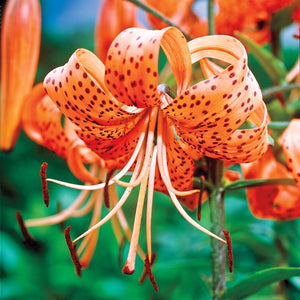
Lilium Tigrinum (lancifolium) is an heirloom favorite, quite properly known as the "Tiger Lily" of "Grandma's garden" fame. It has large unscented pendant orange flowers with black spots and recurved tips. It is a notoriously vigorous grower and naturalizes easily, producing a big crop of stem "bulblets" every year and aerial bulbils (resembling black beads thickly arranged along the stem).
Once they develop rootlets, these bulbils can be easily raised to blooming size, in fact will plant themselves if allowed to drop to the ground. If you seek a rapidly-propagating lily, this one's FOR YOU! In the Orient this species is raised for its edible bulbs (delicious in veggie stir-fry dishes. Very enduring and virus-resistant. We barely keep up with the revival of demand for this hard-to-get species. 16-18 cm bulb size. Choose between 1 bulb or a 3-pack.
Once they develop rootlets, these bulbils can be easily raised to blooming size, in fact will plant themselves if allowed to drop to the ground. If you seek a rapidly-propagating lily, this one's FOR YOU! In the Orient this species is raised for its edible bulbs (delicious in veggie stir-fry dishes. Very enduring and virus-resistant. We barely keep up with the revival of demand for this hard-to-get species. 16-18 cm bulb size. Choose between 1 bulb or a 3-pack.
Botanical name: Lilium lancifolium 'Splendens'
Form: Perennial
Hardiness Zone: 3-9
Flower Color: Orange/black spots
Foliage Type: Linear, green leaves arranged in whorls or spirals up the stems
Bloom time: July-August
Height: 3-4 ft
Spread: 12 inches
Light requirements: Full or partial sun
Plant depth: 6 inches of soil over top of bulb
See "Growing Tips" for more detailed instructions
Form: Perennial
Hardiness Zone: 3-9
Flower Color: Orange/black spots
Foliage Type: Linear, green leaves arranged in whorls or spirals up the stems
Bloom time: July-August
Height: 3-4 ft
Spread: 12 inches
Light requirements: Full or partial sun
Plant depth: 6 inches of soil over top of bulb
See "Growing Tips" for more detailed instructions
Tips and Growing Instructions
Visit our How-To Cultivation Library for more growing tips.
Species lilies, also known as Tiger Lilies, are wild lilies, native to North America, Europe, and Asia. Delicate and full of charm, there are 80 - 100 accredited Species. Most species lilies do not require specialized care and will naturalize themselves very well. They are very adaptable to most soil conditions and environmental conditions, and they do quite well in warm, moist climates with fertile soil. Tiger Lily bulbs for the most part are smaller than hybrid varieties, but will produce good quality stems and a lot of blooms. Their delicate, beautiful flowers are quite showy and most will bloom for long periods compared to other lilies.
Lilies are incredibly easy to grow and few garden pests trouble them. The most natural location for lilies is on sloping ground with excellent drainage. Lilies prefer to have their blooms in the sun and their roots in the shade. Try planting them among annuals or perennials that will keep their roots cool.
The general rule of thumb for planting spring bulbs is to plant two to three times as deep as the bulb is tall. This means that some of our larger Bulb-Zilla lily bulbs will need to be planted 6-8 inches deeps. Plant with the roots downward and the scales upward. After planting, water well two or three times. Lilies are most effective when planted in groups of three or more. Space them about a foot apart – they will spread and fill this space in no time!
Always allow the leaves on the stalk to turn yellow and fall off as part of the lily’s natural growth process. This ensures that the bulbous underground part of the plant has gotten enough nourishment and will mean greater growth next year. Each year watch their beauty increase as they multiply!
Visit our How-To Cultivation Library for more growing tips.
Species lilies, also known as Tiger Lilies, are wild lilies, native to North America, Europe, and Asia. Delicate and full of charm, there are 80 - 100 accredited Species. Most species lilies do not require specialized care and will naturalize themselves very well. They are very adaptable to most soil conditions and environmental conditions, and they do quite well in warm, moist climates with fertile soil. Tiger Lily bulbs for the most part are smaller than hybrid varieties, but will produce good quality stems and a lot of blooms. Their delicate, beautiful flowers are quite showy and most will bloom for long periods compared to other lilies.
Lilies are incredibly easy to grow and few garden pests trouble them. The most natural location for lilies is on sloping ground with excellent drainage. Lilies prefer to have their blooms in the sun and their roots in the shade. Try planting them among annuals or perennials that will keep their roots cool.
The general rule of thumb for planting spring bulbs is to plant two to three times as deep as the bulb is tall. This means that some of our larger Bulb-Zilla lily bulbs will need to be planted 6-8 inches deeps. Plant with the roots downward and the scales upward. After planting, water well two or three times. Lilies are most effective when planted in groups of three or more. Space them about a foot apart – they will spread and fill this space in no time!
Always allow the leaves on the stalk to turn yellow and fall off as part of the lily’s natural growth process. This ensures that the bulbous underground part of the plant has gotten enough nourishment and will mean greater growth next year. Each year watch their beauty increase as they multiply!
Shipping
Sorry, we do not ship outside the U.S. or to Hawaii due to agricultural restrictions.
We guarantee safe arrival of healthy bulbs, that varieties will be true-to-name, and will grow if planted as instructed, subject to the limitations described in our Shipping and Returns Policy.
We begin shipping our bulbs in mid-February through Spring. Despite what you may have heard, Spring planting of bulbs is not a bad thing, and in fact, there are many advantages to planting in Spring. Visit our Spring Planting page to learn more. Upon arriving, your bulbs and most of your perennials may show signs of growth such as green leaves and sprouts - this is okay and transportation during this time should not harm the plants.
All bulbs and perennials should be planted in your garden as soon as possible to ensure the best success. If you must delay planting, open the bags to permit air circulation and place them out of direct sunlight in a cool, well-ventilated room. Do not place the bulbs where they can freeze. If you have the space, storing the bulbs in the refrigerator is another excellent way to “hold them” prior to planting. If you choose this method of storing your bulbs, be sure not to store fruit with them, as this is detrimental to bulbs.
Plant outdoors when the ground is no longer frozen and the conditions have improved for your zone.
If you have any questions or concerns our customer service team would be glad to help you at any time. Please use our contact form, email us at [email protected], or call us at 541-671-3196.
Shipping Notes
- Free Standard Shipping on $100+ Orders to the USA.
- Except Preorder products are shipped in 48 hours.
- Delivery to the USA:
- Standard Shipping : 3-10 business days
- If time is of the essence, please consider selecting expedited delivery for faster service.
Exchange/Return Notes
- We offer a 30-day return/exchange service after receiving.
- Final sale items are not eligible for returns or exchanges.
- To process your return/exchange, please contact us at [email protected]
- Please click here for more details>>> Return & Exchange Policy
4.7 ★★★★★
Based on 2184 reviews
Sort
Product Reviews
★★★★★ 5
Perfect for Little Learners!
Format: Board book
My toddler loves these books! The bright colors and real pictures inside are wonderful to help my child learn about new topics, she is always asking for a new National Geographic book!
WAS THIS REVIEW HELPFUL?YesReportShare
Reviewed in the United States on January 28, 2024
★★★★★ 5
Toddler approved!
Format: Board book
My 2 year old loves this book! The pictures are beautiful, he's learned the names of all of the bugs, and it's a nice small size that's easy to read using one hand with my toddler in my lap before bedtime. I bought this when he was around 18 months old and it is still a hit.
WAS THIS REVIEW HELPFUL?YesReportShare
Reviewed in the United States on June 12, 2021
★★★★★ 5
Great book!
Format: Board book
I really like this book it includes: ladybug, bumblebee, praying mantis, firefly and (monarch) butterfly. So a good selection of bugs a small child is likely to experience in their yard or park in North America. For the photo board book aged children I really prefer that they discuss vocabulary that the child will be able to use to describe the world around them so I appreciate that most kids will see most of these bugs fairly easily and frequently. I did question the praying mantis since I see them much less frequently than the other bugs in the book but my husband said it is an exciting bug when kids do see it so he supports the choice--I think a fly or mosquito might have been a somewhat more useful choice as far as vocabulary our son could use most often. I liked that they did say the butterfly was a monarch but typically used butterfly so if a child lives where other butterflies are more common they learned the more general term. I think fireflies are less common in some regions but they are so magical as a small child that I think it is a good choice.
WAS THIS REVIEW HELPFUL?YesReportShare
Reviewed in the United States on April 2, 2018
★★★★★ 5
Children's Board Book
Format: Board book
Beautiful large pictures for toddlers to view. Limited factual text.
WAS THIS REVIEW HELPFUL?YesReportShare
Reviewed in the United States on September 26, 2024
★★★★★ 5
Son loves it
Format: Board book
Sturdy enough for 19 month old. He loved learning about the insects and looking for them outside. I love the real pictures and facts.
WAS THIS REVIEW HELPFUL?YesReportShare
Reviewed in the United States on March 9, 2022