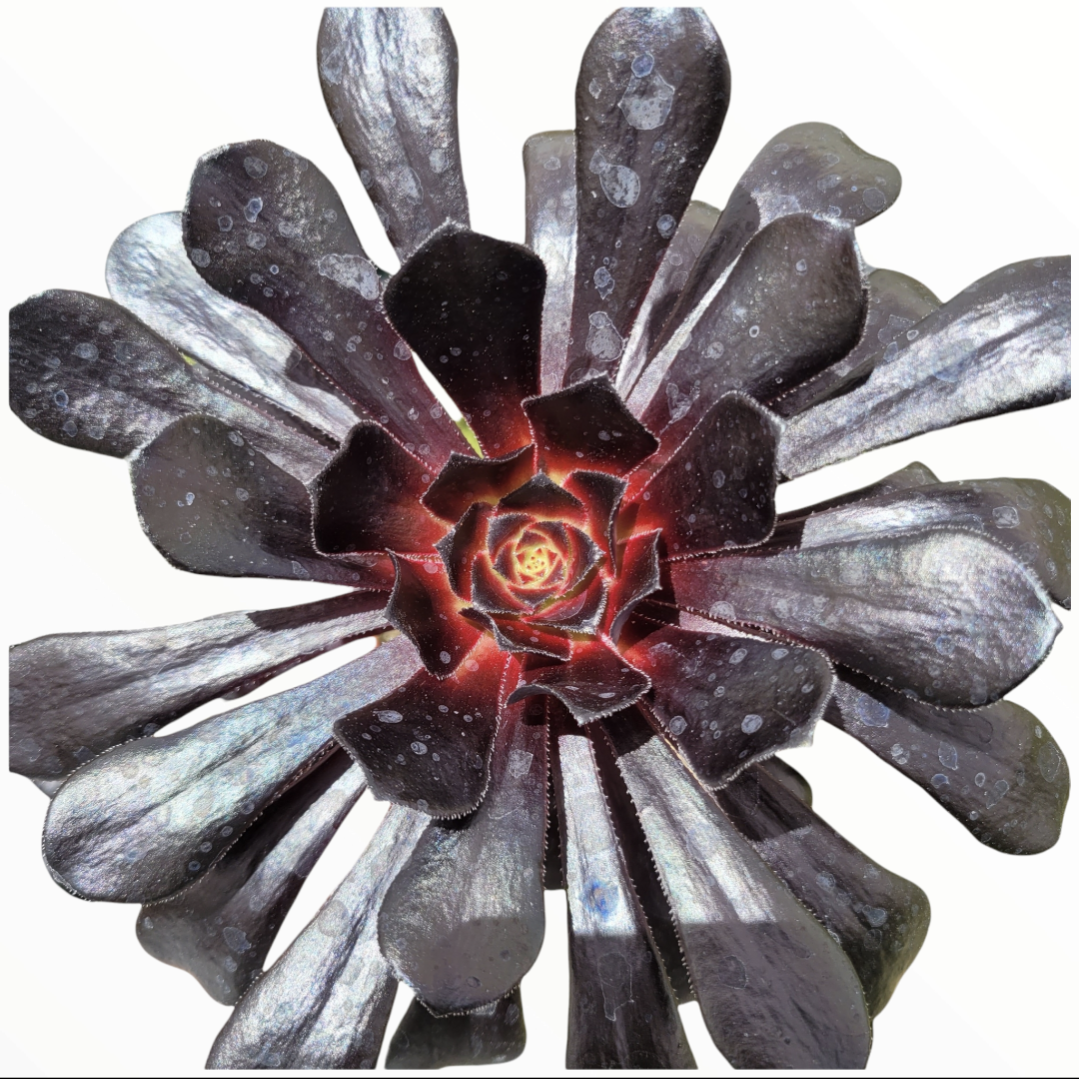
large black succulent Aeonium arboreum 'Black Rose'
SKU: 54206367060
large black succulent

large black succulent Aeonium arboreum 'Black Rose'

Sale price$22.53 Regular price$25.03
Save 10%

Pay in installments of $6.26 with ShopPay, AfterPay and Klarna

Shipping Estimate
USA
  • USA
  • CAN

Ships within 48 hours · Estimated delivery Jul 3 - Jul 8

Promo Codes Available:

For Your Every Summer RSVP, with Code: SUMMER15

Description

large black succulent Aeonium arboreum 'Black Rose'Aeonium arboreum 'Black Rose' is a cultivated species of the genus Aeonium in the Crassulaceae family, originally from the western Canary Islands in Morocco. The purple black leaves are arranged in rosette like cascades, giving a sense of solemnity and mystery, with high ornamental value. It should be grown in a well drained and permeable medium. The plant is shrubby and growing upright with branched old stems that are cylindrical and light brown. The

Aeonium arboreum 'Black Rose' is a cultivated species of the genus Aeonium in the Crassulaceae family, originally from the western Canary Islands in Morocco. The purple-black leaves are arranged in rosette-like cascades, giving a sense of solemnity and mystery, with high ornamental value. It should be grown in a well-drained and permeable medium.

The plant is shrubby and growing upright with branched old stems that are cylindrical and light brown. The fleshy leaves are slightly thin, integrated into a 6" daisy-shaped rosette of leaves at the tips of the branches. The leaves are oblong-ovate or oblanceolate with apices being 2" long. The leaf margins have white eyelash-like teeth, and the leaves are blackish purple. In winter, they could get greenish purple if they don't receive sufficient sunlight.

Black Rose is tends to absorb heat more than typical succulents because the leaves themselves tend to turn black, so too much sunlight will cause the leaves to soften. It belongs to the "winter type" of succulent plants, and the bottom leaves will wither in summer when it is dormant, which is a normal metabolism. It grows in the cool season and is dormant in summer but not for long.


Care Tips

Light: Place the plant in semi-shade in high summer. In winter, you need plenty of light. Turn the potted plant regularly to ensure that it receives even light so that the plant's body form does not bend.

Water: Under normal growth conditions, Black Rose should be watered once every 2 weeks to ensure that the potting soil is damp, if the potting soil is too wet, it is easy to cause stem and leaf excessive growth. In summer, the Black Rose is dormant in a high temperature and humid environment. In winter, the room temperature is low, watering should not be too much to ensure that the potting soil is slightly wet.

Soil: The soil requirements must be loose and breathable. This will not only facilitate the breathing condition of the root system, but also effectively avoid the occurrence of waterlogging, which is beneficial to its growth in such an environment. 

Potting: Choose high pots, and the bottom of the pot needs to have drainage holes. It is recommended to use ceramic pots. Ceramic pots have a certain degree of permeability. Clay pots lose water too quickly, plastic pots tend to retain water for too long and permeability is poor.

Temperature: The optimum growth temperature is 68-77°F (20-25℃). In winter, if the minimum temperature is not lower than 51.8°F (11℃), the plants can be watered normally so that they can continue to grow, but there is no need to fertilize. If you can't maintain such a high temperature, you can water moderately and make the plant dormant, and it can also tolerate a low temperature of 39.2-42.8°F (4-6℃). 

Humidity: Black Rose grows well in average household humidity levels when grown indoors. Does not like too much humidity. Normal household humidity is good for this plant.


Shipping & Handling

  • The 2 Inch Black Rose plants are shipped with the pot and soil
  • The 4 Inch and larger plants are shipped bare roots without the pot and soil:
  • You will receive a very similar plant to the one shown in the photos; shape and color may vary
  • Ship within USA & its outlying territories only
  • Please visit Order Processing & Shipping info page for additional details


Care Instructions

Please visit our Succulent Care info page for more details.

To ensure the health of succulents, it is important to plant them in porous, well-draining soil. Succulents require little watering, but don't like to sit in wet soil. To create an adequate cactus mix, simply add pumice, perlite, or grit to cactus soil to provide the proper drainage.

Make sure to leave drought periods between waterings to prevent the plant from water-logging.


Weather Conditions

  • When ordering, be mindful that living succulents can be damaged by the cold weather.
  • If you live in an area that is below 40 degrees Fahrenheit, please add a shipping warmer to your order or consider purchasing plant until the weather is more suitable.
  • Shipping Warmer: 72+ Hours Heat Packs available for $1.7 each
Shipping Notes
  • Free Standard Shipping on $100+ Orders to the USA.
  • Except Preorder products are shipped in 48 hours.
  • Delivery to the USA:
  1. Standard Shipping : 3-10 business days
  • If time is of the essence, please consider selecting expedited delivery for faster service.
Exchange/Return Notes
  • We offer a 30-day return/exchange service after receiving.
  • Final sale items are not eligible for returns or exchanges.
  • To process your return/exchange, please contact us at [email protected]
  • Please click here for more details>>> Return & Exchange Policy
SKU: 54206367060

Discover Niche Categories That Outsell large black succulent

Top-Converting Item to Boost Your Average Order

4.7 ★★★★★
Based on 2129 reviews
Sort
Highest Rating
Newest First
Oldest First
Product Reviews
A
Verified Purchase
Amazon Customer
Boise, US
★★★★★ 5
Perfect bronze holder
Color: Oil Rubbed Bronze
Great paper towel holder that matches all my other bronze kitchen items.
WAS THIS REVIEW HELPFUL?YesReportShare
Reviewed in the United States on January 26, 2026
J
Verified Purchase
Battle Creek, US
★★★★★ 5
Looks nice, good construction and good value
Color: Warm Gold
Looks nice, good construction and good value. Stays in place when tearing off sections of paper towels and looks more expensive than it was.
WAS THIS REVIEW HELPFUL?YesReportShare
Reviewed in the United States on December 5, 2025
M
Verified Purchase
MommaWolf
Lake Worth, US
★★★★★ 5
Great product!
Color: Oil Rubbed Bronze
Beautiful and easy to assemble and use, good weight to it so doesn’t get knocked over. I have three of these and love them!
WAS THIS REVIEW HELPFUL?YesReportShare
Reviewed in the United States on September 19, 2025
B
Verified Purchase
B. Marold
Charlottesville, US
★★★★★ 5
Great Guide for Specialized Bible Study or Pastoral Use.
Format: Hardcover
`Commentary on the New Testament Use of the Old Testament', edited by G. K. Beale and D. A. Carson supports the idea that given any approach to the examination of the New Testament you may think of, someone has written a book about it. And a superb book it is, if you have need for an examination of this subject from almost every angle. I say almost, because there is actually one thing I would like to have seen in this book, and it is not there. More on this anon. For the lay reader, be aware that this is a scholarly book, with all the Greek, Hebrew, Aramaic, and (I suspect) even Coptic terms used freely, just when I've gotten in the habit of tracking down Greek, I have to deal with two even more difficult languages. I mention that primarily for those who are allergic to footnotes and phrases in languages other than English. Otherwise, I am delighted in how easy the reading is in all the contributions from eighteen (18) major scholars on the New Testament. Much of this is attributable to the marching orders given to the writers by the two editors. This list of guidelines makes the diverse contributions very uniform, which contributes to the value of this book as the guide to a specialized type of Bible study based on this book's subject. Anyone who has tracked down more than a handful of OT passages used in the NT will realize that the NT writers often take some liberties with their interpretations, reading in a prophesy about Jesus which, in the original text actually referred to something completely different. And, one has also run across a wide range of different ways in which OT texts are used, from `exact' quotes to paraphrases to allusions. The editors address this range by asking all authors to address their OT citations from at least five different points of view. These are: 1. What is the NT context of the citation? What is the genre and literary structure of the book or chapter? 2. What is the OT context of the citation? Do these Markan citations come directly from Exodus, for example, or are they quoted from Isaiah's use of Exodus verses? 3. How was the OT quote handled or interpreted by Second Temple Judaism, or early Judaism in general? 4. From what text is the OT quotation copied. The Septuagint (LXX), the Masoretic text, or a Targum (scripture translated into Aramaic or Coptic). 5. What is the ultimate use or connection being made by the NT author's use of the OT. Is it simply to emote a connection, is it a use of a common OT idiom, is it a parable use, shorthand to evoking an OT story, or is there a belief that events in NT times fulfill a specific OT prophecy. Of course, many commentaries on individual NT books do this as well, but most do not go into detail on points 2, 3, and 4. In looking at those parts of the NT I know best, I find this book delivers everything it promises on these five points, but that the book cannot replace good commentaries and study Bibles for NT books. In looking at one of the most famous uses of OT scripture in Luke, at 4:18 - 19, where Jesus teaches from Isaiah 61:1 - 2, the authors, David Pao and Eckhard Schnabel cover all the editors' points admirably, including references to important opinions by famous scholars such as Rudolph Bultmann. For this passage and for all others in this chapter on Luke, the actual passage is NOT presented in any translation. Therefore, one has to have a copy of the Bible open to the passage, as you read the authors' interpretation of it. Less important is the fact that the explanation of this section of Luke on Jesus' teaching in the Nazareth synagogue says nothing about the puzzling climax, where the congregation turns on Jesus. But that is a logical limitation of the approach, and is not relevant to the subject of the book. The introduction to Lucan passages was illuminating, as it tells us that even though one of Luke's primary objectives was to show the resolution of OT prophesies, Luke actually uses fewer OT quotes than Matthew. This is rarely discussed in commentaries on Luke. So, especially with regard to the synoptic Gospels, this would be an excellent book to use as a guide to OT references in the NT. For the scholar, there is the usual tower of bibliographical references after each article, plus the usual index to Biblical citations at the back of the book. There was just one thing I wanted which is missing. This is a `reverse' index, if you will, of OT books, with the number and locations of where verses are cited in the NT. The reason for wishing such an index is as a guide to selecting which OT books may best be studied together, as with Luke and Deuteronomy (some commentators claim the 10 chapter journey of Jesus to Jerusalem is patterned after Deuteronomy). Ultimately, this is a great reference if you make a habit of studying NT scriptures in depth, as either a pastor or bible study teacher.
WAS THIS REVIEW HELPFUL?YesReportShare
Reviewed in the United States on December 19, 2007
D
Verified Purchase
DJ
Waukegan, US
★★★★★ 5
Most Amazing
Format: Kindle
To look at the New Testament through the same thought process of those that wrote it is nothing short of ingenious. It takes nothing away from the Word being written by the Holy Spirit through men. In fact, it adds to the validity of the cohesion between the Old and New Testament while giving insights rooted in God’s Word written centuries before the coming of Christ. It does include the Apocryphal books as well and it’s citations of OT are well documented to work both from the OT to the NT or from the NT to the OT which is the purpose of this book. I would highly recommend this book to anyone who desires to dig deeper into the thought process of God and move beyond the regular commentary process that tends to be limited to the author’s insights and singular theological perspective. Further, if you desire to answer the question of why is this written or how did this come to be, many passages point to multiple references from the OT giving substance to Paul’s letter to encourage a young pastor to hold onto what has been given to him. Not a new teaching as we would assume, but a correct understanding of the Hebrew Testament in light of Jesus death, resurrection, and ascension into the Ancient of Days court as described in Daniel 7. Jesus is clearly more than a teacher when viewed through the eyes of the Hebrew Testament, He is the second person of the Holy Trinity for which this Old Testament confirms multiple times over. The downside of this extensive commentary is the use of technical jargon and the assumption that the reader has fluency in Hebrew and Greek. However, if you are a student who sits in the front of the classroom because you want to learn more and miss nothing (and not up there because the teacher desires to keep a closer eye on you) this book will not disappoint you. On the contrary, you will find it’s usefulness beyond sermon and Bible Study preparation. You will get the opportunity to sit in the dirt and learn from the Master as Mary did and will find it is hard to move onto the rest of your list that needs to get done for the day.
WAS THIS REVIEW HELPFUL?YesReportShare
Reviewed in the United States on August 9, 2022

recommand products