SKU: 44850807669
ponytail palm good luck

ponytail palm good luck Ponytail Palm

Sale price$19.61 Regular price$21.79
Save 10%

Shipping Estimate
USA
  • USA
  • CAN

Ships within 48 hours · Estimated delivery Jul 13 - Jul 18

Promo Codes Available:

For Your Every Summer RSVP, with Code: SUMMER15

Description

ponytail palm good luck Ponytail PalmCurly Ponytail Foliage on a Swollen Trunk Ponytail Palm is one of those plants that makes people smile at first glance. A swollen, bulbous base tapers into a slender trunk, crowned with a fountain of long, ribbon like leaves that spill over the sides like a green ponytail. Despite its common name, it isnt a true palm at all, but a caudex forming succulent native to Mexico, which has evolved to store water in its thick base. The look is part desert

Curly “Ponytail” Foliage on a Swollen Trunk

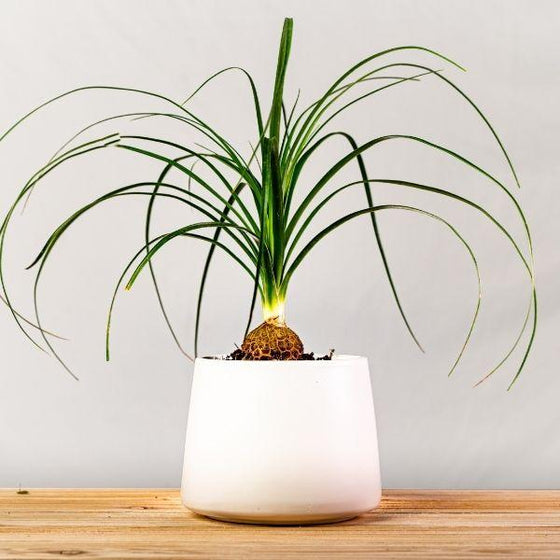
Ponytail Palm is one of those plants that makes people smile at first glance. A swollen, bulbous base tapers into a slender trunk, crowned with a fountain of long, ribbon-like leaves that spill over the sides like a green ponytail. Despite its common name, it isn’t a true palm at all, but a caudex-forming succulent native to Mexico, which has evolved to store water in its thick base. The look is part desert sculpture, part whimsical houseplant, and it fits just as well on a sunny windowsill as it does styled on a plant stand.

Slow, Compact Growth, and Long-Lived

Indoors, Ponytail Palm is slow-growing, which makes it a fantastic long-term companion plant. Young plants have a single trunk and a tight tuft of foliage, while older specimens gradually thicken their base and may branch into multiple heads over time. In containers inside the home, most plants typically top out at around 3–4 feet tall, although very old specimens in large pots can reach 5–6 feet. Because it grows slowly and stays relatively narrow, it’s easy to tuck into corners, tabletops, or grouped displays without worrying that it will outgrow the space overnight.

Bright Light and Infrequent Watering is all it requires

Think of Ponytail Palm as more of a succulent than a palm when it comes to care. It thrives in bright, indirect light and happily basks in a bit of gentle direct sun, especially morning or late-afternoon rays. A bright east or south window is ideal; in lower light, it will survive, but growth slows dramatically, and the trunk may elongate rather than stay stout. Plant it in a very well-draining mix—such as cactus or succulent soil, or potting mix heavily amended with sand and perlite—so that excess water runs through quickly and never lingers around the roots.

Watering is where Ponytail Palm really earns its “set it and forget it” reputation. The caudex stores water, so you’ll want to let the soil dry out completely between waterings, then soak thoroughly and drain well. In most indoor settings, that means watering every 2–4 weeks, less in low light or winter, and a bit more in bright, warm conditions. It prefers typical household temperatures of around 65–80°F and average humidity, shrugging off dry indoor air that would bother more finicky tropicals. Overwatering is just about the only way to truly get into trouble with this plant—if the base ever feels soft or the leaves pull out easily, it’s a sign the roots have stayed wet too long.

Pet-Safe Personality Plant for Home or Office

In the “indoor landscape,” Ponytail Palm is pure personality. Use it as a quirky focal point on a plant shelf, as a sculptural accent on a low stool, or lined up in multiples for a desert-inspired vignette. It pairs beautifully with cacti, snake plants, and other drought-tolerant houseplants, adding a softer, playful texture to an otherwise spiky or architectural grouping. And because it’s considered non-toxic to cats, dogs, and even horses, you can relax a bit if curious paws can’t resist playing with those tempting, dangling leaves.

Shipping Notes
  • Free Standard Shipping on $100+ Orders to the USA.
  • Except Preorder products are shipped in 48 hours.
  • Delivery to the USA:
  1. Standard Shipping : 3-10 business days
  • If time is of the essence, please consider selecting expedited delivery for faster service.
Exchange/Return Notes
  • We offer a 30-day return/exchange service after receiving.
  • Final sale items are not eligible for returns or exchanges.
  • To process your return/exchange, please contact us at [email protected]
  • Please click here for more details>>> Return & Exchange Policy
SKU: 44850807669

Discover Niche Categories That Outsell ponytail palm good luck

Top-Converting Item to Boost Your Average Order

4.8 ★★★★★
Based on 2425 reviews
Sort
Highest Rating
Newest First
Oldest First
Product Reviews
J
Verified Purchase
JLP04
Alexandria, US
★★★★★ 5
Great read for all levels!
Format: Kindle
This book is truly educational and informative. Finally a book that actually helps with navigating through experiences and scenarios in this business that you can apply to real life. Whether you're an active or passive investor, or a "newbie" or veteran in the real estate space, this book will add value to you.
WAS THIS REVIEW HELPFUL?YesReportShare
Reviewed in the United States on July 7, 2021
H
Verified Purchase
Hubert Herring
Birmingham, US
★★★★★ 5
great resource for high school parents
Format: Paperback
A terrific book -- on many levels. It is, first, a series of excellent suspense stories, with vivid characterizations of the students seeking admission to Wesleyan. The author found some fascinating students to follow, with the result that the reader really cares what happens to them. Even more important -- especially to someone about to embark on the college hunt -- he provides an invaluable insight into how the admissions process works. The admissions game, I now realize thanks to this splendid tale, is a crazy-quilt mixture: at Wesleyan, at least, the process focuses on the individual, quirks and all, far more than I imagined. At the same time, the process comes off as frighteningly random -- with so much depending on which admissions officer reads the application, and what that person focuses on in the few minutes available. The book is also a vivid reminder that admissions officers are people, too -- people of infinite variety. So it was a pleasure to read -- and it will also prove immensely useful to parents. One common theme kept repeating: take the hard courses, even if it means lower grades. Another: having a passion is a real plus, but the rest of the record can't be a disaster. But those are just the beginning.
WAS THIS REVIEW HELPFUL?YesReportShare
Reviewed in the United States on September 11, 2003
B
Verified Purchase
Brian Tarbox
Chelsea, US
★★★★★ 4
Very accurate view of admission (I worked there); compelling read, enlightening even for people who think they already know
Format: Kindle
I was a Senior Interviewer during my senior year at Wesleyan 1981 and so I worked with many of the main characters in the book. Although the book describes a later time period it rang entirely true to me. The volume of applications...the controlled chaos...the searching for a hook or a champion for an application was very familiar. At least at Wes it seemed (and seems) that unless one's application has some unusual feature that the school is looking for that year (a particular athlete or a particular musician or a particular tough background that was overcome) the road to admission will be challenging. An area that did surprise me was the emphasis on the family of the applicant...and the degree to which an applicant was held to a higher standard if their parents were deemed to be college fluent. I guess this makes sense and actually provides a leveling of the playing field but it was surprising none the less. It may also be surprising to some that these days you don't just need to convince the gatekeepers that you could be successful at the school..you must also show how your presence would enhance the school. This is of course an enormous burden for most teenagers. Like it or not this is the reality at many "top" schools. If you or your child is applying to college you owe it to yourself to read this book....either to understand the game or to make an informed decision not to play.
WAS THIS REVIEW HELPFUL?YesReportShare
Reviewed in the United States on May 20, 2013
P
Verified Purchase
P. Meltzer
Lexington, US
★★★★★ 5
What is better? The overachieving 6 or underachieving 8?
Format: Hardcover
First, let me say that I thought that this was an excellent book and would recommend it to anyone who is at all interested in the college admissions process. Second, I was surprised at how many of the reviewers seemed shocked--shocked!--that applicants got bonus points for coming from minority backgrounds. Was this some kind of revelation? However one thing that surprised me a little bit is how--even moving beyond race entirely--the more advantages you have had in life, the more disadvantageous it will be for your admissions process. For example, I was unaware that having successful parents would be, in essence, held against you on the theory that more would be expected of you. While other reviewers have (jokingly?) said that they would advise their white kids not to check the "Caucasian" box, I might advise my (still very young) kids to say that their parents have been unemployed their whole life. I suppose that the main issue which this whole process really boils down to is the following: As a college applicant, is it more important to succeed in life relative to the world around you (i.e. relative to your classmates, to others of your race, to others of your geographical area, to your own parents' life and accomplishments, etc.) or is it more important to succeed absolutely and not on a relative scale. This book clearly informs us that the answer is the former and not the latter. Whether that should be the answer is another question. For example, say that a student's entire life could be distilled into 2 numbers each on a sliding scale from 1-10. The first number is simply your academic performance (grades, SAT's, course load, etc.) The second number is your background (race, economic circumstances, gender, etc.) In the case of Wesleyan, it seems clear to me that they would rather have a student whose first number was, say, a 6 if his or her second was a 2 (take Mig for example in Steinberg's book) than a student whose first number was an 8 if the second number was a 9 or 10 (take Tiffany Wang for example). Whether that is the right approach is certainly a legitimate issue for discusion and I'm not saying that it's not. I suppose that one of the things that would be interesting to know (even though one never really can know of course) is whether those numbers will change in the future. For example, if one were to know that Mig would always be a 6 and Tiffany would always be an 8, would that change the analysis as to which is the right approach? I suspect that part of the reason that a school like Wesleyan would favor the overachieving 6 over the underachieving 8 is due to the hope or expectation that those trends will continue in the future and that one day the 6 will actually be ahead of the 8. And maybe that's the way it works. Who knows.
WAS THIS REVIEW HELPFUL?YesReportShare
Reviewed in the United States on February 28, 2003
J
Verified Purchase
Jeremy W.
Los Angeles, US
★★★★★ 5
You will find out how a selective private college evaluate and admit students
Format: Paperback
I'm a high school counselor and college advisor. Fifteen years ago when I started my college counseling position, I struggled to understand or explain to students and their parents how a selective private college evaluate and admit students. It was this book that helped me understand the essence of selective private college admissions. Compared to other dry theory books, this book tells the admissions practice as stories that are easy to read, understand, and associate with. I highly recommend this book to students, parents, and new counselors.
WAS THIS REVIEW HELPFUL?YesReportShare
Reviewed in the United States on December 5, 2024

recommand products