SKU: 33948819332
tri color succulent

tri color succulent Buy 'Sedum Spurium Tricolor' Online

Sale price$23.10 Regular price$25.67
Save 10%

Shipping Estimate
USA
  • USA
  • CAN

Ships within 48 hours · Estimated delivery Jul 14 - Jul 19

Promo Codes Available:

For Your Every Summer RSVP, with Code: SUMMER15

Description

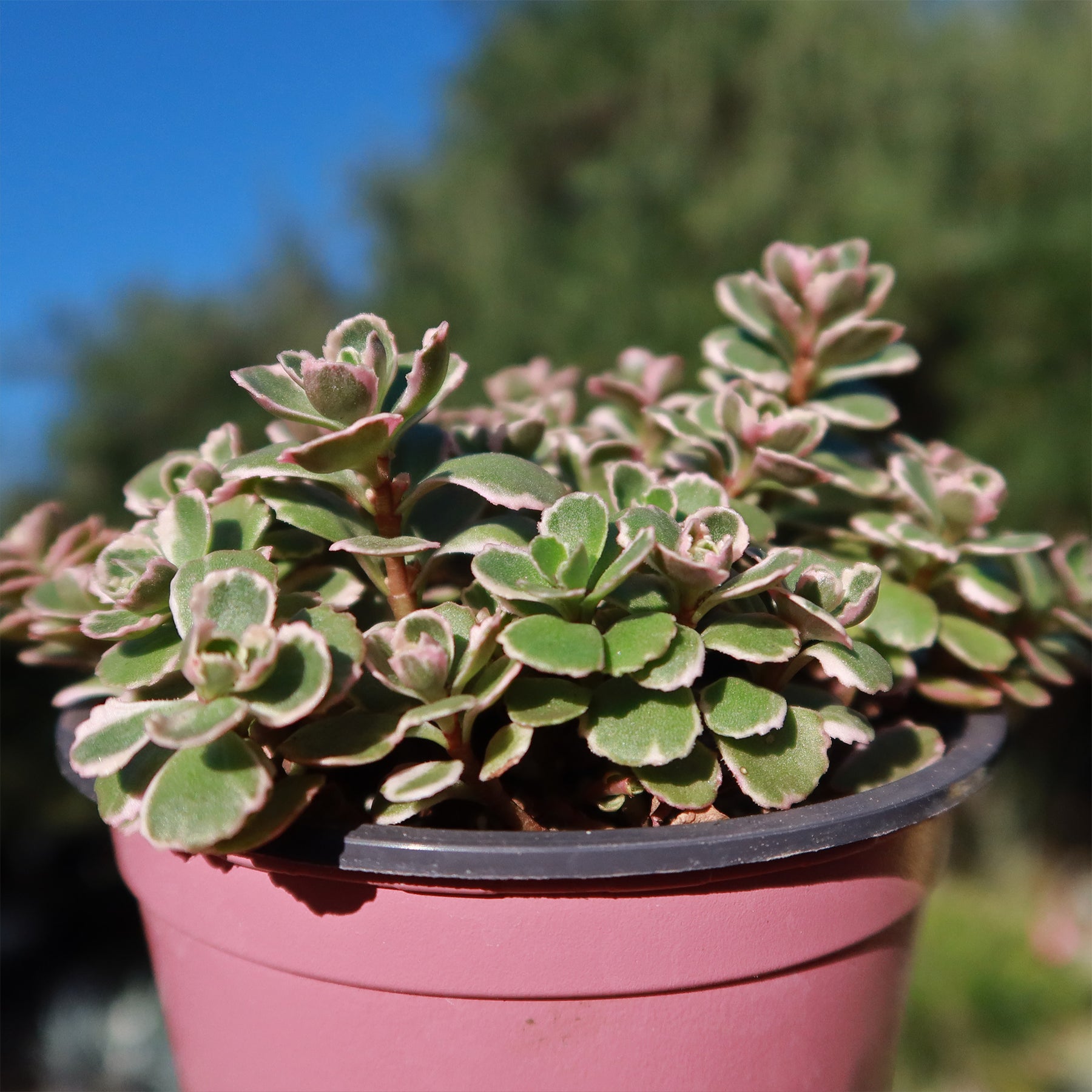
tri color succulent Buy 'Sedum Spurium Tricolor' OnlineIntroducing the Sedum spurium Tricolor, a beautiful and eye catching succulent plant that belongs to the genus Sedum. Tricolor sedum has many other common names such as Caucasian stonecrop 'Tricolor', Two row Stonecrop 'Tricolor', Dragon's Blood, Sedum spurium variegatum, and Phedimus spurius 'Tricolor'. The combination of the green, pink, and cream color gives this sedum plant a tricolor appearance, hence the name "Tricolor Sedum." The Sedum name

Introducing the Sedum spurium Tricolor, a beautiful and eye-catching succulent plant that belongs to the genus Sedum. Tricolor sedum has many other common names such as Caucasian stonecrop 'Tricolor', Two-row Stonecrop 'Tricolor', Dragon's Blood, Sedum spurium variegatum, and Phedimus spurius 'Tricolor'. 

The combination of the green, pink, and cream color gives this sedum plant a tricolor appearance, hence the name "Tricolor Sedum." The Sedum name comes from the Latin word "sedeo," meaning to sit, referring to its general growing habit of sitting and sprawling over rocks. 

Native to the Caucasus, the tricolor sedum is a low-growing, sprawling, mat-forming plant that is commonly grown as ground cover and grows up to 24 inches wide.  

The tricolor sedum is an evergreen plant with thick, obovate, flattened variegated leaves that are medium green with reddish-tinged margins. The lower stem leaves are deciduous, while newer ones are evergreen and turn deep burgundy in fall. These leaves are arranged in tight clusters, creating a dense and compact growth habit. When it's cold outside, the foliage of Sedum 'Tricolor' turns red. The combination of colors adds a lovely touch to any garden or indoor space. 

The flowers of Sedum spurium tricolor bloom in clusters of small, star-shaped flowers that come in various shades of pink, red, or even white. These charming blooms appear during the late spring to mid-summer months, adding a burst of color to your garden. The flowers attract pollinators like bees and butterflies, making your garden a buzzing and fluttering paradise. They create a beautiful contrast against the colorful foliage, creating a stunning display. 

Additionally, this Tricolor Sedum is friendly to both humans and pets. It's generally safe to have around your home or garden. However, it's always a good idea to exercise caution and keep an eye on curious pets or children around any plants, just to be on the safe side.  

Watering Needs 

When it comes to watering Sedum spurium Tricolor, it's important to find the right balance. This Sedum succulent is known for its drought-tolerant nature, so it doesn't require frequent watering. Overwatering can cause root rot, which can be harmful to the plant.  

Allow the soil to dry out between waterings. Before giving your Sedum tricolor a drink, check the top inch of the soil. If it feels dry to the touch, that's a good indication that it's time to water. Remember, it's better to underwater than to overwater this sedum. 

When it comes to water, make sure you do it thoroughly. Give your Sedum tricolor a good soaking, allowing the water to reach the roots. But be careful not to let it sit in standing water, as this can lead to root rot. Make sure the soil has proper drainage to prevent waterlogged roots. 

Sedum spurium Tricolor is more active in the growing season so it may require more frequent watering during that time. However, during the dormant period or in cooler months, it will need less water. Adjust your watering schedule accordingly to the needs of your Sedum plant. 

Remember, it's always better to underwater than to overwater succulents like Sedum Spurium tricolor. These succulent plants have adapted to survive in arid conditions, so they can handle periods of drought. Observing the soil moisture and adjusting your watering accordingly will help keep your sedum happy and healthy! 

Light Requirements 

When it comes to light requirements for Sedum tricolor, this lovely succulent thrives in bright and indirect sunlight. If growing indoors, find a spot for your Sedum spurium tricolor where it can receive at least 4-6 hours of sunlight each day. This can be a sunny windowsill or a spot in your garden that gets ample sunlight. Additionally, make sure to rotate your Sedum tricolor plant every few weeks. This will ensure that all sides of your tricolor sedum receive equal amounts of light and prevent it from leaning or growing lopsided. The more light it gets, the better it will grow and maintain its vibrant colors. 

While Sedum spurium tricolor loves sunlight, it is important to protect it from direct sunlight during the hottest parts of the day when growing outdoors.This can cause sunburn or scorch the leaves. If you notice the leaves turning brown or yellow, it may be a sign that it's getting too much direct sunlight. Consider providing some shade during the hottest hours. 

Remember, finding the right balance of light is key for the health and vibrancy of your Sedum spurium Tricolor. Bright and indirect sunlight is ideal, with some protection from the intense midday sun. Enjoy watching your Sedum succulent thrive in its sunny spot. 

Optimal Soil & Fertilizer Needs 

When it comes to choosing the right soil and fertilizers for your adorable tricolor Sedum, you need to be extra cautious and use the right kind of soil.  Moisture can be a real killer, leading to root and stem rot in no time flat. But fear not, my fellow green thumbs!

Planet Desert has got your back with our specialized succulent potting mix that includes 5 natural substrates with organic mycorrhizae – perfect for promoting healthy roots and happy Sedum plants.  

Natural NPK fertilizers also last longer and keep your soil alive by adding other beneficial compounds and microbes that encourage Sedum spurium tricolor plant health and nutrient absorption. So, skip those harsh chemicals and give your Sedum succulent some love with some awesome organic fertilizer once a year in spring.  However, it's important not to over-fertilize your tricolor sedum spurium, as this can lead to excessive growth and reduced hardiness. 

Hardiness Zone & More 

When growing indoors, Sedum tricolor thrives in temperatures that range between 60-75°F. It can handle slightly cooler temperatures during the winter months, but it's best to avoid exposing it to extreme cold or hot temperatures. Keep it away from drafts and ensure it receives ample sunlight or bright indirect light indoors. 

When growing Sedum spurium Tricolor outdoors, this succulent is generally suitable for zones 3-9. It can tolerate a range of climates, from colder regions with freezing temperatures to warmer areas with milder winters. Just make sure to provide protection from frost during colder months. 

In terms of humidity, Sedum spurium Tricolor can tolerate a range of humidity levels, from dry to slightly humid conditions. It's important to note that succulents, including Sedum tricolor, are more susceptible to root rot in high humidity. So, make sure the soil has proper drainage to prevent waterlogged roots. 

Remember, whether you're growing Sedum tricolor indoors or outdoors, providing the right temperature and humidity conditions will help it thrive. Keep an eye on the temperature and ensure proper drainage to keep your tricolor sedum succulent happy and healthy! 

Propagating Sedum Tricolor  

When it comes to the propagation of sedum tricolor, it is a rewarding way to expand your succulent collection. Start by selecting a healthy stem, cutting it below a leaf node, removing lower leaves, allowing the cut end to dry and callus, planting it in a well-draining potting mix, and placing it in a bright location with indirect sunlight. Then, water sparingly to prevent root rot. After a few weeks, roots should form from the cut end. Patience is key for successful propagation. 

The Bottom Line 

Overall, the Sedum spurium Tricolor (Two-Row Stonecrop) is a lovely tricolor sedum that belongs to the Crassulaceae family. It is a low-growing perennial with trailing stems and small, fleshy leaves that come in a variety of colors, including green, pink, and cream. This beautiful plant adds a vibrant touch to gardens, rockeries, and even containers. Sedum tricolor is known for its ability to tolerate various growing conditions, including drought and poor soil. Your tricolor sedum prefers full sun to partial shade for at least 4-6 hours daily and requires well-draining soil. With its eye-catching foliage and easy-care nature, Sedum spurium Tricolor is a popular choice among succulent enthusiasts. 

Shipping Notes
  • Free Standard Shipping on $100+ Orders to the USA.
  • Except Preorder products are shipped in 48 hours.
  • Delivery to the USA:
  1. Standard Shipping : 3-10 business days
  • If time is of the essence, please consider selecting expedited delivery for faster service.
Exchange/Return Notes
  • We offer a 30-day return/exchange service after receiving.
  • Final sale items are not eligible for returns or exchanges.
  • To process your return/exchange, please contact us at [email protected]
  • Please click here for more details>>> Return & Exchange Policy
SKU: 33948819332

Discover Niche Categories That Outsell tri color succulent

Top-Converting Item to Boost Your Average Order

4.1 ★★★★★
Based on 215 reviews
Sort
Highest Rating
Newest First
Oldest First
Product Reviews
A
Verified Purchase
A. Menon
Houston, US
★★★★★ 5
A valuable review of the collapse of the USSR
Format: Kindle
Collapse is a modern review of the fall of the Soviet Union with a skepticism of its inevitability. This review is valuable on its own merits but given recent events of Russia's invasion of the Ukraine it is particularly timely and provides the reader a comprehensive history for which to to think about current events. The book is divided into two sections. The first covers the reform period under Gorbachev which were the seeds the end and the second part which detailed the political events around the collapse of the Soviet Union. It discusses the reform agenda, the power struggles the lack of correspondence between optimistic visions and practical realities involving reform and ultimately the failure of the West in providing any cushions for a viable economic transition at the end. The author starts with the main leader associated with the fall of the USSR, namely Gorbachev. The author starts by highlighting the consensus perspective that the fall of the Soviet Union was an inevitability of the inadequacy of the system to compete in modern times coupled to weakening energy prices that made the state unviable. One could argue with the modernization of the Chinese state, the fall of USSR perhaps was not inevitable had the party been more adaptive to changing conditions. Either way the author believes that such a view is ultimately wrong and the collapse of the union was a direct result of misguided reforms that were counterproductive and accelerated the fall of the regime. The author puts the policy errors squarely at the feet of Gorbachev who he frames as being too focused on theoretical debates rather than focusing on practical realities. The author discusses how Gorbachev's lack of willingness to use force as well as his optimism about the chances for a shared vision by the population led to a fracturing state where a variety of tribal interests started to diverge. The soviet states were not tied to each other tightly through shared ideology or history and so when reforms led to lower living standards and resources had the potential to be divided, the factionalism of the system came to the forefront. Furthermore the lack of willingness to suppress dissent let to a system that ultimately became immobile to competing voices for which none had a solution to the real problems of the system. The author moves on to the fall of the USSR which really started with the Berlin Wall. There were clearly splintering objectives and the population behind the USSR had divergent hopes on the future. Most states claimed desires for democracy but many really were moving to various forms of ethnically based populism. The concessions made by the USSR on Germany are argued to show the naivety of Gorbachev who was trading Soviet influence for the hope that his signals would be taken well in the West and reciprocated with good will and eventual aid. The sequential failing of the state stemmed from the conflicting power from the formation of democratic parties to compete with the Soviet legislature; the clear separation of powers became ambiguous and ultimately this incoherence of the system led to a partial lost confidence in Gorbachev and a temporary coup. The democratic advocates like Yeltsin then agreed to multiple side deals in which the USSR was carved up along vaguely tribal lines in a hasty fashion that left lingering problems for the following generation. The chaos of reform and decaying control led to a failing state that fractured chaotically and became impossible to salvage once the snowballing began. Collapse is a detailed historical overview of the last decade of the USSR with a focus on the failure of Gorbachev. It discusses the political and economic challenges of the state that led to its collapse but focuses on the failure of leadership that was the root cause from the author's perspective. It is hard to argue that exogenous events didnt put substantial pressure on the regime such that it might have been destined to fail but the authors arguments that the reforms were ineffective are hard to argue with. Furthermore for there to have been a realistic chance of a change in economic model substantial aid would have been required and the idea that the Washington consensus was a sufficient laundry list to lead the USSR into the modern economic world is completely ludicrous. One is reminded of the politics behind economic bodies like the IMF despite the claims to be independent and objective analysis on best practices. As a consequence of the unrealistic idealism of the time and the subsequence tragic failure of following that idealism to a disorganized state we now have substantial lingering frictions that are impossible to heal. Collapse is highly worthwhile read that is filled with details and certainly relevant today.
WAS THIS REVIEW HELPFUL?YesReportShare
Reviewed in the United States on April 20, 2022
H
Verified Purchase
Hab Madoyan
Carnegie, US
★★★★★ 5
very good book
Format: Paperback
I was 8 when the Union collapsed. I don’t remember much, but the years that followed were full of conspiracy theories and stories about who “razvalil Sovetskiy Soyuz.” This book tries to answer that question. You can sense from the book that the author is not happy with how everything ultimately evolved. The Soviet system was corrupt, inefficient, and ill, but probably there was a chance to cure it rather than kill it. However, I think the book is overall quite balanced and very informative and is a must read.
WAS THIS REVIEW HELPFUL?YesReportShare
Reviewed in the United States on March 7, 2026
B
Brandon Nelson
San Leandro, US
★★★★★ 4
So very long….
Format: Paperback
Every time Yeltsin takes a nap? Paragraph. Bush mumbles something indecisive to Scowcroft? Boom—chapter! I felt like I was experiencing the fall of the Soviet Union in real, agonizing time. Look, it’s a fine book. If you’re going for a career in the foreign service, this is a good place to start. Otherwise, you can get a fine rendering of these events in much more concise form elsewhere.
WAS THIS REVIEW HELPFUL?YesReportShare
Reviewed in the United States on April 6, 2023
B
Verified Purchase
Blu
Pawtucket, US
★★★★★ 5
P O W E R F U L .
Format: Paperback
The author summarized: "The ghost of the disappeared Soviet Union ... still haunts the imagination of contemporaries .... This amazing story teaches us not to trust in the seeming certainty of continuity and should help us prepare for sudden shocks in the future" (p. 439). An engrossing in-depth eloquent analyses concerning the events and individuals affecting the 1991 demise of the Soviet Union. Moreover, the unforeseen Chernobyl nuclear disaster on April 26, 1986, crystallized the horrors of a possible nuclear war. Thus, a new orientation to end the exorbitant arms race with the United States. Further, General Secretary Gorbachev promulgated new reforms, including, relaxing travel restrictions in 1989: "... [T]he shock that thousands of Soviet people experienced when they crossed Soviet borders and visited Western countries .... For first-time Soviet travelers to the West a visit to a supermarket produced the biggest effect. The contrast between half-empty, gloomy Soviet food stores and glittering Western palaces with an abundant selection of food was mind-boggling.... This experience changed Soviet travelers forever" (p. 82). At times, repetitive and somewhat confusing. For instance, U.S. President Bush needed Gorbachev's approval for his Iraq offense, which was initially described on Page 143, then inexplicably again, on Page 172. On another occasion, the author indicated that Yeltsin was influenced by Alexander Solzhenitsyn's brochure "How To Rebuild Russia," on Page 150, which is again repeated, on Page 173. Scrupulous editing needed. Notwithstanding such glitches, nonetheless, a fascinating detailed portrayal of the unexpected implosion of a superpower. Having read other books on the subject, if I had to select only ONE about the USSR collapse, I would choose this as the best.
WAS THIS REVIEW HELPFUL?YesReportShare
Reviewed in the United States on July 8, 2025
A
Verified Purchase
Andrew Platek
Pawtucket, US
★★★★★ 5
Thought Provoking
Format: Kindle
I bought this book after I heard the author on a podcast. Growing up in the US we have been inundated with the story that the collapse of the Soviet Union was an inevitable triumph of liberal, Western values. I had my doubts. Even poorly run dictatorships can muddle along for years. What the author did was center Gorbachev in the story. He was the eye of the storm. It was the terrible combination of Gorbachev’s ambitious idealism and gross ineptitude that led to the dismantling of the Soviet Union. Unlike much of Marxist historical narratives which emphasize the forces of history; the author shows that it’s individuals who shape events and are shaped by them. A different person than Gorbachev could have turned the tide in a different direction and left us a different world than we have today. This is a history book that teaches lessons not just about the Soviet Union but about human history in general.
WAS THIS REVIEW HELPFUL?YesReportShare
Reviewed in the United States on August 1, 2025

recommand products