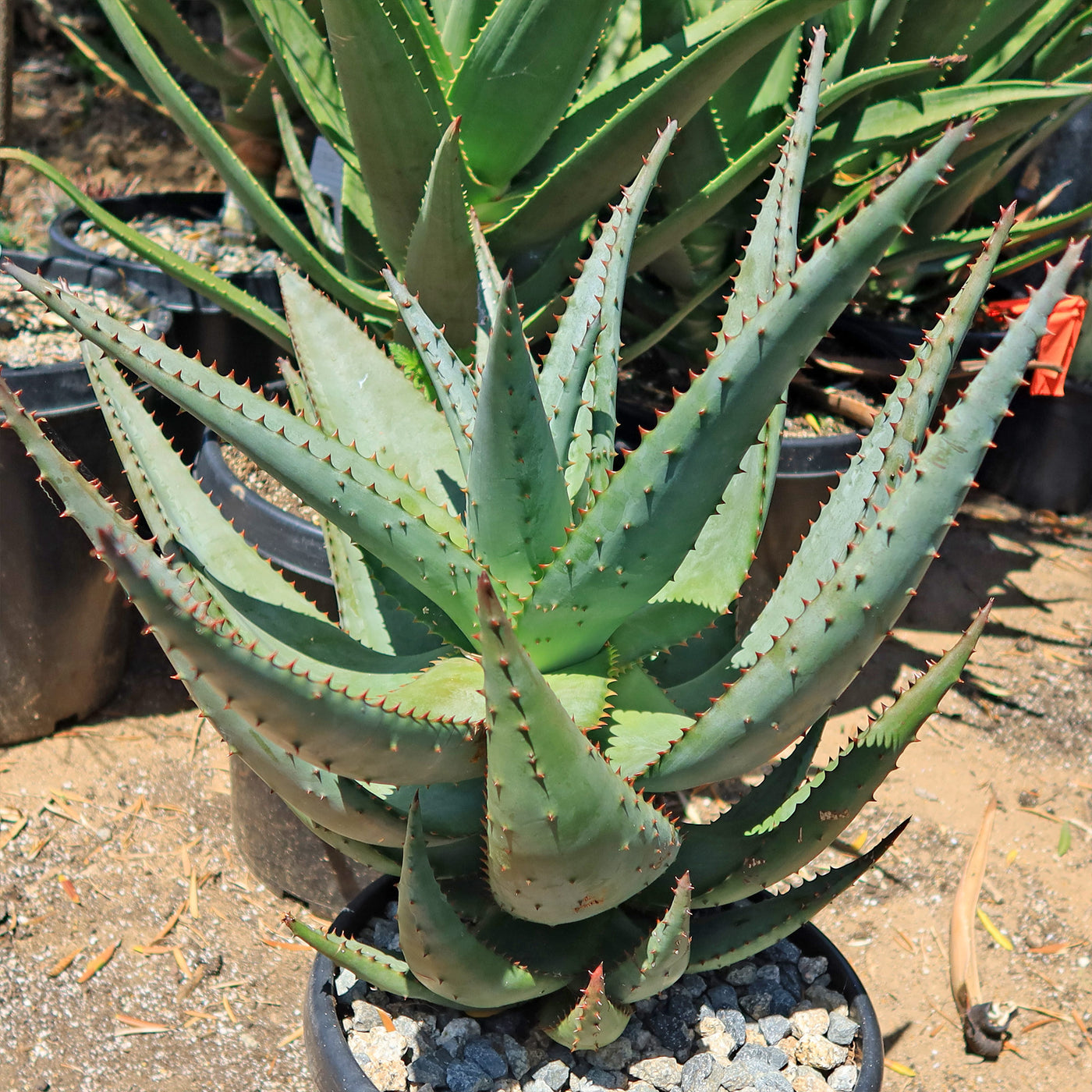
aloe vera plant in the desert Cape Aloe
SKU: 32409622348
aloe vera plant in the desert

aloe vera plant in the desert Cape Aloe

Sale price$24.44 Regular price$27.16
Save 10%

Shipping Estimate
USA
  • USA
  • CAN

Ships within 48 hours · Estimated delivery Jul 8 - Jul 13

Promo Codes Available:

For Your Every Summer RSVP, with Code: SUMMER15

Description

aloe vera plant in the desert Cape AloeIntroducing the Aloe ferox, also known as cape aloe, which is a vibrant member of the Aloe genus. The name "ferox" derives from the Latin word meaning "fierce" or "wild," which reflects the plant's spiky leaves and hardy nature. Aloe ferox goes by several common names, including Cape Aloes, Bitter Aloes, Red Aloe, and Tap Aloe. Native to Southern Africa, the Aloe ferox, a single stemmed succulent with an upright trunk, grows in a dense rosette

Introducing the Aloe ferox, also known as cape aloe, which is a vibrant member of the Aloe genus. The name "ferox" derives from the Latin word meaning "fierce" or "wild," which reflects the plant's spiky leaves and hardy nature. Aloe ferox goes by several common names, including Cape Aloes, Bitter Aloes, Red Aloe, and Tap Aloe.  

Native to Southern Africa, the Aloe ferox, a single-stemmed succulent with an upright trunk, grows in a dense rosette pattern. The blue-green, stiff lance-shaped leaves have small, brown prickles that resemble spines on both the upper and lower surfaces of the leaves. They are armed with sharp, spiky teeth along the edges, which act as a defense mechanism against herbivores. The dried leaves form a petticoat on the stem. The leaves can grow up to 12 feet tall and 5 feet wide, making them quite impressive. 


When the Aloe ferox plant matures, it produces tall, sturdy tubular flower spikes that can reach up to 10 feet in height.

The flower spikes are adorned with orange or red flowers that attract pollinators like birds, bees, and insects.

The blooming period usually occurs during the spring months, adding a vibrant touch to the plant's overall appearance.

Aloe ferox can be
propagated through pups or seeds. One common way is through offsets, also known as "pups," which are small plantlets that grow at the base of the mother plant.

These can be carefully separated and replanted to establish new Aloe ferox plants. Additionally, seeds can be collected from the flowers and sown to grow new young plants themselves, although this method takes longer to produce mature plants. 

When it comes to the benefits of Aloe ferox, this popular medicinal plant has similar medicinal qualities to Aloe vera.  Like Aloe vera, the aloe gel of Aloe ferox has traditional cosmetic and medicinal applications, for many conditions such as moisturizing hair and skin, treating sun burns, and treating skin irritations. Aloe vera lacks laxative and purgative properties; in contrast, the gel-like flesh of Aloe ferox that is extracted from the trunk possesses these qualities. 

Additionally, the Aloe ferox is non-toxic to both humans and pets. These aloe plants are suitable for xeriscaping, desert gardens, and rock gardens. 

Watering Needs 

Like most succulents, Aloe ferox prefers infrequent but deep waterings. It's important to let the soil dry out almost completely between waterings. Overwatering can lead to root rot, so it's better to underwater than overwater. 

In the spring and summer, during the growing season, water your Aloe Ferox thoroughly once every two to three weeks. This allows the roots to soak up the water and then dry out before the next watering. 

In the winter months, when the plant is in its dormant phase, you can reduce the frequency of watering. Watering once a month should be sufficient during this time. Just make sure the soil is completely dry before watering again. 

Remember, the key is to provide enough water to hydrate the plant without letting it sit in soggy soil. Aloe ferox is adapted to survive in arid conditions, so it's important not to overdo it with watering. Keep an eye on the succulent plant and adjust the watering schedule as needed based on the moisture level of the soil. 

Light Requirements 

When growing Aloe ferox indoors, it's important to provide it with bright, indirect sunlight. Place your plant near a window that receives plenty of sunlight throughout the day. A south or west-facing window is usually ideal. Aloe ferox can tolerate some direct sunlight, but too much can cause the leaves to burn. If you notice the leaves turning brown or developing sunburn spots, it's a sign that the plant is getting too much direct sunlight. In that case, you can move it slightly away from the window or provide some light shade. 

If you don't have access to a window with sufficient sunlight, you can also use artificial grow lights. LED grow lights are a great option as they provide the right spectrum of light for plant growth. Place the lights about 12 to 18 inches above the plant and keep them on for about 12 to 14 hours a day. 

When growing Aloe ferox outdoors, it thrives in full sun to partial shade. It can handle direct sunlight for several hours a day, but providing some shade during the hottest part of the day can help prevent leaf burn. If you live in a region with extremely hot and intense sunlight, providing some afternoon shade can be beneficial. Aloe ferox can tolerate a wide range of light conditions, but too much intense sunlight can stress the plant. 

It's important to note that Aloe ferox is a succulent species, and it can adapt to different light conditions to some extent. However, for optimal growth and health, providing it with bright, indirect sunlight or partial shade is recommended. 

Remember, finding the right balance of light is crucial for the well-being of your Aloe ferox. Monitor how the plant responds to its current light conditions and make adjustments accordingly. If the leaves start to stretch or become pale, it's a sign that the plant is not getting enough light. On the other hand, if the leaves become yellow or develop brown spots, they may be getting too much direct sunlight. 

Optimal Soil & Fertilizer Needs 

Aloe ferox prefers well-draining soil that mimics its natural habitat. A sandy or sandy-loam soil mix works best. This type of soil allows excess water to drain away, preventing the roots from sitting in soggy conditions, which can lead to root rot. Planet Desert specializes in succulents and has specialized succulent potting soil that includes an organic substrate with mycorrhizae to help with the growth of a healthy root system to help your succulents thrive. As an okay alternative, you can create your own potting mix by combining equal portions of perlite, coarse sand, and good natural potting soil. 

Aloe ferox doesn't require frequent or heavy feeding. During the growing season, in the spring, you can fertilize your Aloe ferox once a year. Use a balanced (5-10-5), water-soluble NPK fertilizer specifically formulated for succulents or cacti. In the dormant season, which is usually during fall and winter, you can reduce or stop fertilizing altogether. Aloe ferox tends to slow down its growth during this time, so it doesn't require as much nutrient supplementation. 

Remember, it's always a good idea to observe your Aloe ferox plant and adjust your care routine based on its specific needs. If you notice the leaves turning yellow or the plant showing signs of stress, it may be a sign of over-fertilization. In that case, it's best to reduce the frequency or strength of your fertilizer application. 

Hardiness Zones & More 

Aloe ferox is typically grown as a houseplant in regions where the climate is not suitable for outdoor cultivation. It can thrive indoors in temperatures between 60°F and 80°F during the day. It can tolerate slightly cooler temperatures at night, but it's best to avoid exposing it to temperatures below 50°F. In terms of humidity, Aloe ferox is adaptable and can tolerate average indoor humidity levels. However, it appreciates a slightly drier environment, so it's not necessary to increase humidity levels artificially. 

Native to southern parts of South Africa, the Aloe ferox thrives outdoors in warm, arid climates in USDA zones 9 to 11, where temperatures rarely drop below 20°F. As for humidity, Aloe ferox can handle a broad range of humidity levels, including dry conditions. It is relatively drought-tolerant and can withstand periods of low rainfall. 

Remember, these are general guidelines, and it's important to consider your specific location and microclimate when growing Aloe ferox. Always monitor your plant for any signs of stress, such as wilting or discoloration, and adjust its care accordingly. 

Final Thoughts 

Overall, the Aloe ferox (cape aloe) is a remarkable accent plant with a rich history and numerous benefits. Its spiky leaves, vibrant flowers, and medicinal properties make it a popular choice for both ornamental and therapeutic purposes. Aloe ferox prefers well-draining soil, ample sunlight, and occasional watering. It is important to avoid overwatering and protect your cape aloe from frost outside of USDA zones 9-11, during colder months to ensure its health and longevity. Whether you're looking to add a touch of beauty to your garden or harness its healing properties, Aloe ferox is a plant worth exploring. Don't miss out on this opportunity to add something truly exceptional to your garden. Order your very own Cape aloe 'Aloe ferox' for sale today. 

Shipping Notes
  • Free Standard Shipping on $100+ Orders to the USA.
  • Except Preorder products are shipped in 48 hours.
  • Delivery to the USA:
  1. Standard Shipping : 3-10 business days
  • If time is of the essence, please consider selecting expedited delivery for faster service.
Exchange/Return Notes
  • We offer a 30-day return/exchange service after receiving.
  • Final sale items are not eligible for returns or exchanges.
  • To process your return/exchange, please contact us at [email protected]
  • Please click here for more details>>> Return & Exchange Policy
SKU: 32409622348

Discover Niche Categories That Outsell aloe vera plant in the desert

Top-Converting Item to Boost Your Average Order

4.7 ★★★★★
Based on 1058 reviews
Sort
Highest Rating
Newest First
Oldest First
Product Reviews
V
Verified Purchase
VickieCyber
Massapequa, US
★★★★★ 5
Not Squeakable for Mini/Toy Aussies
Size: Medium (VALUE 2-Pack), Style: Chicken
Very durable and good squeaker. However, too large and hard for my Mini Aussies to squeak. My Aussies love their squeaky toys, unfortunately not this one.
WAS THIS REVIEW HELPFUL?YesReportShare
Reviewed in the United States on May 1, 2026
G
Verified Purchase
GB
Pawtucket, US
★★★★★ 4
Not indestructable, but very sturdy
Size: Medium, Style: Beef
I have recently been blessed (and cursed) with my first Super Chewer dog, a year old Australian Shepherd. She will chew herself out of boredom, so it's imperative we always have sturdy toys readily available for her, preferably in every room. Playology and Kong by and large have been the best toys we can find for her. Kong has a very good rubber ball, bone, and ring that have held up spectacularly (no noticeable damage after months of use, except maybe some pin-prick teeth marks). Dogs need a wide range of textures though for enrichment, so we've been dabbling with the Playology line (the tire, plush bone, dry-tech rope), including this ball. The scent factor is definitely interesting. Most people know Playology for the peanut butter scents, so I was very excited to find a multitude of flavors available on Amazon, especially with the different scents clearly labeled. I choose the red or beef flavored since the only two in the medium size in stock at the time were beef and sweet potato. The scent is indeed noticeable to humans, but it's not too strong or overwhelming on its own (walking down the Playology aisle in Petsmart can be overwhelming though since they have dozens of dozens of scented toys, much like going down a candle aisle). I can't speak for the dog on how she feels about the scent, but she took to the ball immediately, same as the normal peanut butter ones we get. The medium size is pretty much perfect for her (she's just under 50lbs). It's got decent bounce for playing fetch in the house, but not so bouncy that we're afraid to use it in the house. It's got a decent density to it as well that adds to the sturdiness. The biggest issue is the squeaker. It's not an obnoxious squeaker by any means, and the dog enjoys it very much. However, when you put a squeaker in any toy, it reduces the density and creates a weak spot dogs can exploit. She did good with the ball at first and was able to sit and chew on it for minutes as a time without doing any real damage (her teeth leave lots of pin-prick teeth marks, but they don't do any real damage to the ball, just superficial marks). Aussies are considered incredibly smart though, and it didn't take her long to learn she could rip out the bottom of the ball where the squeaker is sealed inside to tear the squeaker out, thus ripping the squeaker apart and compromising the structural integrity of the ball. We're debating if we want to toss the ball in the trash or attempt letting her play with it in a supervised session without the squeaker to see if it is safe. So, overall, this is a very tough ball. It does accumulate teeth marks that are essentially harmless, but there is a weak spot in the seam where the squeaker is inserted, which means this is not indestructible. It is by and large a great ball for fetch and likely won't ever be destroyed unless a dog is left with it long enough to chew a hole through that squeaker seam. Playology balls are pretty costly though, so the risk of it becoming unusable once the squeaker is ripped out is a bit off-putting. The bright side is that if you monitor your dog, you can likely get several weeks or months of use out of the ball; just no unsupervised play sessions. 7/10, durable, bouncy, and the scent keeps the dog interested, but the ball is not good unsupervised as it can be destroyed if the squeaker is ripped out. We will continue to buy Playology toys, but we will likely not buy too many of these balls until a more durable one (maybe without a squeaker) is released.
WAS THIS REVIEW HELPFUL?YesReportShare
Reviewed in the United States on March 20, 2022
L
Verified Purchase
Loving life!
Carnegie, US
★★★★★ 1
No. Just no. My own dog shamed me…
Size: Medium, Style: Beef, Size: Medium, Style: Beef
My German Shepherd likes squeaky balls. She has lots of them. Most are similar to a tennis ball. By the way, don’t give your dog an actual tennis ball. The outer material is made for grip for tennis. It’s abrasive and is not good for your dog’s teeth enamel at all. Anyway, for $14.99, I thought I’d give this one a try. The pictured packaging alone was an eye grabber. The picture you see on Amazon is a cardboard with item specific info on the card: flavor, size, what it is (squeaky ball). The pictured product also has a hole in the card to secure and present the item the card describes. Even two color coded red zip ties securing the ball in the card hole. Awesome presentation and frankly that’s what made me give this a shot. So, as far as the presented product/packaging on Amazon, great job! I even sent a link to a buddy and he bought one too. Well, I cannot speak for everyone, but what I received was what’s pictured with my review. A red ball in a clear bag, along with a card that describes the product line. Nothing specific to what I actually bought (like the slick item-specific packaging on Amazon. To find that, I had to read the condensed description on the Amazon specific bar code that is right on top of a different barcode. This kind of thing displeases me. I want what grabbed my attention on amazon. No, this was not a return. This is how they come. I figured with item specific info on the packaging, the company is putting some money into packaging that makes you feel like you bought something specific. Pictured one says all natural beef. The chicken one says chicken. Pictured one says the size. Heck, I’d of been happy to at least have the ball attached to a card that at least says it’s a squeaky ball. Nope. Cost cutting is not ok when you are selling a beef flavored, medium size squeaky ball for $14.99. What arrives is an advertisement for the whole line, nothing that says what it is, the flavor, the size (unless you try to make out the Amazon bar code desc). Just a ball in a bag with an advertisement to buy other stuff they make. Maybe you received what’s pictured. I texted my buddy and asked him what he received. The exact same thing I did. In my opinion, when one cuts corners on packaging, I have no doubt corners could have been cut with the product itself. The squeak isn’t as easy as kong ball squeaker. Takes effort. So if your dog likes to play by walking/running around while constantly biting and getting that pleasing squeak each time, that didn’t happen here. Yes, I know the tennis ball type squeakers are different. But this says it’s a squeaker ball. Not just a squeaker ball, but a flavored squeaker ball. Mine smelled like rubber. Where’s the beef? I threw it a few times. My dog chased it a bit, did her usual “what’s this” evaluation, bit into it a few times with her very strong jaws, only to have no squeak. God as my witness, she dropped it, looked at me with what I insist is a look of disappointment, and walked away. She then went to the big bin of a huge variety of squeaky balls and grabbed one. She then went upstairs, with a squeak every second or so as she went up. I went and picked this one up with slobber and all. To get this to squeak requires opposing thumbs. So I suppose it could be marketed as a hand strengthener that squeaks. Friends lab had zero interest as well. So, I’m gong to actually return a dog toy. This was a disappointment. If it had come carded the way it shows on Amazon, I would not be as frustrated. I won’t take a chance when corners are cut when it comes to my dog. Update the picture to what I received is my advice to the company. I have a feeling what I got wouldn’t sell as easily. Topping it off, I noticed something odd. It doesn’t squeak when squeezing it, only when it is released to go back to its regular shape. So it’s a reverse reward. Weird. All the squeaker balls we have make a noise both when squeezing and releasing. Sorry Olina (my pooch).
WAS THIS REVIEW HELPFUL?YesReportShare
Reviewed in the United States on April 25, 2023
D
Verified Purchase
Dana H
Belleville, US
★★★★★ 5
Best Toy EVER!
Size: Jumbo, Style: Peanut Butter
I was a bit skeptical. We have had NO joy in finding toys for "aggressive" chewers that actually last more than a day for our 1 year old Staffordshire/Pittie mix. He has jaws of iron! (or so it seems) Nothing holds up. He is literally eating them, and subsequently gets them taken away, within 24 to 48 h ours. IF that long. He finds it a challenge to get to the center of whatever toy he has, whether it is supposed to have a center or not! We bought this in April of last year!! Yes, the squeaker is no longer squeaking (a blessing in disguise) but the ball itself is still intact, with no nicks, dings, pieces missing, etc. It still bounces well, and he still loves it. 1 year later, still going strong! I didn't realize it had been that long, until today. So I had to write a review, and buy a couple more Playology Jumbo toys. I hope they hold up 1 tenth as well!
WAS THIS REVIEW HELPFUL?YesReportShare
Reviewed in the United States on December 20, 2025
E
Verified Purchase
E. Masters
Battle Creek, US
★★★★★ 3
Hit or miss
Size: Medium, Style: Beef, Size: Medium, Style: Beef
I’ve purchased this item multiple times. Twice now, I got duds. Within minutes of opening the package, the ball was destroyed. The other times, it lasted months! I don’t know how to explain it.
WAS THIS REVIEW HELPFUL?YesReportShare
Reviewed in the United States on April 22, 2026

recommand products