Shipping Estimate
USA
- USA
- CAN
- USA
- CAN
Ships within 48 hours · Estimated delivery Jul 12 - Jul 17
 Promo Codes Available:
For Your Every Summer RSVP, with Code: SUMMER15
Description
philodendron brasil pale leaves Philodendron hederaceum var. oxycardium 'Brasil' – Foliage FactoryPhilodendron hederaceum var. oxycardium 'Brasil' Philodendron hederaceum var. oxycardium 'Brasil' is a green and lime heartleaf Philodendron with irregular yellow green streaking through the leaf centre. The leaves are cordate at the base, pointed at the tip and arranged along long flexible stems that can trail, cascade or climb with support. New growth can show reddish to orange tones on young stems and petioles before maturing greener. The leaf
Philodendron hederaceum var. oxycardium 'Brasil'
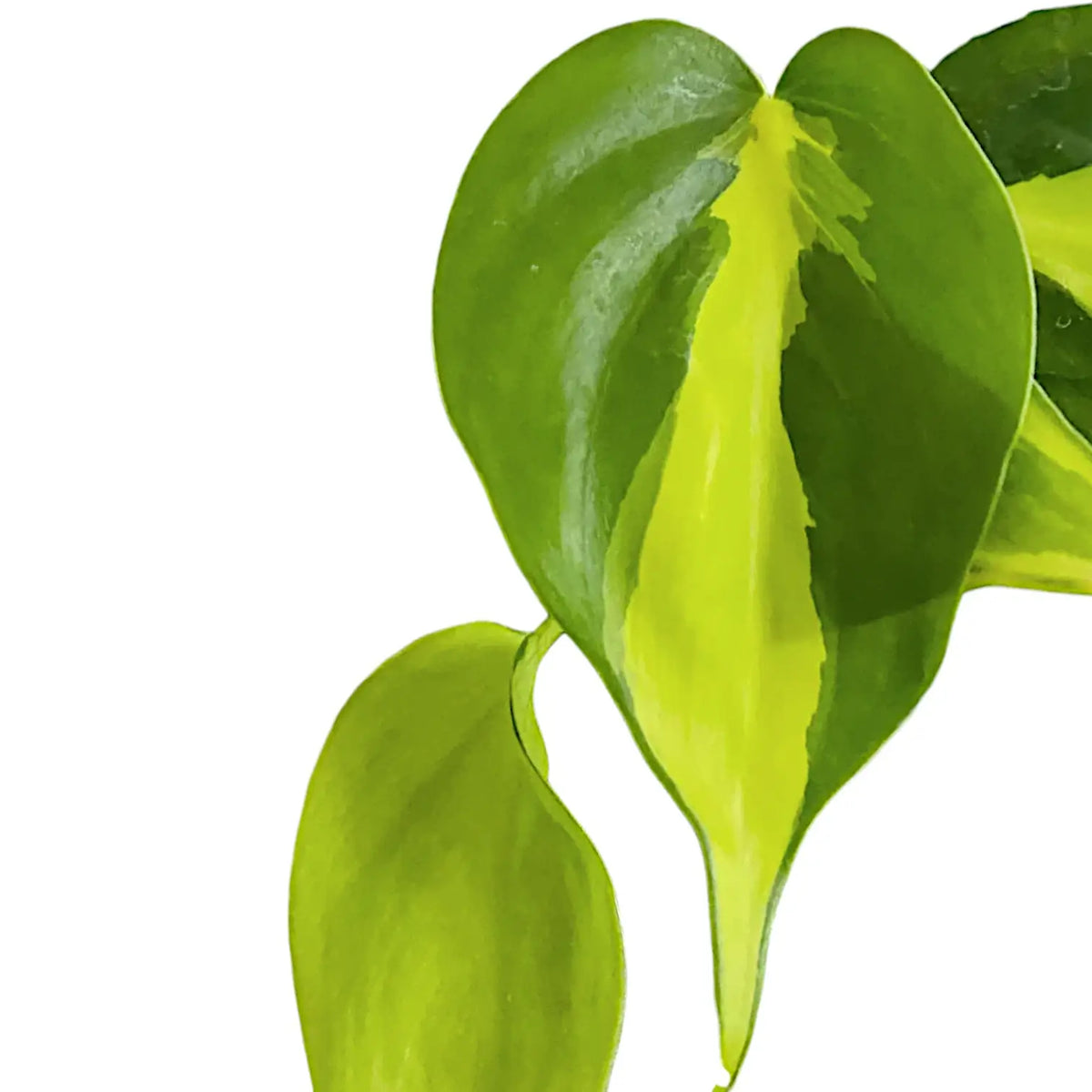
Philodendron hederaceum var. oxycardium 'Brasil' is a green-and-lime heartleaf Philodendron with irregular yellow-green streaking through the leaf centre. The leaves are cordate at the base, pointed at the tip and arranged along long flexible stems that can trail, cascade or climb with support.
New growth can show reddish to orange tones on young stems and petioles before maturing greener. The leaf pattern varies naturally: some leaves carry a narrow central flash, while others show broader yellow-green sections across the midrib area.
Philodendron 'Brasil' lime flashes through dark green heart leaves
- Dark green heart-shaped leaves with irregular yellow-green to lime central variegation.
- Young stems and petioles can show reddish to orange tones before maturing greener.
- Elongated leaf tips give the foliage a sharper outline.
- Irregular central streaking varies naturally from leaf to leaf.
- Multiple rooted stems in one pot create a fuller cascade of patterned leaves.
Philodendron 'Brasil' as a Holambra selection
Philodendron 'Brasil' was selected in Holambra, Brazil, in 1991 from a naturally occurring mutation of a heartleaf Philodendron. Its green and yellow-green variegated leaves, elongated tips and reddish young stems define the cultivar.
The vine branches from nodes after pruning and can become dense when several cuttings are grown together. A vine that repeatedly produces plain green leaves can be cut back to a stronger patterned node to keep the leaf pattern balanced.
Growing Philodendron 'Brasil' with clear colour and tight internodes
- Light: Give bright indirect light for shorter internodes; hot direct sun can scorch pale sections of the leaves.
- Watering: Let the upper 25–35% of the mix dry before watering again, then drain the pot fully so the fleshy roots do not sit wet.
- Substrate: Use a chunky aroid mix with bark, perlite or pumice and a modest moisture-holding component.
- Temperature: Keep it warm, preferably 18–27°C, with no cold draughts around hanging baskets or shelves.
- Humidity: Moderate humidity is enough for routine growth; steadier humidity can help fast-growing vines unfurl with fewer curled tips.
- Training: A pole or trellis gives older stems contact and can encourage larger, neater leaves on established growth.
- Pruning: Trim long bare vines above a node to encourage branching and use the cuttings for propagation.
- Fertilizing: Feed lightly during active growth with a balanced fertiliser diluted below full strength.
- Repotting: Repot when the roots have filled the container or watering dries the mix unusually quickly.
- Propagation: Stem cuttings root readily when each cutting includes at least one node and a healthy leaf.
- Mineral substrates: It can adapt to airy semi-hydro or mineral substrates if the roots are transitioned gradually and kept oxygenated.
Philodendron 'Brasil' green reversions, scorch and pests
- Plain green sections: Cut back repeated green growth to a patterned node to keep the variegation balanced.
- Scorched pale areas: Move the plant away from direct sun; pale tissue can mark quickly in hot light.
- Yellow lower leaves: Check whether the pot has stayed wet too long, especially in cooler months or dense soil.
- Thin, stretched vines: Increase indirect light or give the stems support so the leaves sit closer together.
- Sticky residue or distorted tips: Inspect new growth and stem nodes for thrips, spider mites, mealybugs and scale before they spread along the vine.
Philodendron 'Brasil' pet safety
Philodendron 'Brasil' is not pet-safe if eaten. Its tissues contain insoluble calcium oxalate crystals, which can irritate the mouth and digestive tract, so place it out of reach of pets that bite leaves or stems.
Philodendron 'Brasil' published name and Holambra cultivar origin
The botanical background sits under Philodendron hederaceum var. oxycardium, published as Philodendron hederaceum var. oxycardium (Schott) Croat in World Checklist and Bibliography of Araceae in 2002. The variety is based on the earlier name Philodendron oxycardium Schott. Philodendron means tree-loving, hederaceum refers to ivy-like growth, and oxycardium describes the sharply heart-shaped leaf blade. The cultivar Philodendron 'Brasil' was selected in Holambra, Brazil, from a naturally occurring variegated mutation and is grown for its lime-yellow central patterning and reddish young growth.
Philodendron 'Brasil' brings fast heartleaf growth, flexible trailing stems and lime-patterned leaves that vary naturally from node to node.
Shipping Notes
- Free Standard Shipping on $100+ Orders to the USA.
- Except Preorder products are shipped in 48 hours.
- Delivery to the USA:
- Standard Shipping : 3-10 business days
- If time is of the essence, please consider selecting expedited delivery for faster service.
Exchange/Return Notes
- We offer a 30-day return/exchange service after receiving.
- Final sale items are not eligible for returns or exchanges.
- To process your return/exchange, please contact us at [email protected]
- Please click here for more details>>> Return & Exchange Policy