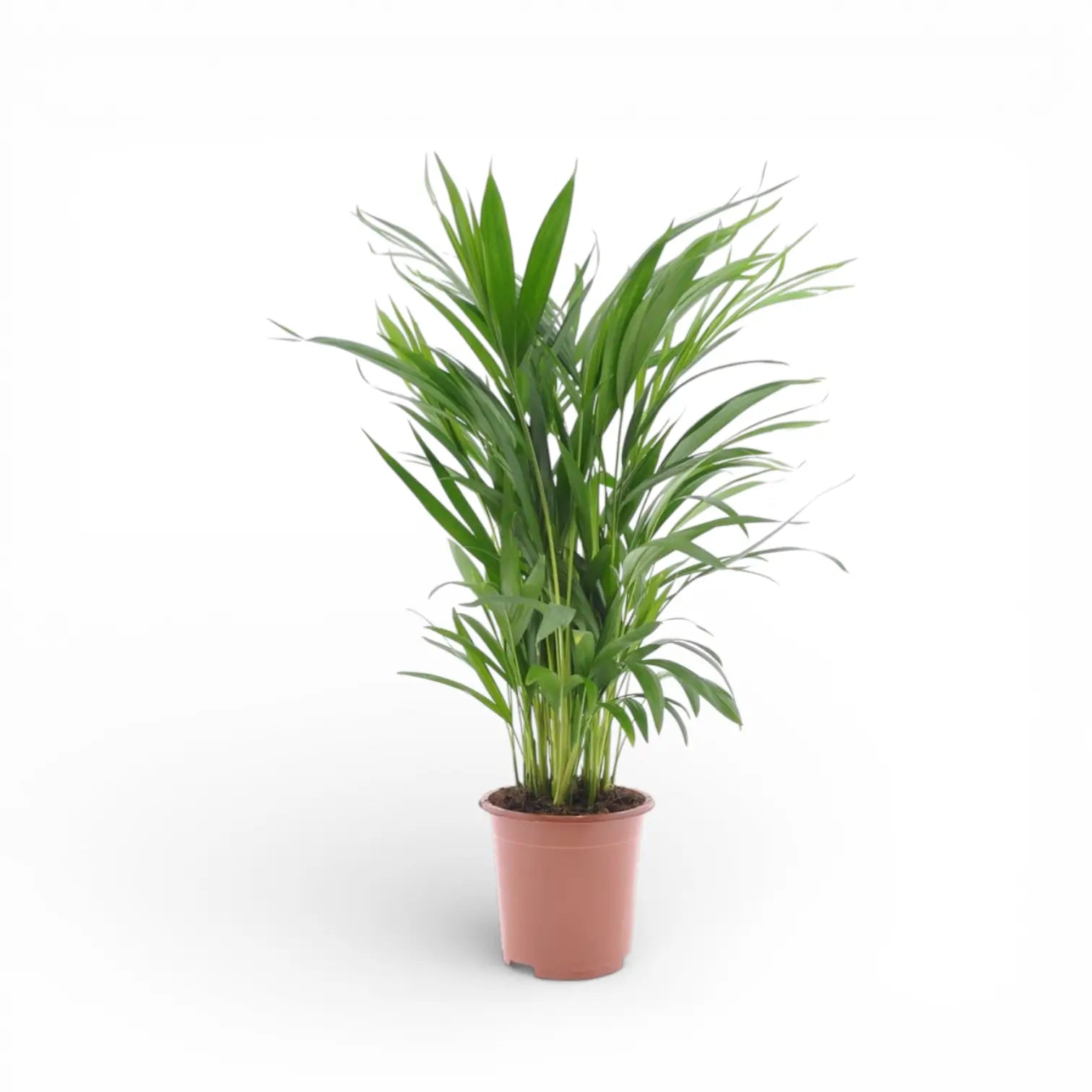
areca palm plant uk Chrysalidocarpus lutescens
SKU: 27202472218
areca palm plant uk

areca palm plant uk Chrysalidocarpus lutescens

Sale price$20.95 Regular price$23.28
Save 10%

Shipping Estimate
USA
  • USA
  • CAN

Ships within 48 hours · Estimated delivery Jul 8 - Jul 13

Promo Codes Available:

For Your Every Summer RSVP, with Code: SUMMER15

Description

areca palm plant uk Chrysalidocarpus lutescensChrysalidocarpus lutescens Chrysalidocarpus lutescens, still widely known under the synonym Dypsis lutescens, is a clustering palm with upright cane like stems and long, arching feather leaves. Several stems rise from the base, creating a soft, fountain shaped crown with yellow green petioles and narrow leaflets arranged along each frond. Indoors, this palm develops slowly into a broad, leafy specimen with a layered vertical outline. As the stems

Chrysalidocarpus lutescens

Chrysalidocarpus lutescens, still widely known under the synonym Dypsis lutescens, is a clustering palm with upright cane-like stems and long, arching feather leaves. Several stems rise from the base, creating a soft, fountain-shaped crown with yellow-green petioles and narrow leaflets arranged along each frond.

Indoors, this palm develops slowly into a broad, leafy specimen with a layered vertical outline. As the stems mature, they become more defined, while the fronds keep the crown airy, layered, and finely textured.

Golden cane palm details

  • Golden cane palm forming grouped yellow-green stems
  • Arching pinnate fronds with many narrow green leaflets
  • Yellow-green leaf stalks and midribs give the plant its warm tone
  • Can form a sizeable indoor floor plant over time
  • Rarely flowers indoors; mature outdoor plants may produce yellow flowers and small fruits

Eastern Madagascar origin and clumping growth

Chrysalidocarpus lutescens is native to Madagascar and belongs to the palm family, Arecaceae. In habitat and tropical cultivation it can grow as a shrub-like or tree-like palm, with multiple stems forming a broad clump. Indoors, its final shape depends on light, root space, and steady watering.

Each stem grows from a central crown. Fully brown fronds can be removed at the base, while green fronds should stay in place so the palm retains enough leaf area for new fronds. New fronds emerge from the growing points and gradually open into the palm’s feathered canopy.

Because this palm forms a clump, uneven growth is normal: some canes may sit lower while newer stems fill the centre. Turn the pot occasionally so the crown develops evenly, and keep the leaf bases open enough for inspection because pests often settle where the fronds meet the stems.

Keeping Chrysalidocarpus lutescens evenly leafy

  • Light: Use a bright, indirect position. Gentle morning or late afternoon sun suits acclimated plants, while strong midday sun behind glass can scorch fronds.
  • Watering: Keep the substrate evenly lightly moist during active growth, then let the upper layer dry before watering again. Avoid cold, saturated soil.
  • Substrate: Use an airy, well-drained palm or houseplant mix with mineral drainage material to keep the root zone open.
  • Temperature: Keep the palm warm, ideally above 18 °C, and avoid cold draughts or temperatures below about 15 °C.
  • Humidity: Average to moderate indoor humidity is workable, although very dry heated air can crisp leaflet tips. Use a humidifier where winter air becomes persistently dry.
  • Feeding: Use a low-strength fertiliser in spring and summer. Too much feed can show as yellowing or salt stress on leaflet tips.
  • Repotting: Move up one pot size when roots have filled the container, often after 2–3 years. Avoid oversized pots that keep the mix wet for too long.
  • Pruning: Remove only fully spent fronds. Cutting green fronds reduces the palm’s active leaf area.
  • Leaf cleaning: Wipe dusty leaflets gently or rinse the fronds with lukewarm water so the narrow leaflets can receive light evenly.

Frond, cane and pest checks

  • Brown tips: Often linked to dry air, irregular watering, salt build-up, or old leaf age. Check moisture pattern and flush the substrate if fertiliser salts have built up.
  • Yellowing fronds: Can follow overwatering, poor drainage, low light, nutrient imbalance, or natural ageing of older leaves. Check the root zone before feeding.
  • Mites or scale insects: Fine stippling, webbing, sticky residue, or bumps on stems and leaf bases need early inspection and treatment.
  • Collapsed stems: Soft bases usually point to root or crown stress from persistently wet, cool conditions.

Pet-safe palm status

ASPCA treats the areca palm, Chrysalidocarpus lutescens, as non-toxic to cats and dogs. Sensitive pets may still get mild stomach upset from chewing the fronds.

Accepted name and synonym note

Chrysalidocarpus lutescens H.Wendl. is the accepted botanical name for this Arecaceae species. Dypsis lutescens remains a common synonym in horticulture. The genus name refers to chrysalis-like fruits, while lutescens means turning yellow, matching the yellow tones in the flowers, stems, and leaflet midribs.

Chrysalidocarpus lutescens grows into golden cane clusters with airy fronds and a full upright palm outline.

Shipping Notes
  • Free Standard Shipping on $100+ Orders to the USA.
  • Except Preorder products are shipped in 48 hours.
  • Delivery to the USA:
  1. Standard Shipping : 3-10 business days
  • If time is of the essence, please consider selecting expedited delivery for faster service.
Exchange/Return Notes
  • We offer a 30-day return/exchange service after receiving.
  • Final sale items are not eligible for returns or exchanges.
  • To process your return/exchange, please contact us at [email protected]
  • Please click here for more details>>> Return & Exchange Policy
SKU: 27202472218

Discover Niche Categories That Outsell areca palm plant uk

Top-Converting Item to Boost Your Average Order

4.4 ★★★★★
Based on 89 reviews
Sort
Highest Rating
Newest First
Oldest First
Product Reviews
O
Verified Purchase
Olga
Boise, US
★★★★★ 5
A lot of fun for dogs
Color: Multi Squeaker Balls, Size: Large, Style: 4-Pack, Color: Multi Squeaker Balls, Size: Large, Style: 4-Pack
My dogs love it a lot. Balls don't fall off the balcony - good size. Great sound which catches dogs attention . Colorful . Good quality.
WAS THIS REVIEW HELPFUL?YesReportShare
Reviewed in the United States on May 28, 2026
J
Verified Purchase
Jarrett Austin pirtle
Grantham, US
★★★★★ 5
👍🏼
Color: Multi Squeaker Balls, Size: Medium, Style: 4-Pack
This dog squeak ball has been a big hit in my home and keeps my dog entertained for long periods of time. The squeaker really grabs their attention and encourages play, tapping into their natural instincts to chase and fetch. My dog especially loves how it bounces and squeaks, making it perfect for both indoor and outdoor play. It’s lightweight and easy for them to carry around, even for quick games of fetch in the yard. In terms of durability, it has held up pretty well so far. The squeaker may not last forever with heavy use, but the ball itself still stays in good shape. Overall, it’s a fun, engaging toy that keeps my dog active and happy.
WAS THIS REVIEW HELPFUL?YesReportShare
Reviewed in the United States on April 29, 2026
P
Verified Purchase
Precise Disarray
Massapequa, US
★★★★★ 4
budget friendly for dogs who lose balls in the creek
Color: Multi Squeaker Balls, Size: Medium, Style: 4-Pack
Not great quality, but works for our needs. I have a ball crazy lab. She loves for me to throw a ball using the Chuck-it Ball Launcher. We do this in our wide back yard that butts up to a creek. At some point during her run and fetch, she will take a quick detour right into the creek. She nearly always still has the ball, but once in awhile it is lost. Not wanting to chance it on more pricy (and more durable) balls, I get these or something like these. They dont cost much, yet they do the job. I' not upset if one gets sacrificed to the creek waters and mud. Since the balls end up getting wet often, they will kinda fall apart over time (chasing, kicking, throwing, retrieving, dog saliva etc). But she doesn't chew on them. Glad she doesnt as tennis balls arent good on teeth, but even if it was ok, the balls probably would be breached easily. SO get these if you are like me and want a ball that does the job but arent a total financial loss if get lost or destroyed. For indoor play we and by we I mean our 3 dogs demand that we use the rubbery max glow chuck-it ball. And will ignore this style ball. Yes, I am well trained. lol
WAS THIS REVIEW HELPFUL?YesReportShare
Reviewed in the United States on November 11, 2024
L
Verified Purchase
Lisa
Whiting, US
★★★★★ 1
These balls SUCK! External squeakers, minimal bounce and blue that is too dark.
Color: Multi Squeaker Balls, Size: X-Small, Style: 8-Pack
We have 2 little dogs in our home - a 1.5 year old Pomsky, and a 9 year old Pekingese. My Peke has shown no interest in tennis balls for years, until today! Imagine my excitement! Until she promptly destroyed the first squeaker on one of the blue balls. When I removed it, she began peeling the logos off the ball, and then started tearing the fuzz off! My dog has never destroyed any toy in her life, so this was shocking! Then the Pomsky decided that she wanted to play fetch with the new balls - she has Golden Retriever energy - and decided to destroy a squeaker in the midst of playing! She also wasn't nearly as interested in these tennis balls as her other tennis balls that she inherited from my Peke. 1. STUPID design, with the squeakers sticking out of the balls (the don't sit flush), so they are asking to get chewed or pulled out by any dog, even elderly 10 lb dogs! And a 9 lb young adult. 2. They are difficult to squeak compared to their Kong tennis balls, hence why the Pomsky wasn't interested for long. 3. They don't bounce as much as the Kong tennis balls, either, which made them less than exciting for the athletic and agile Pomsky. Meh. We wanted to get the smallest tennis balls we could get (1.5 inch) because neither dog will play with the 2 inch or bigger ones, but we also wanted to get colors they could easily see! The Pomsky clearly prefers the yellow balls to any other color (red, orange, green, darker blue, watermelon design), so we wanted to get like a bright blue or turquoise couple of balls to appeal to them! Well, my senior Peke liked the blue ones the most, but also liked the red and orange. Pomsky didn't like the blue ones. I think they're too dark of a blue to be easily seen in our home afternoons and evenings in the winter. We love Outward Hound toys in our house, but these were an expensive FLOP. They are the right size, but WHY did they put the squeakers so visible and appealing to dogs? I've never seen the squeaker in the Kong tennis balls. My advice is that Kong seems to make the best tennis balls for toy breeds, in the 1.5" size. Outward Hound dropped the ball here... no pun intended. The blue is darker than the photos depict (may be better in natural sunlight outdoors), the squeakers are external, and they barely bounce at all. Our next step will be to get the pressurized bright blue tennis balls from another brand, in hopes that the bounce and visibility will outweigh the lack of squeakiness. If those don't work, I guess we'll stick to the classic neon yellow Kong tennis balls! At my local Target, they only have multicolor packs of them, and the dark blue, red and green get completely ignored. *Dogs can only see shades of blues, yellows and black, grey and white. While some dogs may not seem to care about color, our Pomsky clearly does. :(
WAS THIS REVIEW HELPFUL?YesReportShare
Reviewed in the United States on December 21, 2023
H
Verified Purchase
Hummingbird
New York, US
★★★★★ 5
My Dog Loves Them
Color: Multi Squeaker Balls, Size: Small, Style: 8-Pack
These cute little squeaky balls are the perfect size for my Shih Tzu. She loves to chew on them and make them squeak all the time, so they are durable. I would purchase them again.
WAS THIS REVIEW HELPFUL?YesReportShare
Reviewed in the United States on May 16, 2026

recommand products