Pay in installments of $7.48 with
 ,
,
 and
and

Shipping Estimate
USA
- USA
- CAN
- USA
- CAN
Ships within 48 hours · Estimated delivery Aug 2 - Aug 7
 Promo Codes Available:
For Your Every Summer RSVP, with Code: SUMMER15
Description
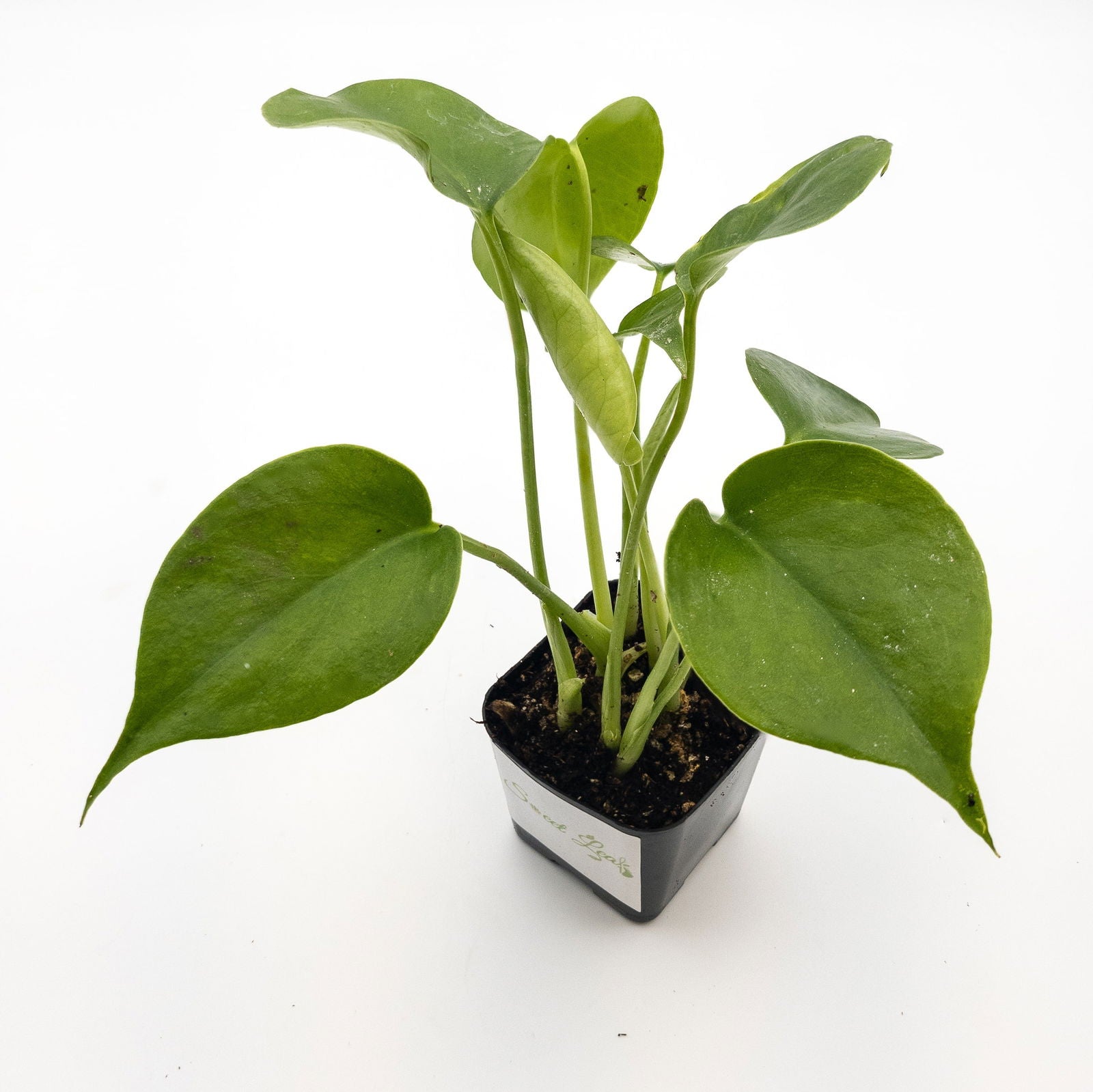
monstera deliciosa pups Baby Monstera Deliciosa – Sweet Leaf NurseryInformation on heat packs and weather is below. Monstera Deliciosa (Swiss Cheese Plant, Mexican Breadfruit, Windowleaf, Split Leaf Philodendron) is a climbing tropical evergreen perennial vine in the Araceae family, native to Central America. They are toxic to fuzzy pets, but reptile safe in small amounts. All parts of the Monstera are toxic to humans except the fully ripened fruits. DO NOT EAT your monstera fruits if you do not know what you are
Information on heat packs and weather is below.Monstera Deliciosa - (Swiss Cheese Plant, Mexican Breadfruit, Windowleaf, Split Leaf Philodendron) is a climbing tropical evergreen perennial vine in the Araceae family, native to Central America. They are toxic to fuzzy pets, but reptile safe in small amounts. All parts of the Monstera are toxic to humans except the fully ripened fruits. DO NOT EAT your monstera fruits if you do not know what you are doing.
Monstera produce large green leaves, growing up to two feet long or more, and will develop fenestrations (holes) in the leaves as they age. Mature Monstera bloom when you mimic their natural habitat with a white and yellow flower spike that grows to be up to 6 inches tall. Flower spikes will develop into fruits that are up to 10 inches long. Great plant for outdoor decoprations in the proper zone and can grow indoors to fill corners. When trellised or staked, plants will climb up to 70 feet high, but can be pruned to keep them a manageable size and cuttings with a node will root for propagation.
Plants will arrive in a 2 inch plastic nursery pot for safe travel, and will need to be repotted upon arrival in a 4” pot with any standard potting soil. Plants like to be somewhat rootbound, and should only go up one pot size at a time when they begin to outgrow their pots.
Species likes to be in hot, humid temperatures but will be happy in warm areas outdoors. Plants should come in when temps get into the high forties and the plants leaves will freeze and be damaged or killed below 32 degrees F. Cold hardy outdoors year round in Zones 10 - 12, in bright shade. Normal room temperature inside is ideal. Plants prefer bright indirect light and will not do care for direct sun. Easy to grow, these plants are semi-drought tolerant. Allow the top two inches of soil to dry out between waterings. Plants get very dramatic when under watered but will perk back up if watered in time. Fertilize monthly with a liquid, balanced (16-16-16- to 20-20-20 strength) fertilizer during the growing season from Spring to Fall. Mist or place on a tray of rocks or pebbles to increase humidity. Message us for a link to our care guide for more detailed instructions.
Unboxing Instructions: When plant arrives, pot will be in a bag or wrapped to reduce soil loss. remove paper and packaging materials and cut out of bag or wrapping and water thoroughly. Repot in a peat based, standard potting soil.
Shipping Notes
- Free Standard Shipping on $100+ Orders to the USA.
- Except Preorder products are shipped in 48 hours.
- Delivery to the USA:
- Standard Shipping : 3-10 business days
- If time is of the essence, please consider selecting expedited delivery for faster service.
Exchange/Return Notes
- We offer a 30-day return/exchange service after receiving.
- Final sale items are not eligible for returns or exchanges.
- To process your return/exchange, please contact us at [email protected]
- Please click here for more details>>> Return & Exchange Policy
4.7 ★★★★★
Based on 12 reviews
Sort
Product Reviews
★★★★★ 5
An amazing book ...
Format: Paperback
An amazing book. Reading the book helped me understand why the US is experiencing difficulties in "perceived righteousness" today. I would recommend it to anyone who would like to change the World for the better.
Howard Zinn is a benevolent hacker: the kind of hacker I would like my children to be, and why not: all children to be.
For me, Zinn’s A People’s History of the United States hacks history and defines a problem and offers a solution:
1. The problem: a one-sided patriotic history enslaves the masses,
2. The solution: a bottom-up, humanistic history empowers everyone and opens the doors for future reconciliations among different communities.(1)
At this critical juncture of human history both are relevant not only for the US but rather for our race.
A one-sided patriotic bias in history: at what cost?
1. hides wrongdoings and the associated guilt,
2. serves as the first line of defense to deflect current & future criticisms for the past & current mistakes,
3. tampers data gathering, silences questioning & divergence of opinions,
4. reduces communication among communities,
5. defines “the patriotic” and increases the chances of populating the armed forces,
6. defines the other: “the unpatriotic,”
7. increases insecurities,
8. evokes fears (of retribution, etc.)
9. can be misused to justify violence against “the other,”
10. builds a common memory for the masses, builds their egos so that these egos can later be exploited,
11. allows the word “culture” to be used as an equivalence: American culture = being American; (2)
12. a politician can mix these facts to incite emotional reactions of the masses and eventually reach a higher number of votes in a predetermined direction, inexpensively,
13. at school, in the media, in speeches of politicians, and during different rituals (starting with reciting the pledge of allegiance and singing of the national anthem) the patriotic history is repeated and reinforced. Under these conditions, the masses learn to repeat what is given to them. They shun away from questioning further. Their concept of free-will is replaced by a misplaced trust. They learn not to deviate from the norm: they are enslaved and are not even aware of this enslavement.
Many words lose their meaning: “a more perfect Union” “Justice” “secure the Blessings of Liberty,” “democracy.” A higher degree of cynicism and later a deep feeling of helplessness ensue. There are costs to the individual, the family, the society. Since many worldwide look up to the US morally, the use of one-sided patriotic history in the US produces world leaders who imitate bad examples. Consequently, Humanity pays dearly.
A bottom-up, humanistic history empowers everyone:
1. can eliminate ignorance,
2. can eliminate convenient forgetfulness,
3. can eliminate arrogance,
4. improve self-esteem, communication, & understanding
5. can reduce violence,
6. can empower the individuals and the masses: psychologically and economically and thus improve the quality of life,
7. can help the path to sustainable peace.
Among the different communities, the wounds are real. A one-sided history often does not address all of these wounds. Denial freezes any possibility of a reconciliation. A reconciliation process would pass through an acceptance of a historical wrong doing.
In time, mankind may realize that what Howard Zinn has started may be the building blocks of sustainable peace.
As a new year starts, I wish upon all of us: nations, creeds, ethnicities, etc. our very own Howard Zinns.
(1) In the US, these communities can be whites, blacks, American Indians, Mexicans, WASPS, Catholics, Jews, Moslems, Chinese, Japanese, etc. In Turkey, where I am from, these communities include the seculars, non-seculars, Alevites, Armenians, Greeks, Jews, Kurds, etc.
(2) Most of us are led to believe that “being” American/WASP/Jewish/Moslem/... is a “culture;” we almost always have these attributes thanks to coincidences; i.e. we are born into these “states;” how can a state that is largely a coincidence, be culture? I would suggest that only what is done through our free-will is deemed culture. Interestingly worldwide, the education systems, the media, and politicians use and propagate the word “culture” to imply largely a static state, rather than the result of a willful action.
WAS THIS REVIEW HELPFUL?YesReportShare
Reviewed in the United States on December 24, 2016
★★★★★ 5
Good quality
Format: School & Library Binding
Perfect!
WAS THIS REVIEW HELPFUL?YesReportShare
Reviewed in the United States on April 30, 2026
★★★★★ 5
Great book perfect for history lovers
Format: School & Library Binding
This book is perfect for people who love history in general. Very interesting topic in that it deserts why different cultures became more prominent than others over time. I’m still getting through it, but wanted to write a positive review because I’m enjoying it so much.
WAS THIS REVIEW HELPFUL?YesReportShare
Reviewed in the United States on January 23, 2024
★★★★★ 4
Makes you think!
Format: School & Library Binding
Jared Diamond’s Guns, Germs, and Steel is all about figuring out why some societies became super powerful while others didn’t. His main idea is that geography and the environment had a huge impact. Basically, places with good crops and animals to farm had an easier time growing and becoming stronger. The book mixes history, science, and geography in a way that’s pretty easy to follow, even though it covers a lot. Some people think Diamond focuses too much on geography and doesn’t consider enough other factors, but it definitely makes you think differently about history and why the world is the way it is today. It’s a really interesting read if you’re into learning about why things turned out the way they did.
WAS THIS REVIEW HELPFUL?YesReportShare
Reviewed in the United States on March 22, 2026
★★★★★ 5
Great book
The narrator possesses a refined and compelling voice, and the author's writing style stimulates the mind. The author uses a tremendous amount of detail to avoid unnecessary/inaccurate generalizations and intentional/unintentional misinterpretations. However, the author executes this feat without allowing the reader to feel lost in mundane facts. I enjoyed the author's use of rhetorical questions to explore the viewpoints of persons who oppose his assertions. Overall, an informative and invigorating read. I highly recommend this book for anyone who has ever asked, "Why did certain people and cultures end up with so much, while others ended up with so little".
WAS THIS REVIEW HELPFUL?YesReportShare
Reviewed in the United States on August 26, 2010