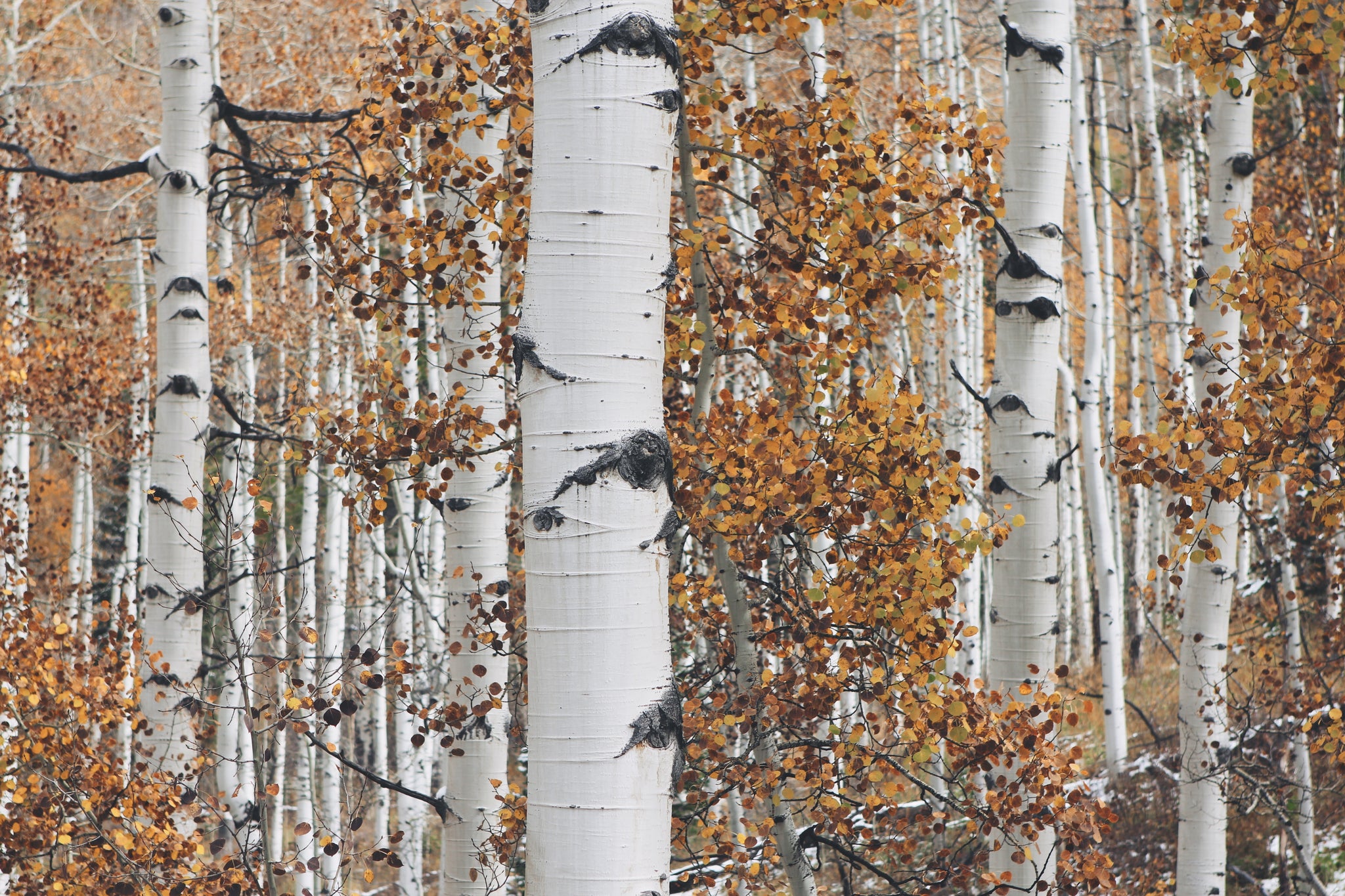
SKU: 26207173183
quaking aspen bonsai tree

quaking aspen bonsai tree Quaking Aspen

Sale price$18.56 Regular price$20.62
Save 10%

Shipping Estimate
USA
  • USA
  • CAN

Ships within 48 hours · Estimated delivery Jul 14 - Jul 19

Promo Codes Available:

For Your Every Summer RSVP, with Code: SUMMER15

Description

quaking aspen bonsai tree Quaking AspenPopulus tremuloides Grow your own Quaking Aspen, a cherished icon of America's High Country! 100% guaranteed Seed grown on California's Redwood Coast Transplanting and care instructions included Highlights Moisture Medium Cold Hardiness 60F Light Full Sun Size 20 80' tall 10 30' spread Lifespan 200 yrs Growth Rate Fast Growing Drought Tolerance High Wind Resistance High Tree Story Quaking Aspen: A Cherished Icon of North America's High Country A

Populus tremuloides

  • Grow your own Quaking Aspen, a cherished icon of America's High Country!
  • 100% guaranteed
  • Seed-grown on California's Redwood Coast
  • Transplanting and care instructions included


Highlights

Moisture
Medium
Cold Hardiness
-60°F
Light
Full Sun
Size
20 – 80' tall / 10 – 30' spread
Lifespan
200 yrs
Growth Rate
Fast Growing
Drought Tolerance
High
Wind Resistance
High
Tree Story

Quaking Aspen: A Cherished Icon of North America's High Country

A member of the willow family, Aspen is the most widespread tree on the North American continent, yet its beauty is anything but common. In autumn, Aspens are nothing less than stunning – gilded with brilliant golden leaves, perpetually trembling and splashing sunlight in every direction. Aspens are fast growers, and can survive almost anywhere – so long as they get ample sunlight. Aspens typically grow to around 80 feet in height, and usually live for about a century.

Populus tremuloides
, also known as “Golden Aspen,” “Quaking Poplar,” and “Small-toothed Aspen,” among other common names, makes its glowing presence known throughout all the great Mountain systems of the United States and Canada. The species’ immense range spreads all the way down into the mountain ranges of Mexico, as well. Every account of early western exploration includes mention of the remarkable beauty of the Aspen groves encountered in the mountains. As one naturalist wrote: “Where the deer bound, where the trout rise, where your horse stops to slather a drink from icy water while the sun is warm on the back of your neck, where every breath you draw is exhilaration — that is where the Aspens grow.”

Aspens grow quickly, and are often the first “pioneer” species to re-populate burned over or otherwise exposed areas of the forest. As a population, they chase sunlight, and are nearly indifferent to changing soil conditions. Likewise, they are a “vagabond” species, which will migrate as other vegetation competes and crowds in for sunlight.

Aspens are especially prolific in high, dry, cool places, commonly close to clean, rushing water, where they form open, sunny groves and regenerate in pure stands, primarily from basal sprouting. In some regions of the far North, Aspens are the only hardwood trees present among the conifers, making them particularly spectacular as they sparkle brilliantly in gilded contrast with the otherwise monochromatic evergreens.

Aspens are typically smallish trees, around 40 feet tall with trunk diameters under two feet across. Their trembling, ever-moving leaves are pale green in spring and summer, burnishing to radiant gold in autumn. Aspen bark is smooth and the color of white-ash. Older trees have bark that’s nearly black at the base, turning to smooth mottled gray higher up the trunk. The bark has analgesic and anti-inflammatory properties, making it a highly valued source of medicine for Native American peoples.

In addition to lending beauty and elegance to the North American high country and providing medicine to indigenous peoples for centuries, Aspen also contribute valuable wildlife habitat and food for a wide variety of animals. Some estimate that as many as 500 different animal and bird species rely on Aspens for forage and shelter. Of all these Aspen fans, it is the beaver who is the true Aspen worshipper. For food and construction materials, the Quaking Aspen is clearly the beaver’s favorite tree. Humans also have a great appreciation for Aspen’s usefulness — it is one of America’s leading pulpwood trees.

The American National Champion Quaking Aspen tree resides in the State of Michigan. The tree is 109 feet tall, with a trunk diameter of nearly 40-inches.

Populus tremuloides
, Quaking Aspen, is a beautiful, useful, historically important, and truly iconic species that can be cultivated virtually anywhere — including your yard, garden, deck, or patio!

About Jonsteen's Seedlings

All of our trees are seed-grown at our nursery on California's Redwood Coast, which is inspected monthly and licensed by the California Department of Agriculture. Trees can provide a natural barrier against high winds, temperatures, noise pollution and soil erosion, all while benefiting local air quality, wildlife and property values — a Jonsteen seedling will only grow in value and beauty!


About Jonsteen's 100% Guarantee

All of our trees are guaranteed to arrive healthy and in good condition. If your tree perishes despite your honest efforts, we will be happy to replace it with a small-sized seedling for just the cost of shipping/handling. You can learn more about our guarantee and tree replacement policy here.


Size Chart

Seedling Size Chart: Medium

Due to the dynamic nature of actively growing trees, as well as the tremendous variation between species’ growth rates, we rely on the cubic volume of a seedling’s root mass to determine its “size” (Small / Medium / Large / XL). Within each size there is minor variance — the dimensions provided here represent the category minimum. If exact measurements are essential, please contact us about current stock.


Shipping Notes
  • Free Standard Shipping on $100+ Orders to the USA.
  • Except Preorder products are shipped in 48 hours.
  • Delivery to the USA:
  1. Standard Shipping : 3-10 business days
  • If time is of the essence, please consider selecting expedited delivery for faster service.
Exchange/Return Notes
  • We offer a 30-day return/exchange service after receiving.
  • Final sale items are not eligible for returns or exchanges.
  • To process your return/exchange, please contact us at [email protected]
  • Please click here for more details>>> Return & Exchange Policy
SKU: 26207173183

Discover Niche Categories That Outsell quaking aspen bonsai tree

Top-Converting Item to Boost Your Average Order

4.2 ★★★★★
Based on 880 reviews
Sort
Highest Rating
Newest First
Oldest First
Product Reviews
B
Verified Purchase
b slev
Los Angeles, US
★★★★★ 5
seekers paradise
Format: Kindle
Some of this book disturbed me a little but overall I found it amazing and fascinating. Possibilities abound in fantasy and can be just the thing you need to open up. Enjoy! I sure did.
WAS THIS REVIEW HELPFUL?YesReportShare
Reviewed in the United States on May 22, 2026
J
Verified Purchase
Jenni DaVinCat
Birmingham, US
★★★★★ 3
We Should All Be a Little Stranger.
I understand why this book is often cited as one of the most important sci-fi books of all time. While reading it, you might begin to question why it’s lumped into the sci-fi category because the themes are very human. It is science fiction, that cannot be argued, but it’s also a coming of age story, a religious story and at its very core, a story about love. Valentine Michael Smith was born and raised on Mars, but he is a human. He is brought back to Earth to learn what it means to be a human. This causes the reader to be forced to think outside of the box because Michael is not just coming from a different human culture, he has never learned what it means to be a human so any chapter told from his perspective is like an outsider, looking in on human culture. It’s wildly fascinating to think about ourselves in this manner. As Michael progresses in his grokking of humans, he gets out to explore the world and to challenge it. Our concepts of God/religion and sex/love are strange to him. We tend to not really think about it from an outside perspective because this is just the way life is, but being forced to think about it, makes for a very fascinating read. I’d never really considered myself to be a “prude” but there were times that this book made me feel that way. At times, the reader must take a step back and remember that Heinlein did intend for many of the themes to be viewed as satire of what is commonly accepted. There were a few negatives when reading this book, however. It was written in the sixties, which was a very different time from today in terms of the way women are spoken to/about and how they are treated. Heinlein wasn’t too bad in this regard, but there were a few sentences that made me stop for a second. Heinlein also has some of his characters go on these long drawn-out speech tangents that go on for pages and pages. I felt it was a little unnecessary to go on for that long, especially considered the length of the uncut version. It took me a little while to get through this book and normally I’m a pretty quick reader. Negatives aside, I do feel like this book is important. The story itself is not challenging, but as I stated before, it challenges the reader to think about humans from an outside perspective and that is fascinating. He really doesn’t seem to rely too much on Sci-fi elements, preferring to focus on the human elements of the story (love, religion etc.). If you’re looking for something long and fulfilling, this may just be the sci-fi book for you!
WAS THIS REVIEW HELPFUL?YesReportShare
Reviewed in the United States on September 29, 2016
K
Verified Purchase
Kendal Brian Hunter
Louisville, US
★★★★★ 5
Wicked Satire, yet Strangely Familiar
Format: Mass Market Paperback
Heinlein's satire is wicked and well-placed, reminiscent of Voltaire and Swift. IF you love British comedy, you'll love this book. Both come from the same sarcastic taproot. I'm still debating whether or not the main charter is Smith or Jubal. Maybe it is us, since we need to recognize that we are Juba, and must nurture, and eventually become like Smith. Smith's reflective, contemplative message, reminds of Thomas A Kempis ( ), James Allen ( ), Lao Tzu ( ). Smith's message is nothing new: as C. S. Lewis pointed out, "Really great moral teachers never do introduce new moralities: it is quacks and cranks who do that... The real job of every moral teacher is to keep on bringing us back, time after time, to the old simple principles which we are all so anxious not to see." . In fact, Smith's slogan "Thou art God" is merely run-of-the-mill Christianity: * "Inasmuch as ye have done it unto one of the least of these my brethren, ye have done it unto me." * "Be ye therefore perfect, even as your Father which is in heaven is perfect." * "Therefore, what manner of men ought ye to be? Verily I say unto you, even as I am." * "Ye are gods; and all of you are children of the most High." * "God became man so that man might be god." * "It is a serious thing to live in a society of possible gods and goddesses to remember that the dullest and most uninteresting person you may talk to may one day be a creature which, if you saw it now, you would be strongly tempted to worship, or else a horror and corruption such as you now meet if at all only in a nightmare. . . . There are no ordinary people. You have never met a mere mortal, Nations, cultures, arts, civilizations, these are mortal, and their life is to ours as the life of a gnat. But it is immortals whom we joke with, work with, marry, snub, and exploit--immortal horrors or ever lasting splendours." . Heinlein seems to have stolen a page from Søren Kierkegaard, who tried to re-Christianize Christianity ( , 458). To paraphrase John, "Brethren, I write no new commandment unto you, but an old commandment which ye had from the beginning." As I read this book, Smith struck me as oddly familiar. His first name, Michael, refers to the Archangel, the captain of the Lord's army. The second name, Valentine, is the patron saint of all shades of love, phileo, agape, eros, and romance. The last name, Smith, makes him Everyman. But I wonder if there is something more. What happens to Smith is common to all founders of religions--Abraham, Jesus, Mohammed, and so forth. There is evolution, turns and twists of fate, and eventual triumph. However, there is a deeper nuance. Society begins with vulgarized Christianity, then there was the Fosterite Revolution, and another apostasy and commercialization of religion as a Megachurch. And lastly comes along Smith, with his Martian philosophy. This bears a strong parallel to the life of Joseph Smith . In fact, both have a similar martyrdom: "Thou art God" versus "O Lord My God." The satire can get tedious at time, but I think this flaw is excusable. As I read, I kept thinking that this book could loose about 1/3rd of the text. But on the other hand, the artistry and beauty of the wicked satire forces me to say, "Leave it alone." Note: This book is the Q document for so much other fiction. I see shades of "Dune" here and there. Smith the new prophet is akin to Ender, the Speaker for the Dead. And if you have seen Star Trek: The Original Series episode "Charlie X," some of the elements will seem a bit too familiar. Keep in mind that this book came first, and that it does a much better job of mixing wit and wisdom than Kirk and Spock. There is no comparison--after reading this book, "Charlie X" rolls like a flat tire.
WAS THIS REVIEW HELPFUL?YesReportShare
Reviewed in the United States on July 9, 2007
P
Verified Purchase
P. Biealczyc
Louisville, US
★★★★★ 5
Really nice
Format: Paperback
Great read and gift
WAS THIS REVIEW HELPFUL?YesReportShare
Reviewed in the United States on May 31, 2026
K
Verified Purchase
Kindra Foster
Alexandria, US
★★★★★ 4
Classic, but a bit disappointed
I’ve always wanted to read this book. Heard a lot about it and it’s importance in the science fiction genre. But I didn’t care for Heinlein’s style of writing. There was a lot of subtle humor in it that was enjoyable, and I suspect he meant for it to be a caricature of humanity. I enjoyed the analysis of human nature throughout the story. But I was disappointed in the direction the story took toward the end. It seemed like a cheap way to develop the possibilities that had been laid out in the rest of the book. I want to believe human beings would value the opportunity and show up in a better way if such a thing really happened. I felt like the main character was so rich and unique in the beginning, but in the end, he felt flat and inscrutable. Having said all of that, maybe if I hadn’t been swayed by my own expectations, I would have enjoyed the story more. I’ll have to try some of his other books and see what I think!
WAS THIS REVIEW HELPFUL?YesReportShare
Reviewed in the United States on May 28, 2024

recommand products