SKU: 254392184
sansevieria cylindrica buy online

sansevieria cylindrica buy online African Spear Plant 'Sansevieria cylindrica' - Shop Online

Sale price$25.79 Regular price$28.66
Save 10%

Shipping Estimate
USA
  • USA
  • CAN

Ships within 48 hours · Estimated delivery Jul 11 - Jul 16

Promo Codes Available:

For Your Every Summer RSVP, with Code: SUMMER15

Description

sansevieria cylindrica buy online African Spear Plant 'Sansevieria cylindrica' - Shop OnlineGet ready to be amazed by the African Spear plant, also known as Sansevieria cylindrica (Dracaena angolensis), one of the snake plant varieties and a vibrant member of the Sansevieria genus! It has many other common names, including cylindrical sansevieria, the cylindrical snake plant, the Starfish sansevieria, the bow string hemp, dragon fingers, and pencil Sansevieria. This snake plant does not have ordinary upright, dark green leaves; they are

Get ready to be amazed by the African Spear plant, also known as Sansevieria cylindrica (Dracaena angolensis), one of the snake plant varieties and a vibrant member of the Sansevieria genus! It has many other common names, including cylindrical sansevieria, the cylindrical snake plant, the Starfish sansevieria, the bow-string hemp, dragon fingers, and pencil Sansevieria. 

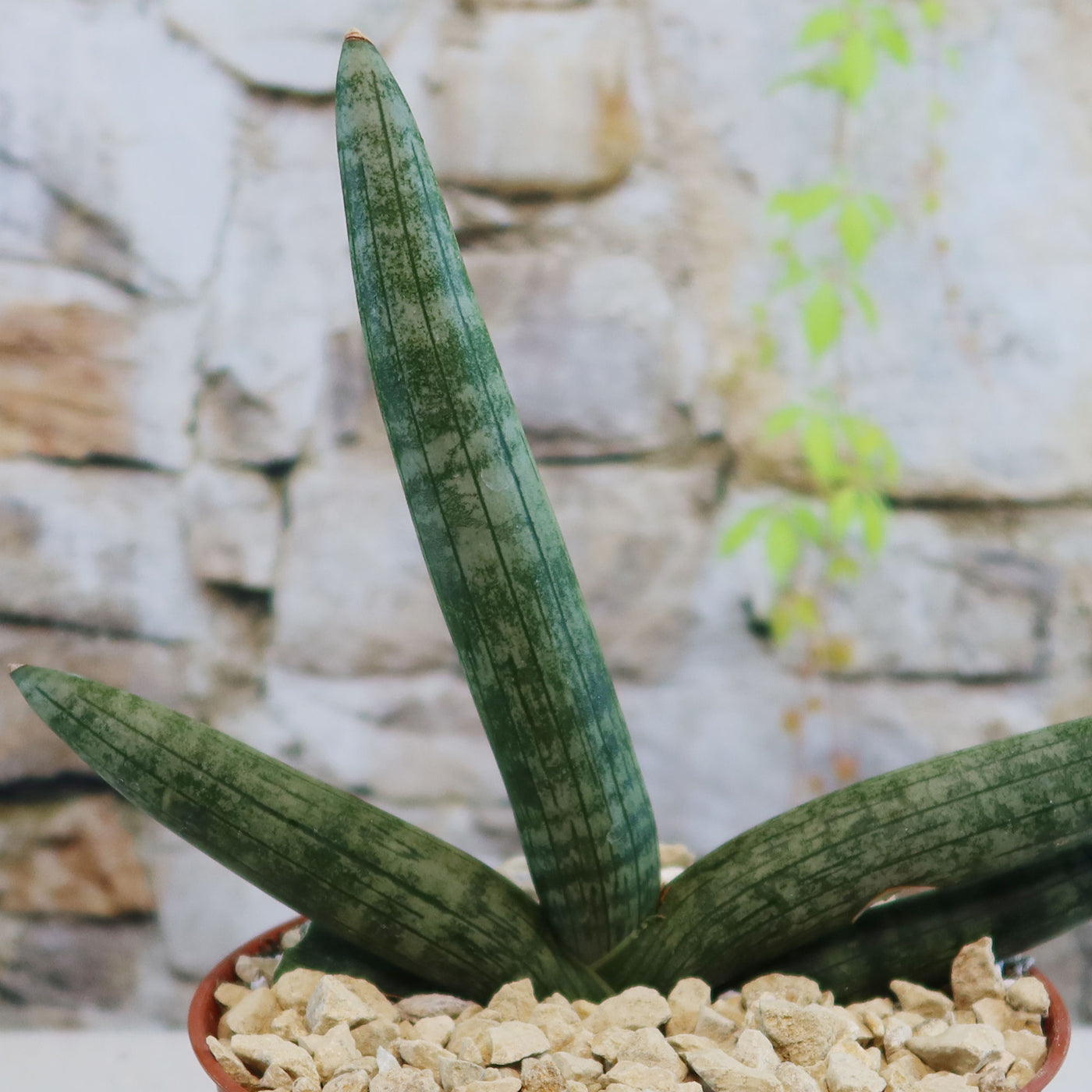
This snake plant does not have ordinary upright, dark-green leaves; they are horizontally striped and have an extraordinary cylindrical fan shape that tapers to a fine point at its tips.The single leaf of this spear sansevieria can grow up to 7 feet tall and up to 1.4 inches wide. 

In the right conditions, these extraordinary Sansevieria plants might surprise you with a small creamy-white flower spike shooting up from their center. While the cylindrical snake plant flower is not the largest or most colorful among its succulent family, it does have a distinct, sweet-smelling, and pleasing fragrance. These delicate white blooms dance in the air like tiny fairies spreading joy and enchantment everywhere they go. It's simply magical! 

Remember, these cylindrical snake plants are mildly toxic for humans and pets, so, it's important to keep them away from children and pets. It is the simplest way to multiply and propagate Sansevieria cylindrica plants. You can either adopt the division or the leaf-cuttings method of Sansevieria cylindrica propagation. While this slow-growing succulent is known to live longer than most other succulents provided it is kept in a warm and well-lit position. 

Watering Needs 

Native to Africa, the African spear succulent plant doesn't need much water to thrive. In fact, it's best to water the Sansevieria cylindrica plant only when the soil is completely dry, which can be once every two to three weeks. When you do water your Sansevieria plants, be sure to do so thoroughly, allowing the water to soak into the soil. Be careful not to overwater it, as this can cause root rot, which can be fatal to the plant. 

But come wintertime (dormant period), you can cut back to every two weeks or less. And get this - any type of water (except hard water) will work just fine! So, whether you use tap or filtered, or even rainwater, your cylindrical snake plant will thrive in no time. Just remember to avoid hard water since this African spear plant doesn't like lime very much. 

Light Requirements 

The African spear plant, or Sansevieria cylindrica survives in bright full sunlight but can also tolerate low light conditions. It's best to avoid direct afternoon sunlight, as this can burn the leaves. 

If you're growing the African spear indoors, place it near a north-facing window that gets plenty of bright, indirect light. If you're growing it outdoors, be sure to provide it with some shade during the hottest part of the day. Without enough light, photosynthesis rates drop, leaves become thin, colors appear dull, there is an unhealthy look to the plant, and growth is stunted. 

Optimal Soil Needs 

The Sansevieria cylindrica prefers soil that's well-drained and rich in organic matter. A good potting mix for this African spear should be a combination of peat moss, perlite, and sand. You can also add some compost or aged manure to the soil to provide additional nutrients. Planet Desert has got your back with our specialized succulent potting mix that includes 5 natural substrates with organic mycorrhizae perfect for promoting healthy roots and happy plants. 

When it comes to fertilizing this Sansevieria, it's best to use a slow-release fertilizer that's high in nitrogen. You can fertilize the plant once a year during the growing season, which is typically from spring to fall. Avoid over-fertilization as it can lead to the death of your stunning succulent. 

Hardiness Zone & More 

Typically grown in hot, arid desert regions, the Sansevieria cylindrica thrives indoors in warm, dry surroundings. If you live in USDA regions 9 to 11, you can also grow these Sansevieria plants outdoors year-round, but they are not cold- or frost-tolerant, so you should plant them indoors or put them in a pot and move them indoors during the winter if you live outside of these regions. 

Keep your African spear plants away from cold, drafty windows and air vents if you are growing them indoors in a cold climate. 

We think you will love this Sansevieria plant order your very own Sansevieria cylindrica - African spear or cylindrical snake plant today and start enjoying its beauty in no time! 

Shipping Notes
  • Free Standard Shipping on $100+ Orders to the USA.
  • Except Preorder products are shipped in 48 hours.
  • Delivery to the USA:
  1. Standard Shipping : 3-10 business days
  • If time is of the essence, please consider selecting expedited delivery for faster service.
Exchange/Return Notes
  • We offer a 30-day return/exchange service after receiving.
  • Final sale items are not eligible for returns or exchanges.
  • To process your return/exchange, please contact us at [email protected]
  • Please click here for more details>>> Return & Exchange Policy
SKU: 254392184

Discover Niche Categories That Outsell sansevieria cylindrica buy online

Top-Converting Item to Boost Your Average Order

4.3 ★★★★★
Based on 2053 reviews
Sort
Highest Rating
Newest First
Oldest First
Product Reviews
R
Verified Purchase
Received as seen on the app. Thanks
Massapequa, US
★★★★★ 5
Product received
Format: Paperback, Format: Paperback
Product received in good condition. I like the book
WAS THIS REVIEW HELPFUL?YesReportShare
Reviewed in the United States on February 19, 2026
D
Dulcimoo
Draper, US
★★★★★ 3
I think this book will give many beginners a good quick start into Python programming
A review of "Python: QuickStart Guide by Robert Oliver" Published by ClydeBank Media Copyright (c) 2023 ISBN-13: 978-1-63610-038-8 First Edition: Last Updated: April 24, 2023 In summary - I feel this book has missed some opportunities, is trying to be “cute" and is somewhat lacking in detail in some of the beginning explanations. However … this book starts at the bottom and builds you up. When you are done … while not quite a Python Expert you will be well on the way. It really is a good overview of Python and covers a lot of ground; while it does leave out some things I would have liked to see, [cough cough turtle graphics — turtles make a great introduction to objects … even if they may have taken a detour to the application you end up with at the end] you can’t put every everything including the kitchen sink in a book like this. Most of the things I would have liked to see differently are just nit-picky: they have these little icons (Note, quckclip, detour, etc.) … things like that should be DEFINED before they show up — the introduction is the perfect place to do that; that that isn’t done bugs me. That he brings up “X” as in Algebra isn’t really needed, programming variables are known quantities for the most part, and are more like the names for things, or the name of a box that contains something … the “variables” in Python has little to do with the variables in Algebra which are unknowns you are trying to solve for. As example of missing “essential” detail: In the discussion of data types such as integers, and floating point numbers, and strings but don’t discuss magnitude and precision for the numerical datatypes. Not everyone needs to know that in integers basically have as much precision as you have allowed it memory to run. This isn’t “normal” in most other languages and is a nifty feature of Python. I have used it to compute really large numbers such as the 1 millionth Fibonacci number, or the 33rd perfect number (it has over half a million digits, and is very simple in Python[see the short code at the end of this review for another example]). It doesn’t discuss comparison operators for objects you create (I feel that is an important topic, but may be more advanced that this introductory book is designed for - and actually isn't NEEDED but would have been a nice thing to mention). On the other hand the discussion of Python data structures really was very clear. While it does discuss and use objects, the discussion really isn’t in-depth. But that is OK as this is a quick start guide, not an in-depth reference book. You could (and will later if you go on) find enough to fill a book half this size talking about the details of Python Object Oriented programming ([P]OOP). This one may not be a nit if they are older: The format is somewhat difficult to read when it comes to the code examples. Code examples are highlighted in gray, this lowers the contrast and unless well lighted makes it harder to read, so make sure you read it in a well lit room or use a book light. Bolding the highlighted text would probably solve this issue. The binding is great (it is spiral bound) and even being somewhat thick, every page lies flat — this makes it easy to use for when you are copying the code examples to your computer. The code can be downloaded, but I would recommend that you type everything in. Errors made by having your typed code not be what you intended to type in are a common source of errors and learning how to find and correct those sorts of errors now will save you a lot of problems. The book isn’t just introductory material, but gets into some fairly advanced topics such as databases, test driven development, and using GIT. The book does do a good job about more “advanced” topics. It talks about some features of Python while just a few years old may not have been know to some older Python Developers (like dataclass, or Lamda expressions). It provides you an introduction to developing websites, and interacting with the web, multiprocessing, optimization, and error handling to name a few. I really think topics that may stump some people the author has explained clearly and concisely the make the topics easy to grasp. One thing that surprised me is that it didn’t talk about the philosophy of Python in the introduction… No braces {} or semicolons, but you do need the occasional colon Whitespace, indentation, and blank lines MATTER in Python. That needs to be hammered in (really). One simple way of doing things (not a lot of different ways to do the same thing). And the name Python comes from the Monty Flying Circus kind and not the Reptile kind (even though a lot of Python “stuff” has the snake kind on it). It doesn’t talk about Python 2. Python 2 and 3 are different Code bases, They eventually stopped “improving” Python 2 and Python 3 is the one true version of Python, it should at least have a mention. The phylosophy is important because in Python white space in really important, and that is part of the philosophy of Python that should be covered. This is probably one of the things that messes people up most in the beginning (and that case matters — cow and COW are not the same, as they are in a lot of cases in Windows machines). Here is an example of case mattering: (not from the book). >>> cow=3 >>> cow==COW Traceback (most recent call last): File "", line 1, in NameError: name 'COW' is not defined. Did you mean: 'cow'? Here are some things to try once you get your Python installed that show a bit of Python Humor…(also not from the book)… >>> import this The Zen of Python, by Tim Peters Beautiful is better than ugly. Explicit is better than implicit. Simple is better than complex. Complex is better than complicated. Flat is better than nested. Sparse is better than dense. Readability counts. Special cases aren't special enough to break the rules. Although practicality beats purity. Errors should never pass silently. Unless explicitly silenced. In the face of ambiguity, refuse the temptation to guess. There should be one-- and preferably only one --obvious way to do it. Although that way may not be obvious at first unless you're Dutch. Now is better than never. Although never is often better than *right* now. If the implementation is hard to explain, it's a bad idea. If the implementation is easy to explain, it may be a good idea. Namespaces are one honking great idea -- let's do more of those! >>> Or try import antigravity Python is a fun programming language to learn and it probably the best language for a beginner. Python is a fairly easy to learn programming language, and Mr. Oliver’s brief look back at BASIC is fitting. I do think that Python, in may ways, really is the new BASIC. In conclusion: This book does provide you a step by step learning path, if followed will get you a lot more knowledgeable about Python, while fairly wide it isn’t always as deep as I would like. The Python QuickStart Guide(r) is like one of those tour packages, it covers all the things you need to see but sometimes you wish you could linger a bit more on a topic. The Coffee Shop game that you work in throughout most of the book is interesting and leads to some good topics and gets you in to some really good practices so you start out right. The author has provided a video the help you get going which will help you over the rough beginning spots. If you take the time, and follow the book step by step, I think you will be pleased with your progress, and will be able to do some fun stuff quickly. Just remember to do a little bit every day, because learning to program is like learning any language — practice makes perfect. PS: You might want to try this to see just how easy it is in Python to work with large integers: f=1 for x in range (1, 101): f=f * x print (f" {x:>3d}! = {f:>210,d}") print If you had the book, you would know what to do with that! Also - It may not show up but the following lines need to be indented two spaces in the above example f=f * x print (f" {x:>3d}! = {f:>210,d}") print
WAS THIS REVIEW HELPFUL?YesReportShare
Reviewed in the United States on May 26, 2023
M
Verified Purchase
Michael S.
Fort Morgan, US
★★★★★ 5
Great intro to (Monty) Python...
Format: Hardcover
Quick start books are really really good. Get right to the topic but in a way that does not leave your head swimming. Great intro text to the language that will prepare the reader for deeper tomes with the added bonus of a pretty well structured intro project. Recommend this publisher and will be looking for more of their titles.
WAS THIS REVIEW HELPFUL?YesReportShare
Reviewed in the United States on June 20, 2025
D
Verified Purchase
Dishem
Cuba, US
★★★★★ 5
Great for reluctant readers
Format: Paperback
This book is great for reluctant readers. I got this for my niece and her mother asked if I knew of any other graphic novels like this one because of how much my niece loved reading it. I ended up reading it and the story is very enjoyable and inspiring. The art is exceptional. I was very happy to find that there are more in the series. I bought both the first and second ones for my step daughter and other nieces this Christmas. Highly recommend!
WAS THIS REVIEW HELPFUL?YesReportShare
Reviewed in the United States on January 10, 2026
K
Verified Purchase
Kindle Customer
Whiting, US
★★★★★ 5
Foster Care! Magic Paint! Superheroes! OH MY!
Format: Kindle
This was a great read. I loved everything about it. The artwork is vivid. The main character’s personality is spot-on. The humor was great. Ashley is a girl in a world where she is herself and nobody else. At least, that’s what she thinks. Really, she’s a girl stuck in foster care because her dad’s in jail. She has a carefree attitude on the outside, but on the inside she’s really tender-hearted. Then one day a new family shows up, attempting foster care with Ashley. She’s living pretty nicely there and she’s made a friend named Luke. Then one day her foster mom comes home acting kind of strange. Later, Ashley decides to snoop into what’s in that mysterious suitcase her foster mom brought in and hid in a closet. She and Luke find paint. Lots of tubes of paint. Ashley puts them on her skin, because she “likes the texture.” This is where I think it’s waaaaay too obvious that what she’s doing has to be specifically made like that for the storyline. It’s okay though, they do an okay job of hiding it. Anyway. These paints are magic paints that give the person who wears them superpowers! So of course Ashley has to go and use them and be a superhero she calls ‘Primer’. But her foster mom’s job wants those paints she brought home back. So they send their roughest, toughest soldier to retrieve them. Ashley, of course, has a fight with her foster mom about it, and Ashley decides to run away, taking the paints with her. Then obviously the soldier dude shows up, with a bunch of robots. There it just turns into your normal superhero fight scene, but then Ashley loses and the paints are taken except the teleportation one. The soldier, by the way, is named Strack. So then Ashley’s like, “Oh no, I’ll neeever be a hero” even though obviously she will, this is a superhero story. Suddenly her phone is ringing. It’s her foster dad and mom. She picks up their video call and it’s STRACK! He’s adult-napped her foster parents, of course. She debates going to fight Strack, or to just leave it. She goes with leave it until she looks up and sees a painting she made and this suddenly gives her confidence, for reasons unknown. So then there’s another big fight scene with Strack, but Ashley is overconfident like she knows she can’t die, it’s a book and that would be devastating for little ones reading it. Anyway, she wins and frees her parents and they all live happily ever after. So, this story ends in a cliffhanger that’s not a very good one. It’s just Ashley’s REAL dad seeing her on TV from when she went out and was a superhero the first time, and he’s like, “You’re not Primer, every father knows his daughter’s eyes, ASHLEY. See you soon.” So if I was hanging from a cliff here, I would be attached to it with a safety cable and I would be laying on the top of the cliff, with only my foot hanging off. It’s not much of a cliffhanger. This was a great book about a female superhero. Oh, and another thing I forgot to mention, there is a page you should skip if you are reading to a child under seven. Page…. Let’s see here… oh yes. Page seventy-seven. It involves a gun and likely shooting afterwards, but it isn’t shown. I am a very sensitive person, and even I, an almost-teen was kind of rustled by it. Anyways, great story, lovely artwork, good book. I’m rounding up from 4.5 stars. -written by a tween
WAS THIS REVIEW HELPFUL?YesReportShare
Reviewed in the United States on February 26, 2022

recommand products