jicama seeds for planting True Jicama Seeds - For 2026 Planting USA Garden Vegetable Mexican Yam
SKU: 24016285769
jicama seeds for planting

jicama seeds for planting True Jicama Seeds - For 2026 Planting USA Garden Vegetable Mexican Yam

Sale price$19.57 Regular price$21.74
Save 10%

Shipping Estimate
USA
  • USA
  • CAN

Ships within 48 hours · Estimated delivery Jul 6 - Jul 11

Promo Codes Available:

For Your Every Summer RSVP, with Code: SUMMER15

Description

jicama seeds for planting True Jicama Seeds - For 2026 Planting USA Garden Vegetable Mexican YamJicama, often called the "Mexican turnip," is a globe shaped root vegetable that brings a delightful crunch and subtle sweetness to any dish. With its light brown skin and crisp, white flesh that tastes like an apple but not as sweet, jicama is a refreshing and nutrient packed addition to your garden and kitchen. In Central America, jicama is often sold by street vendors and commonly eaten raw, and seasoned with lemon or lime juice and chili powder.

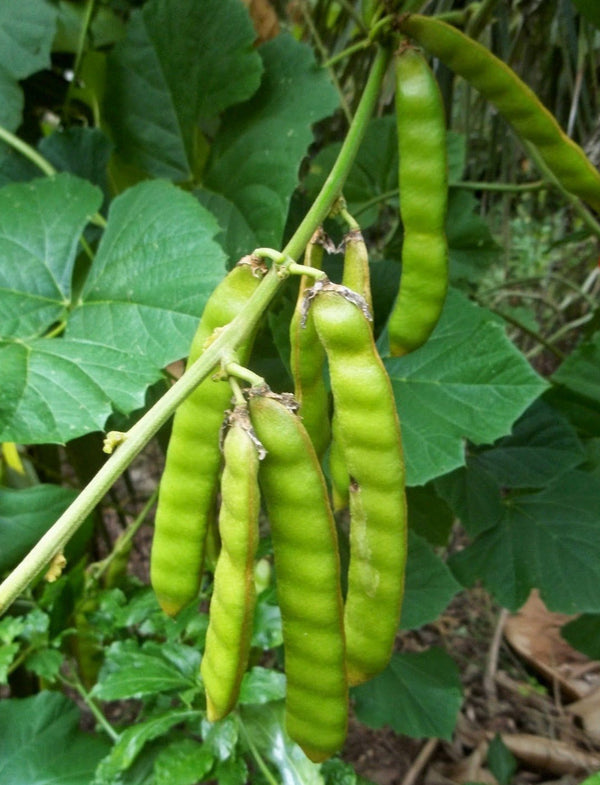
Jicama, often called the "Mexican turnip," is a globe-shaped root vegetable that brings a delightful crunch and subtle sweetness to any dish. With its light brown skin and crisp, white flesh that tastes like an apple but not as sweet, jicama is a refreshing and nutrient-packed addition to your garden and kitchen. In Central America, jicama is often sold by street vendors and commonly eaten raw, and seasoned with lemon or lime juice and chili powder. Its crisp texture also shines in salads, salsas, stir-fries, and soups. This fast-growing, vining plant thrives in warm climates and also produces legume fruits they are typically removed to promote tuber growth. Jicama is a fantastic source of dietary fiber, vitamin C, and prebiotic inulin, making it a perfect ingredient for healthy snacking or boosting gut health. Growing jicama also means you'll have a unique, exotic vegetable to share with friends and family. From its vibrant growth to its culinary versatility, jicama is a must-have for gardeners who love growing something a little out of the ordinary.

Also Known As: Mexican Turnip, Yam Bean, Mexican Potato, Sweet Turnip, Jicama Root, Mexican Radish, Pachyrhizus, Sabiá, Kamote, Chinese Potato.

Plant Name: Jicama, True
Latin Name: Pachyrhizus erosus
Days to Germinate: 10-21
Days to Harvest: 150
Plant Height: 3 - 5 Feet
Spread: 2 - 3 Feet
Growth Habit: Vining
USDA Zones: 5-11
Lifespan: Annual
Brand: TomorrowSeeds
Sunlight: Full Sun, Partial Shade
Pollination: Heirloom, Open-Pollinated
GMO: No
Fungicide-Treated Seeds*: No
Seeds Packed For**: 2026
*Fungicide-treated seeds protect the seedlings from diseases until they are up and growing. Do not eat treated seeds.
**Seeds are freshly packed for the growing season of the year listed. Seeds are still viable beyond pack date. Store in a cool and dry location such as the refrigerator or basement to best preserve germination rates.


Planting Instructions:

Soil Preparation:

Choose an area with heavy, well-draining soil that receives at least 6 hours of sunlight each day. Remove weeds, large rocks, and litter from the planting area. Leave small weeds and dead grass, they will enrich the soil when turned under. Spade or till the soil 8-12 inches deep. Loosening the soil will help the plant establish strong roots.

Plants grow best in soil with lots of organic matter. You may optionally add fertilizer or organic material such as compost, leaves, or rotted hay to mix into the soil at this point. For small gardens, scatter 2-3 tablespoons of a low-nitrogen fertilizer evenly and work into the top 2-3 inches of soil for each hill or 2 foot by 2 foot planting area. For larger gardens, scatter 2-3 pounds of a low-nitrogen fertilizer for each 100 square feet of planting area. Work fertilizer or organic material into the soil and leave the surface smooth.

Form rows of soil beds 4-6 inches high and at least 3 feet apart. This formation of ridges will help with drainage.

Planting:

Jicama grows best in warm temperatures between 70F-90F. Direct-sowing is recommended. Plant Jicama in the spring after all danger of frost has passed and the soil temperature reaches at least 70F. Fall planting is not recommended unless in areas with warmer climates since Jicama requires a long growing season. To plant, make holes 1 inch deep and spaced 12-18 inches apart down the rows of raised beds. Plant 1 seed per hole. If choosing to thin to the strongest plant, plant 2-3 seeds per hole, determine the strongest and healthiest plant, then remove all other plants, narrowing to a single plant per hole. Cover seeds thinly with soil and water after planting.


Planting Depth: 1 inch
Within-Row Spacing: 12-18 inches
Between-Row Spacing: 3 feet


Care During the Season:

Watering: Water the plants deeply, soaking the soil to a depth of 6-8 inches, once a week. If there is no rainfall, water 2-3 times a week. Water especially during flowering and pod formation. Sandy soils may need to be watered more often than heavy clay soils. Mulching around plants can help retain moisture.

Weeding: Keeping plants weed-free improves production. If plowing or hoeing, do not dig deeper than 1 inch to prevent from cutting the feeder roots.

Fertilizing: Once plants start forming pods, you may optionally apply 2 tablespoons of a low-nitrogen fertilizer around each hole, or 1-2 pounds per 100 square feet, without letting the fertilizer touch the plants. Water plants after fertilizing.

Insecticides: Insecticides may be used to protect plants. Bt-based insecticides and sulfur are organic options that can be used for prevention. Sulfur also has fungicidal properties and helps in controlling many diseases. Before using a pesticide, read the label and follow cautions, warnings and directions.

Diseases: If spots or mold appear, treat plants with an approved fungicide. Neem oil, sulfur, and other fungicides may be used. When using fungicides always follow label directions.

Harvesting:

Harvest Jicama when the leaves begin to yellow and die back, signaling that the tuber is mature, about 6-9 months after planting. Gently dig around the base of the plant using a spade or garden fork to avoid damaging the tuber. Harvest jicama when the root is firm and has reached a good size, about 3-6 inches in diameter. You can also test by gently tapping the tuber to see if it sounds hollow. If the tuber feels soft or the plant has already flowered, it’s best to harvest sooner, as the quality may decline.

Shipping Notes
  • Free Standard Shipping on $100+ Orders to the USA.
  • Except Preorder products are shipped in 48 hours.
  • Delivery to the USA:
  1. Standard Shipping : 3-10 business days
  • If time is of the essence, please consider selecting expedited delivery for faster service.
Exchange/Return Notes
  • We offer a 30-day return/exchange service after receiving.
  • Final sale items are not eligible for returns or exchanges.
  • To process your return/exchange, please contact us at [email protected]
  • Please click here for more details>>> Return & Exchange Policy
SKU: 24016285769

Discover Niche Categories That Outsell jicama seeds for planting

Top-Converting Item to Boost Your Average Order

4.1 ★★★★★
Based on 1186 reviews
Sort
Highest Rating
Newest First
Oldest First
Product Reviews
D
Verified Purchase
David E.
Lexington, US
★★★★★ 5
Excellent way to learn about a framework used by Andy Grove and Google. Specific examples and case studies are terrific!
Format: Hardcover
I couldn’t put this book down, so I read it in one sitting. Many business books talk about the organizational brilliance of Andy Grove's Intel, Google, disruptive startups, and high-performing charities. This one actively teaches you how to mimic their organizational brilliance. The book distinguishes itself by providing clear examples of how OKRs help organizations achieve their full potential. Primary source documents, including internal memos, show how Intel CEO Andy Grove used OKRs to rapidly respond to competitive threats. As an admirer of Google, I enjoyed learning how OKRs were used at key points in its history. When Google employed 25 people, CEO Larry Page set OKRs for every engineer. When Chrome sought to disrupt the browser market, OKRs enhanced the product team’s creativity. When YouTube sought to establish its own identity within Google, OKRs helped the team set appropriate business goals. It’s really nice that specific OKRs from Google’s history are included in the book. Some people mistakenly believe that OKRs only work for Google, and the book provides clear examples of how OKRs were successfully implemented by startups, large corporations, and non-profit organizations. Entrepreneurs will enjoy learning how fitness, education, healthcare, and food delivery startups used OKRs to find new markets and manage their expanding headcount. Fans of corporate transformations will enjoy learning how OKRs led to human resources and technology process overhauls at some of the world's largest companies. Non-profit leaders will enjoy learning how the Bill & Melinda Gates Foundation and Bono used OKRs to impact millions. All in all, I found the chapters to be short yet impactful, and arranged in a logical sequence. I particularly liked that as the book progresses, it provides clear examples of how to overcome the nuances of implementing OKRs. I felt my OKR-setting muscles getting stronger by the end of the book.
WAS THIS REVIEW HELPFUL?YesReportShare
Reviewed in the United States on April 30, 2018
I
Verified Purchase
Ian Mann
Boise, US
★★★★★ 4
... Doerr began his career under the tutelage of the great Andy Grove
Author John Doerr began his career under the tutelage of the great Andy Grove, CEO of Intel, who transformed that company into the world's largest manufacturer of semiconductors. It was Andy Grove who turned a simple method “OKRs”, into a devastatingly effective business tool which became the lifeblood of Intel. In 1978, Intel had developed the first high-performance, 16-bit microprocessor, the 8086. Soon it was getting overtaken by Motorola’s 68000 which was easier to program. Using OKRs, Intel launched “Operation Crush” to deal with this threat. The results were fast, focused and effective. “When we smacked Motorola between the eyes,” Doerr writes, “A manager there told me, ‘I couldn’t get a plane ticket from Chicago to Arizona approved in the time you took to launch your campaign.’” Doerr left Intel to join the venture capital firm at Kleiner Perkins Caufield & Byers, and became an early investor in Google. There he managed to entrench Andy Grove’s business tool to great effect and it is acknowledged as a key contributor to Google’s success. The results have made Doerr the 105th richest man in the US. This book describes how to use this tool. John Doerr is the current evangelist for OKRs, OKR stands for Objectives and Key Results. As a strategist, I know the importance of knowing where you are going or as Yogi Berra pithily said: "If you don’t know where you’re going, you might not get there.” However, as Doerr writes, and as you and I know, “Ideas are easy. Execution is everything.” OKRs are for executing. An “objective” is simply what is to be achieved, no more and no less. Key results benchmark and monitor how we get to the objective. The difference between ‘key results’ and ‘key performance indicators’ are very different. I may really be impressed that you performed well, but your efforts are only useful if you achieved the results I need. Marissa Mayer would say of OKRs, “It’s not a key result unless it has a number.” With a number attached, OKRs are either met of not met. There is no grey area, no room for doubt. The time frame for an OKR can vary from a month to a quarter or more, but at the end of the period, they have either been met or they have not. When the objective is clear and specific, it produces far better results than when it is vaguely worded. ‘Performance excellence,’ or ‘Customer satisfaction’ are very different when expressed as ‘98% error free’, or ‘delivered within 12 hours’. Aside from Google and Intel, OKR adherents include IT firms such as AOL, Dropbox, LinkedIn, Oracle, Slack, Spotify, and Twitter. But adherents also include firms such as Anheuser-Busch, BMW, Disney, Exxon, and Samsung. The simplicity of the design of OKRs hides the complexity of implementing the method. When the OKR is formulated, it will undergo iteration – this is inevitable. And this is not the problem. The problem is the commitment of the most senior managers to the discipline that is required. Without the most senior managers' commitment this will fail, much as your previous systems have failed to produce the promised result. In a meta-analysis of seventy studies, high commitment to managing the company by objectives showed a productivity increase of 56%. Where that commitment was low, productivity increases were a mere 6%. The problem with getting results is compounded when we are employing people to think. On an assembly line, it’s easy enough to distinguish output from activity. It gets trickier when employees are paid to think. In a thinking environment, many of the benefits of OKRs are highlighted. A particular challenge for many in such an environment is separating the person from the activity. All too often, feedback becomes very personal leading many managers to avoid confronting non-performance. When the focus is on unequivocal results that can be tracked, then non-performance can move to an analytical discussion. After all, a performance management system is a tool, not a weapon. The OKR is formulated as “We will achieve a certain objective as measured by the following key results. This begins at the highest appropriate level of the organization and then all below can align their OKRs to this meta-OKR. When Bob Noyce and Andy Grove began the “Crush” project, the directive to Intel’s management level was simple and clear: “We’re going to win in 16-bit microprocessors. We’re committed to this.” This objective was given to the top one hundred people at the meeting. It was conveyed to the next level in 24 hours. Intel was close to a billion-dollar company at the time, and “it turned on a dime” - through a clear, aligned, objective and a clear required result. The “Crush” project included top management, the entire sales force, four different marketing departments, and three geographic locations—all working together as one. It was proof of Andy Groves assertion that “Bad companies are destroyed by crisis. Good companies survive them. Great companies are improved by them.” Great companies are not great because they have a great idea, but because their execution is great. There are no exceptions. Those who do not have excellent execution are an accident waiting to happen. Using OKRs, a successful organization can focus on the handful of initiatives that can make a real difference and defer the less urgent ones. The very act of formulating the objective makes communication with clarity possible. Focusing on results rather than activities allows people to adjust their activities to meet the results, rather than to slavishly following performance indicators, as the environment changes. Consider this horrifying finding: In a survey of eleven thousand senior executives and managers, a majority couldn’t name their company’s top priorities! “There are so many people working so hard and achieving so little,” Andy Grove noted. To address this issue will require commitment to making the OKR process effective, and this commitment should not be understated, which is why it has to start from the very top. If you are a leader of your business your commitment should start with a reading of John Doerr’s book, and then share it with your colleagues. My personal experience with the process is best summed up by actress Mae West’s famous statement: I never said it would be easy, I only said it would be worth it. Readability Light --+-- Serious Insights High ---+- Low Practical High +---- Low *Ian Mann of Gateways consults internationally on strategy and implementation and is the author of the recently released ‘Executive Update.’
WAS THIS REVIEW HELPFUL?YesReportShare
Reviewed in the United States on July 27, 2018
E
Verified Purchase
Elizabeth
Waukegan, US
★★★★★ 5
An incredible book that will change your perspective on life.
Format: Paperback
For a long time, I have been reading the works of great poets such as Rumi and Hafez with little knowledge of other poets of the past. However, with confidence, I can say that Kalil Gibran fits into the group of the greatest poets of all time for his wonderous style of writing that invites you into his literary magic. This book guides you along lessons that cover every aspect of life- marriage, children, friendship, etc. The lessons in this book will change your view on life's greatest challenges. Even after you finish the book, you can always come back and review a chapter that you would like to refresh on. Overall, this book is great for anyone who loves poetry and can decipher old English to uncover the beautiful message that Gibran offers to his readers.
WAS THIS REVIEW HELPFUL?YesReportShare
Reviewed in the United States on January 11, 2024
S
Verified Purchase
Scott Herb H
Waukegan, US
★★★★★ 5
Wisdom
Format: Paperback
Fantastic book, easy to read and accessible for all ages
WAS THIS REVIEW HELPFUL?YesReportShare
Reviewed in the United States on February 17, 2026
Z
Verified Purchase
Zubora Gubora
New York, US
★★★★★ 5
👍
Format: Paperback
Wonderful book
WAS THIS REVIEW HELPFUL?YesReportShare
Reviewed in the United States on April 1, 2026

recommand products