Shipping Estimate
USA
- USA
- CAN
- USA
- CAN
Ships within 48 hours · Estimated delivery Jul 10 - Jul 15
 Promo Codes Available:
For Your Every Summer RSVP, with Code: SUMMER15
Description
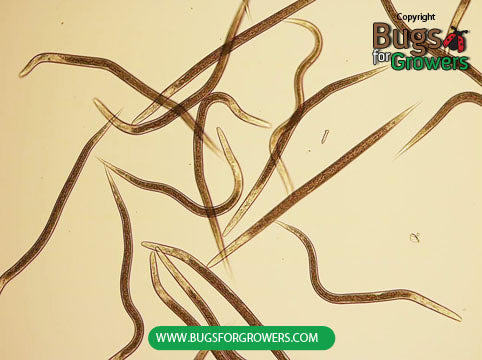
nematode steinernema feltiae for indoor plants Steinernema feltiae Nematodes – Bugs for GrowersSteinernema feltiae is a cold tolerant nematode that can infect and kill insects as low as 10C temperature. This nematode uses an intermediate foraging strategy that is between the ambush and cruiser type. This nematode is most effective against mushroom flies and fungus gnats in mushroom houses and greenhouses, respectively. Facts (show all) Effective against the following pests Beet armyworm, Spodoptera exigua Codling moth, Cydia pomonella Colorado
Steinernema feltiae is a cold tolerant nematode that can infect and kill insects as low as 10°C temperature. This nematode uses an intermediate foraging strategy that is between the ambush and cruiser type. This nematode is most effective against mushroom flies and fungus gnats in mushroom houses and greenhouses, respectively.
Facts (show all)
- Key factors for Steinernema feltiae nematode effectiveness
-
- Steinernema feltiae nematode infective juveniles carry species specific symbiotic bacteria Xenorhabdus bovienii in their gut as weapon to kill their insect hosts.
- For searching insect host, this nematode uses intermediate foraging strategy that lies between ambush and cruiser foraging strategies.
- As other species of entomopathogenic nematodes, Steinernema feltiae nematodes also enter their insect host’s body cavity through the natural openings such as mouth, anus and spiracles. Once in the cavity, infective juveniles release their symbiotic bacteria Xenorhabdus bovienii, which multiplies rapidly in the insect blood, causes septicemia and kill its host within 48 hours of infection.
- Steinernema feltiae nematodes are very good in reducing the populations of fungus gnats by infecting and killing their immature stages both in the greenhouses and the potted house plants. Steinernema feltiae nematodes are very effective in controlling mushroom flies by infecting and killing their immature stages in the mushroom houses.
- The temperature range for this nematode’s activity and infection is a very wide ranging from 50 °F (10 °C) to 77 °C (25 °C).
- How Steinernema feltiae nematodes work in greenhouses, mushroom houses and fields?
-
- When infective juveniles of Steinernema feltiae are applied in any setup like greenhouses, mushroom houses or fields, they start looking for their host using intermediate foraging strategy. Once they locate their host, they enter host’s body through the natural openings such as mouth, anus and spiracles.
- Then in the body cavity (which is filled with insect blood), they release their symbiotic bacteria X. bovienii, which multiplies rapidly causes septicemia and kill its host within 48 hours of infection. Thus they reduce the emergence of the next generation adults of their insect host.
- Why we need Steinernema feltiae nematodes?
-
Steinernema feltiae nematodes work better than other nematode species against different pests at temperature as low as 50 °F (10 °C) in both greenhouses and mushroom houses. They have a wide range of hosts. After application in any setup, they can actively search for their host. They can kill their host within 24-48 hours after infection. They can be easily applied using traditional pesticide application sprayers for large areas or water cans small areas.
- Why they are safer than traditional pesticides
-
- they do not damage plants
- can be used and applied around children and pets
- do not cause any harm to the personnel involved in their production and application
- food products are safe to handle and eat when they are treated with nematodes
- they do not harm humans, animals, beneficial insects (ie. honey bees), microbial communities and other beneficial nematodes
- Research Papers
-
- Adel, M. M. and Hussein, H. M. 2010. Effectiveness of entomopathogenic nematodes Steinernema feltiae and Heterorhabditis bacteriophora on the Colorado potato beetle Leptinotarsa decemlineata (Say) (Coleoptera: Chrysomelidae) under laboratory and greenhouse conditions. Archives of Phytopathology and Plant Protection 43:1485-1494.
- Buitenhuis, R. and Shipp, J.L. 2005. Efficacy of Entomopathogenic Nematode Steinernema feltiae (Rhabditida: Steinernematidae) as Influenced by Frankliniella occidentalis (Thysanoptera: Thripidae) Developmental Stage and Host Plant Stage. Journal of Economic Entomology 98:1480-1485.
- Cuthbertson, A.G., Walters, K.F., Northing, P., and Luo, W. 2007. Efficacy of the entomopathogenic nematode, Steinernema feltiae, against sweetpotato whitefly Bemisia tabaci (Homoptera: Aleyrodidae) under laboratory and glasshouse conditions. Bulletin of Entomology Research 97:9-14.
- Gouge, D.H., Hague, N.G.M., 1994. Control of sciarids in glass and propagation houses with Steinernema feltiae. Brighton Crop Protection Conference: Pest Dis. 3, 1073-1078.
- Gouge, D.H., Hague, N.G.M., 1995. Glasshouse control of fungus gnats, Bradysia paupera, on fuchsias by Steinernema feltiae. Fundam. Appl. Nematol. 18, 77-80.
- Grewal, P.S., Richardson, P.N., 1993. Effects of application rates of Steinernema feltiae (Nematoda: Steinernematidae) on control of the mushroom sciarid fly, Lycoriella auripila (Diptera: Sciaridae). Biocontrol Sci. Technol. 3, 29-40.
- Grewal, P.S., Tomalak, M., Keil, C.B.O., Gaugler, R., 1993. Evaluation of a genetically selected strain of Steinernema feltiae against the mushroom sciarid fly, Lycoriella mali. Ann. Appl. Biol. 123, 695-702.
- Harris, M.A., Oetting, R.D., Gardner, W.A., 1995. Use of entomopathogenic nematodes and new monitoring technique for control of fungus gnats, Bradysia coprophila (Diptera: Sciaridae), in floriculture. Biol. Control 5, 412-418.
- Kaya, H.K. 1985. Susceptibility of early larval stages of Pseudaletia unipuncta and Spodoptera exigua (Lepidoptera: Noctuidae) to the entomogenous nematode Steinernema feltiae (Rhabditida: Steinernematidae). Journal of Invertebrate Pathology 46: 58–62.
- Jagdale, G. B., Casey, M. L., Grewal, P. S. and Lindquist, R. K. 2004. Application rate and timing, potting medium and host plant on the efficacy of Steinernema feltiae against the fungus gnat, Bradysia coprophila, in floriculture. Biological Control. 29: 296-305.
- Jagdale, G. B., Casey, M. L., Grewal, P. S. and Luis Cañas. 2007. Effect of entomopathogenic nematode species, split application and potting medium on the control of the fungus gnat, Bradysia difformis (Diptera: Sciaridae), in the greenhouse at alternating cold and warm temperatures. Biol. Control. 43: 23-30.
- Kim, H.H., Choo, H.Y., Kaya, H.K., Lee, D.W., Lee, S.M., Jeon, H.Y., 2004. Steinernema carpocapsae (Rhabditida: Steinernematidae) as a biological control agent against the fungus gnat Bradysia agrestis (Diptera: Sciaridae) in propogation houses. Biocontrol Sci. Technol. 14, 171-183.
- Lindquist R., Piatkowski J. 1993. Evaluation of entomopathogenic nematodes for control of fungus gnat larvae. Bull. Int. Organiz. Biol. Integr. Control Noxious Animals and Plants. 16, 97-100.
- Lindquist, R.K., Faber, W.R., Casey, M.L., 1985. Effect of various soilless root media and insecticides on fungus gnats. HortScience. 20, 358-360.
- Oetting, R.D., Latimer, J.G., 1991. An entomogenous nematode Steinernema carpocapsae is compatible with potting media environments created by horticultural practices. J. Entomol. Sci. 26, 390-394.
- Richardson, P.N., Grewal, P.S., 1991. Comparative assessment of biological (Nematoda: Steinernema feltiae) and chemical methods of control of mushroom fly, Lycoriella auripila (Diptera: Sciaridae). Biocontrol Sci. Technol. 1, 217-228.
- Tomalak, M., Piggott, S. and Jagdale, G. B. 2005. Glasshouse applications. In: Nematodes As Biocontrol Agents. Grewal, P.S. Ehlers, R.-U., Shapiro-Ilan, D. (eds.). CAB publishing, CAB International, Oxon. Pp 147- 166.
Shipping Notes
- Free Standard Shipping on $100+ Orders to the USA.
- Except Preorder products are shipped in 48 hours.
- Delivery to the USA:
- Standard Shipping : 3-10 business days
- If time is of the essence, please consider selecting expedited delivery for faster service.
Exchange/Return Notes
- We offer a 30-day return/exchange service after receiving.
- Final sale items are not eligible for returns or exchanges.
- To process your return/exchange, please contact us at [email protected]
- Please click here for more details>>> Return & Exchange Policy