Shipping Estimate
USA
- USA
- CAN
- USA
- CAN
Ships within 48 hours · Estimated delivery Jul 13 - Jul 18
 Promo Codes Available:
For Your Every Summer RSVP, with Code: SUMMER15
Description
philodendron eximium houseplant Philodendron eximium – Foliage FactoryPhilodendron eximium Philodendron eximium is an eastern Brazilian climbing Philodendron with glossy green foliage and a hemi epiphytic growth habit. In a pot, it needs an airy mix that lets water drain through freely while keeping the roots evenly moist between waterings. The plant grows as a hemi epiphytic vine with large, ovate to broadly ovate leaves, a cordate base and a paler lower surface. Mature foliage can become substantial, so indoor plants
Philodendron eximium
Philodendron eximium is an eastern Brazilian climbing Philodendron with glossy green foliage and a hemi-epiphytic growth habit. In a pot, it needs an airy mix that lets water drain through freely while keeping the roots evenly moist between waterings.
The plant grows as a hemi-epiphytic vine with large, ovate to broadly ovate leaves, a cordate base and a paler lower surface. Mature foliage can become substantial, so indoor plants benefit from a stable vertical support before the stem becomes heavy.
Glossy climbing leaves on Philodendron eximium
- Origin: Native to eastern Brazil, including southeastern Brazil and a northern record in Pernambuco.
- Growth habit: Hemi-epiphytic climbing vine that can be trained onto a pole or other vertical support.
- Leaves: Large green blades that are ovate to broadly ovate, with a cordate base and paler underside.
- Roots: Needs drainage, even moisture and air around the root zone.
Philodendron eximium from eastern Brazil
Philodendron eximium is native to eastern Brazil and grows primarily in the seasonally dry tropical biome. Its climbing habit and aerial roots suit a loose, aerated substrate in indoor cultivation.
A vertical support helps the stem climb instead of bending around the container. Aerial roots attach more readily to a textured surface as the plant gains height.
Root-zone care for Philodendron eximium
- Light: Give bright filtered light; low light can lead to stretched stems and smaller leaves.
- Watering: Let the upper 20–30% of the substrate dry before watering again, then drain thoroughly.
- Substrate: Use bark, pumice or perlite, and a modest organic fraction so roots stay aerated.
- Support: Add a pole before the stem becomes long enough to lean heavily.
- Humidity: Moderate to good humidity supports larger leaves and smoother unfurling.
- Temperature: Keep above 18°C and avoid cold, damp conditions around the root zone.
- Feeding: Use a balanced fertiliser at low strength during active growth, not when the plant is resting.
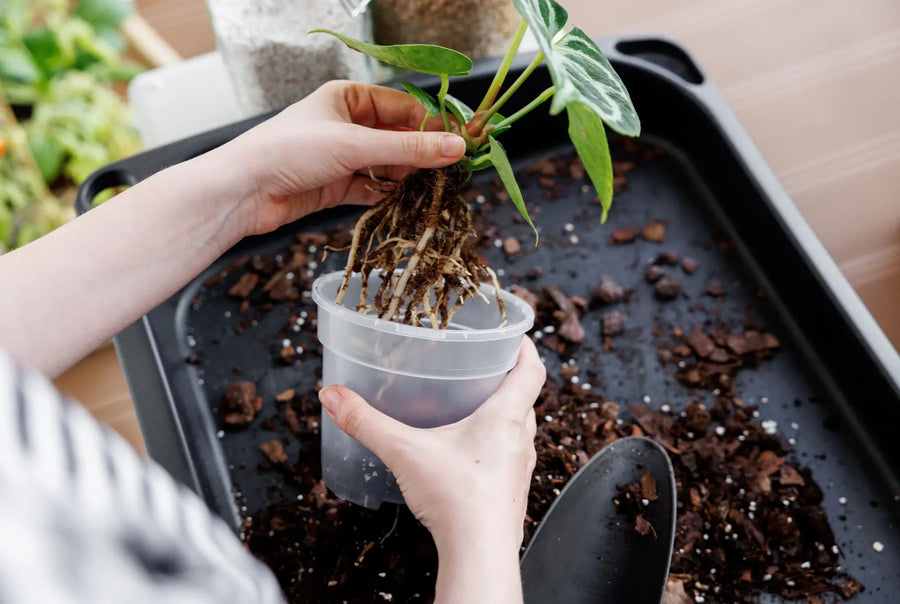
- Potting: Use a pot with drainage and repot when roots have filled the container or the support becomes unstable.
- Propagation: Propagate from stem cuttings with at least one node; single leaves without a node will not produce a new plant.
- Pruning: Cut above a node to shorten the vine or redirect growth; remove damaged leaves close to the stem.
- Semi-hydroponics: Can adapt to mineral substrates such as pon, pumice, lava or LECA if transitioned carefully and kept aerated.
- Growth rate: Usually moderate indoors, with stronger climbing growth in warm, bright conditions.
Philodendron eximium indoor leaf and root issues
- Yellowing after watering: Check whether the pot drains quickly and whether the mix has compacted.
- Thin, stretched stems: Increase filtered light and secure new growth to a support.
- Dry brown edges: Review watering consistency and avoid placing the plant near hot, dry airflow.
- Root slowdown: If the plant stalls in a large pot, downsize or improve aeration before feeding more.
- Pests: Check leaf undersides, petioles and new growth for spider mites, thrips, mealybugs or scale.
Philodendron eximium pet safety
Philodendron eximium should be placed away from pets. The plant contains calcium oxalate crystals, and cut or damaged tissue may irritate skin or the mouth.
Philodendron eximium etymology and publication
The genus name Philodendron comes from Greek roots meaning tree-loving. Philodendron eximium was first published by Heinrich Wilhelm Schott in Oesterr. Bot. Wochenbl. 3: 378 in 1853. The epithet eximium is formed from Latin eximius, meaning distinguished or exceptional.
Order Philodendron eximium for a Brazilian climbing Philodendron with broad green leaves, a pale underside and a strong vertical habit.
Shipping Notes
- Free Standard Shipping on $100+ Orders to the USA.
- Except Preorder products are shipped in 48 hours.
- Delivery to the USA:
- Standard Shipping : 3-10 business days
- If time is of the essence, please consider selecting expedited delivery for faster service.
Exchange/Return Notes
- We offer a 30-day return/exchange service after receiving.
- Final sale items are not eligible for returns or exchanges.
- To process your return/exchange, please contact us at [email protected]
- Please click here for more details>>> Return & Exchange Policy